Wednesday, March 14, 2012

Athos in America: Jason in transition?

Athos in America
By Jason
Published by Fantagraphics


All six of the stories in this latest volume from Europe's eminent purveyor of deadpan, blank-eyed, funny animals are quite good, but two of them especially seem to stand out for me. The first (or last, according to how the book is ordered) is the title story, which sees the return of the main character from The Last Musketeer as he tells his story to a New York bartender, recounting his travels across our great country. It's one of those sort of romanticized portrayals of the United States that you occasionally see from Europe or England, a celebration of the openness of the land and the possibilities available here, while still acknowledging that it's not paradise, and the cruelty of life still reigns supreme. I love the gentlemanly tone of Athos' conversation with the bartender, and with a closing montage of the sights and sounds of America, it's a nicely subdued ending to the book, whose previous stories featured plenty of violence and stormy emotions.


Of those stories, the one that really struck me as something interesting and different from Jason is "A Cat from Heaven", which I hope isn't autobiographical, even though it seems to be. In it, Jason portrays himself as an awful jerk, giving his girlfriend/wife a black eye during an argument, threatening to kill her, acting like a dick to his friends and fans, and just generally being an asshole. It's startlingly stark and emotional, making for a weird disconnect, since it's portrayed exactly the same as in all of Jason's other comics, populated with his minimalist animal characters. But just by giving the character his own name, it becomes raw and personal, like something out of an Adrian Tomine or Ivan Brunetti comic, the artist's soul being laid bare on the page. Maybe it's all an exercise, an attempt to add something a bit darker to his usual style, or maybe it's an anguished confession, but whatever the case, it proves that Jason isn't sitting on his laurels and cranking out repetitively quirky stories in his usual style; he's pushing himself to do new things and communicate through his art, and it's wonderful to watch.

Friday, March 9, 2012

Groo Watch: Sergio Aragones Funnies #7

Just when I think of giving up on this "project", this issue gives me some good Groo stuff. I expected more of the occasional appearances of the character hiding in the corners of the panels, like this one that opens the issue:


But a later story, whose punchline reveals that Sergio's work is being done by elves (or at least a Pacific-islander variant), gives a pretty great look at not just Groo, but everything that he does (oh yeah, spoilers, I guess?):


I love the detail in that panel/splash, not just of all the stuff Sergio is constantly working on (Groo, A MAD look at..., MAD marginals, Simpsons comics, this very comic, etc.), but the amount of work he puts into it, all measuring and ruling, researching, consulting model sheets, keeping track of everything. Even as a joke, it's a pretty great look into what he does.

Finally, there's a bonus appearance by Groo, although it isn't drawn by Sergio. Instead, it's on the letter page, a picture from the sidewalk outside what I assume is Halifax's Strange Adventures:


Sweet! If I ever want to get a tattoo, I know who to call.

Thursday, March 8, 2012

Sometimes I don't get comics (which isn't necessarily a bad thing)

Things You Carry
By Vincent Stall
Published by 2D Cloud


I'm not sure what's going on in this comic, but that doesn't matter, because it's a really cool looking, and it's interesting to try to tease out what plot there is amongst the cool visuals. Sometimes that's all you need: a nicely-illustrated journey through an artist's mind that might or might not be symbolic, if you want to try to wrap it in some sort of interpretation, or just enjoy it for what it is.


From what I can tell, the wordless story follows a character wandering through a garbage-strewn apocalyptic wasteland. He appears human, but he might be something else entirely, with the clothes covering him from head to toe (including a blank, eyeless hood covering his head) hiding whatever is underneath. He doesn't seem to have much purpose, just rummaging around in the rubble, at one point watching a procession of similarly-attired characters playing weird instruments, and then encountering an odd spacesuit-wearing figure in a cave who sends him on some sort of mystical journey (maybe? I'm really not sure what happens). It's weird stuff, but it's pretty gorgeously drawn, with chunky ink lines marking out all the jumbled details of wrecked buildings, clouds that seem to be alive billowing through the scenery, stacks of oddly orderly piles of papers, and what might be an even more apocalyptic ending. This is weird shit, but I dig it. Maybe someday somebody can explain it to me, but I'll be enjoying the mental imagery it provides whether that ever happens or not.
-----

Motherlover
By Nicholas Breutzman, John & Luke Holden, and Raighne Hogan
Published by 2D Cloud


I'm not as keen on this short anthology, but I respect it for what it is. It's divided up into three stories, two by Nicholas Breutzman and one by John & Luke Holden. Breutzman's pages feature some nice, clean illustration, first with a story about a young man having a tryst with a girl and recalling a photo of his grandfather that he found that fascinated him since it looked so much like himself. There seems to be a theme of photography and the way some images really seem to capture a person's likeness while others don't really make much impact. In Breutzman's other story, he tells what might be an autobiographical tale of moving from New York back home to Minnesota, then hanging out with a friend after he arrives. They drink some beer, reminisce about childhood, and wander around a housing development, and that's about it. It's sort of an illustration of the aimlessness of a certain point in one's young adult life, I guess.


More interesting, even if it's not my preferred sort of style, is the Holden brothers' strange, ugly story about a kid hanging out with his friend and trying to get his hands on some pornography. There's a purposeful grotesquerie on display here, a kind of disparaging look at characters who could be described as "white trash", from the friend's mom who is depicted with a hideous, monstrous face and terrifyingly bra-less breasts swinging disturbingly under her shirt, to the narrator, who implores his friend to let him search his family's garage for porn because he "need[s] to see a pussy tonight." I'm not sure if this is meant to be a realistic (perhaps semi-autobiographical?) depiction of lower-class life, or if it's supposed to be an outrageous imagining of the way some people live. Whatever the case, it's pretty disturbing, ugly characters rolling randomly through a world devoid of any positivity toward a seemingly pointless future. The presentation adds to this feeling, with panel-less drawings hanging on the page accompanied by narration set down in childlike handwriting, the wavering lines giving everything a rough, sketchy quality and the colors (by Raighne Hogan), which consist of sickly greens and muddy purples, smeared onto the page for maximum grossness. It's a complete, consistent vision, but not a very pleasant one.


As a small, independently published anthology, this is a good example of these creators' work, and while it's not necessarily something I would seek out, I'm glad I read it, just to get a feel for what kind of comics they make. I'll definitely be interested in checking out their stuff in the future.

Tuesday, March 6, 2012

Pamphleteering: This selection apparently reflects my tastes

Here's what I brought home from the comic book store last week; it's about a month's worth of floppies, I think.

Atomic Robo: The Ghost of Station X #5 (of 5)
Written by Brian Clevinger
Art by Scott Wegener
Published by Red 5 Comics

Man oh man, what an end to a great arc of this ongoing series (which, in the style of Hellboy and BPRD, is delivered as a series of miniseries). Large-scale action that actually threatens the main character's life, with a mystery of ever-increasing scale slowly revealing itself in between moments of a global chase, culminating in the unveiling of a villain that connects perfectly with Robo's life, goals, and personality, making for a nigh-unstoppable threat that resonates beyond whether it can be blown up real good. With the century or so of time that the creative team has to work with, the range of stories that can be told is pretty great, typified by the jump from the last story's young, naive Robo to this one's confrontation of a huge threat challenging him at the height of his abilities and resources. Man, give me whatever these guys can dish out.
-----

Blue Estate #9
Written by Viktor Kalvachev, Kosta Yanev, and Andrew Osborne
Art by Viktor Kalvachev, Toby Cypress, Robert Valley, Peter Nguyen, and Andy Kuhn
Published by Image Comics

I enjoy this noir story for the most part, with its goofy characters, occasional violence, and themes of Hollywood crime, but the most interesting aspect is probably the art, which shifts randomly, sometimes even within a single page, between each issue's contributors. Nathan Fox has been the highlight of the series, but he's not in this issue, so Toby Cypress is probably the star this month. One highlight is a moment in which a character's reaction to having a gun pulled on them is described like a car accident, and that's illustrated by a panel that ends up happening later in the issue when that character does get into a car crash. I don't know if I would recommend this series, since it's so idiosyncratic, but I usually have a pretty good time reading it. High praise?
-----

The Bulletproof Coffin: Disinterred #2 (of 6)
Written by David Hine
Art by Shaky Kane
Published by Image Comics

Not sure what to say about this one. It's one of those bits where characters tell stories that might or might not be "true", apparently meant to be an example of the sort of story you might find in the comics described and sampled in the first volume of this series, with the hint that the various characters are all going to come together for some sort of metatextual crossover by the end of the series, perhaps to confront their creators or something. Whatever; I mostly just enjoy the crazy way that Shaky Kane depicts the weird (or sometimes just unfortunate) shit that happens to people, with the hairy monster of the last story being the highlight. Good times.
-----

Dark Horse Presents #9
By Mike Mignola & Joe Querio, Brian Wood & Kristian Donaldson, Paul Pope, Tony Puryear, Richard Corben, Rich Johnston & Simon Rohrmuller, Alan Gordon & Thomas Yeates, Steve Horton, Caitlin R. Kiernan & Steve Lieber, and M.J. Butler & Mark Wheatley
Published by Dark Horse Comics

Aside from the standard comment about anthologies being a mixed bag, I'm definitely digging this new incarnation of Dark Horse's house mag, which contains samplers of their best creators' work, along with other stuff that I'm guessing they thought was cool enough to print. There's no chapter of Neal Adams' batshit-crazy "Blood" this month, but I'm hoping that one comes back soon, since it's totally nuts. Howard Chaykin's "Marked Man" also ended, so it's mostly new or standalone stuff here. Mike Mignola has a Lobster Johnson short that's pretty cool, even if it ends kind of obviously. Brian Wood and Kristian Donaldson's "The Massive" continues to be introduced; I'm guessing that the stories here are intros to the various characters in the regular series, which is coming later, right? I do like Donaldson's ultra-clean art, especially an eerie underwater moment in this chapter. Paul Pope is as awesome as you would expect with a story about Apollo 12, the second moon landing, full of distinctive lunar landscapes, that weirdly sketchy-yet-realistic machinery that he does so well, and the surprise appearance of a naked lady. Richard Corben adapts an Edgar Allen Poe story as well as you would expect; it's pretty great, with lots of horrified faces, desiccated corpses, tangled scenery, the usual. I like the beginning of Steve Horton's "Amala's Blade" too; it's a cool sci-fi/fantasy/pirate thing with some great designs and stylish art, plus what seems like a good female lead. Caitlin R. Kiernan and Steve Lieber's "Alabaster" is cool too, although I'm not sure if this is a character that has shown up anywhere before. I guess she's an albino monster-hunter that might or might not also be crazy? She sees a freaky four-faced angel at one point, and she also gets confronted by a werewolf lady. I'm not sure what's going on, probably by design, but I love Lieber's moody art.

On the other hand, I can't really figure out what's going on in Tony Puryear's "Concrete Park"; apparently, it takes place on another planet, and it follows various characters who live in a Los Angeles-like city of crime and gangs and whatnot. It jumps from character to character so much that I can't really follow it, and neither the art or the story are compelling enough to really want to do the work to keep up. Rich Johnston and Simon Rohrmuller's "The Many Murders of Miss Cranbourne" is all right, with a decent concept of a vigilante-killer old lady who presents herself with the air of an amateur detective, although this chapter focused on a policeman who falls for all her cover-ups, which isn't that interesting when we've already seen what really happened. The art is kind of generically cartoony too, not really expressive enough to be either humorous or deadpan. I'm fine with Alan Gordon and Thomas Yeates' "The Once and Future Tarzan", with its interesting concept of an immortal Tarzan living in a post-apocalyptic future, but it's been kind of staid and workmanlike so far, nothing to grab the reader and sell them on the coolness of the concept. And finally, M.J. Butler and Mark Wheatley's "Skultar" is a pretty dumb spoof of Conan and other barbarian-themed stories, but it does manage to hit on an amusing joke or two in each chapter. You have to get past the muddy art to see them though.

So yeah, good reading overall, and it will have to take a real dip in quality for me to even consider quitting. I suspect I'm there for the long haul.
-----

Haunt #21
Written by Joe Casey
Art by Nathan Fox
Published by Image Comics

I never expected to be reading this Todd McFarlane series about a ghost mashup of Spider-Man and Spawn, but when Joe Casey and Nathan Fox took over, I had to at least give it a try. And luckily, they appear to have jettisoned everything except the basic concept, which is about a couple of brothers (one of whom is a ghost) that can combine into some sort of ectoplasmic monster. I think they used to work for a spy agency or something, but Casey had that aspect of the book just disappear in his first issue, then killed off the living brother's love interest, instead having the character kidnapped by some sort of evil church and then rescued by a badass spy/mercenary who is like an ultra-competent version of Jeff "The Dude" Lebowski. It's been mostly non-stop action, which is pretty great stuff for Nathan Fox to handle, all ghost tentacles carving up bad guys left and right, lots of blood, gore, and intestines flying everywhere in the midst of mysterious architecture and crazy technology. There's also a bit of character development, as the ghost brother starts to get distanced from the living, caring less and less about morals and emotions and such, which makes for an interesting personal note in the midst of all the crazy action. I'm digging this, for now.
-----

Orc Stain #7
By James Stokoe
Published by Image Comics

Good god, do I love the crazy world James Stokoe has created here, full of weird creatures and cultures, random violence and destruction, bizarre structures, unique landscapes, and a sense that anything can happen, at least within the constraints that have been set up for the milieu. It's a nonstop barrage of mindblowing imagery, all the characters colored with inhuman tints and bristling with sickly pustules and gross scales, machines sprouting tentacles, everything up to and including rocks and mountains seemingly made of reptilian skin, characters getting smashed and sliced up with giant hammers, knives, and spiky hair (?), bright, yet somehow sickly, colors slathered all over the page, just a constant assault on the senses (well, the sense of sight at least, but the comic is so visceral, the mind imagines sounds, scents, and who knows what else). It's amazing, one of my very favorite comics of the moment. Damn.
-----

Prophet #22
Written by Brandon Graham
Art by Simon Roy
Published by Image Comics

Speaking of worldbuilding, Brandon Graham and Simon Roy are going nuts on their revival of this 90s series. I have no idea what the Rob Liefeld issues of this series were like, and I don't really have any desire to find out, unless I'm seized with morbid curiosity at some point; the world created here, a desolate future Earth populated by various aliens and monsters, covered with the wreckage of long-dead civilizations, is amazingly well-realized, and just watching the main character wander through it on his mostly-undefined mission is fascinating. I'm kind of blown away by the level of thought that has gone into the series, all the various creatures that interact with each other in the weird ecosystem and mix of cultures, most of them using gross biological technology that really emphasizes the utterly alien world. I can't wait to see where this goes, even if it continues to kind of freak me out.
-----

Rasl #13
By Jeff Smith
Published by Cartoon Books

I think this series is reaching some sort of endgame, a final confrontation between its universe-hopping protagonist and the evil government forces that exploited his inventions. I think we've finally been caught up on the details of the plot, which is nice, but the best part is probably the images of a town merged with several parallel universe counterparts, resulting in people and animals that are gross conglomerations of bodies sprouting multiple arms and heads, all screaming in hideous agony as they die miserable deaths. Fun! Jeff Smith can draw whatever he wants, and I'll read the hell out of it.
-----

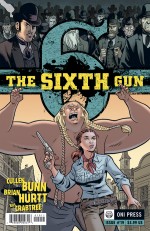
The Sixth Gun #19
Written by Cullen Bunn
Art by Brian Hurtt
Published by Oni Press

This series has become one of my favorite current comics, but unfortunately, it's so consistently good that I don't know if I have much to say about it. I do like that Cullen Bunn continues to build the world as the series goes on, adding new elements with each arc, details slowly accumulating to create a rich mythology that includes mystical weapons, warring religious factions, demons, sorcerers, monsters, and all sorts of cool details that make the Old West setting come to life. It makes me trust that there's a plan for the whole series, and I can't wait to find out where it's going each month. Brian Hurtt on art definitely helps; he's a monster, filling out and solidifying all those details while maintaining a great sense of character and place, and lending an appropriately creepy, moody air when it's called for, which is most of the time. I love it, and I always want more when it's over.
-----

Spaceman #4 (of 9)
Written by Brian Azzarello
Art by Eduardo Risso
Published by DC Comics/Vertigo

Brian Azzarello and Eduardo Risso are near-bulletproof for me after 100 Bullets, and they sure don't disappoint with this new Vertigo series, which is a completely different sort of thing, yet recognizably their work, full of that unique combined personality, all cryptic wordplay and encompassing atmosphere. The plot here, for those who don't know, follows a human-ape hybrid who was designed to work in space but has ended up scavenging the slums of a flooded earth as he ends up in possession of the kidnapped child of a celebrity couple. There are a bunch of twists and turns, and probably some secrets to be uncovered at inopportune times, but the most enjoyable part of the comic is getting to experience the future that Azzarello and Risso have created, trying to decipher the slang that everyone speaks in, marveling at the busted-up locales where the people survive and the believable technology that they use, enjoying the expressive characters and sudden, shocking violence. I expect nine issues is going to be too short of a time to spend in this fucked-up, all too possible future.
-----

Wasteland #34
Written by Antony Johnston
Art by Justin Greenwood
Published by Oni Press

Interest in this title may have been flagging around these parts due to the erratic schedule over the last year or so and the loss of artist Christopher Mitten, but things kind of snap back into place in this issue, with a revelation that brings many of the series' themes into focus, namely the emphasis on belief systems, the supernatural, creation stories, and religions. Suddenly, this isn't (necessarily) the sci-fi post-apocalyptic story that it appeared to be, but a sweeping history of mythological proportions. Huh, how about that? Color me reinvigorated.

Tuesday, February 28, 2012

Webcomics shoutout: Hey, have you guys heard about Kate Beaton?

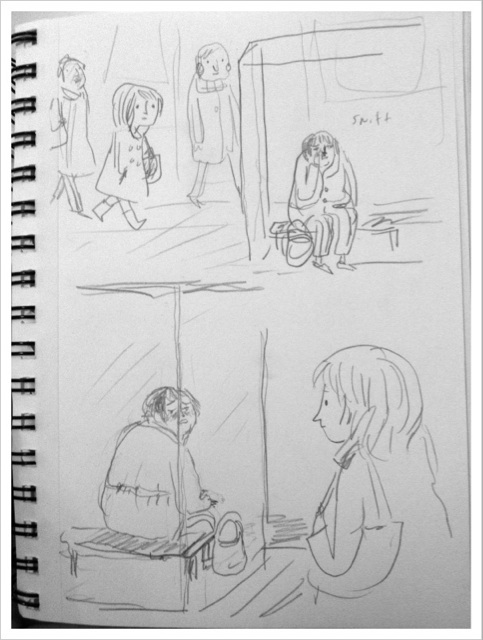
Yes, yes, I know, everybody is always talking about Kate Beaton, and how great she is, and I completely agree. If any web-cartoonist deserves the acclaim, it's her. But what I want to talk about isn't her most visible stuff, the history/literature/whatever comics she "officially" posts on her website, but the more off-the-cuff, diary-style stuff she posts on Twitter. (EDIT: of course, when I go to her site, I see that the strip I'm talking about has been posted there too. Whoops.) That's one of the great advantages of our current information age, at least for art-process junkies like me: artists being able to share their napkin doodles, life drawings, sketchbook pages, and random nonsense with the world. Beaton's output at this sort of thing is unceasing, and now that she has scaled back the posting schedule of her regular work, it's one of the few places to see her new stuff on a regular basis. I love the way she captures interesting moments or scenes from her life, sometimes just transcribing scenes on paper before they disappear in the mists of time and memory, like this scene of an old woman crying at a bus stop:


And other times exaggerating events and turning them into running jokes, like this super-cute polite kid who she imagines going around doing good deeds:


But I especially love the strips in which she interacts with her family. The way she depicts her parents as slightly clueless and eccentric, but good at heart and full of love toward their children, it ends up being a beautiful reciprocation of that familial affection, a depiction of the willingness to accept those closest to you despite (or because of) their occasional weirdness and aggravating tendencies. This recent strip in which she remembers building a birdhouse with her dad is wonderful for all sorts of reasons (the body language, especially of present-day Kate climbing a tree; the dialogue that manages to relate a certain accent and cadence even if you haven't heard it spoken; the wide-eyed, open-mouthed cuteness of lil' Kate), but what really gets me is how the depiction of her dad in the flashback is so obviously the same character that I've come to know and love (which is weird to say, since he's a real person that I've never met, but I do love when he shows up in her comics), but at an earlier time in his life. In the present day, he's usually depicted with a sort of gruffness communicated through slouched shoulders, a bushy moustache, and opaque glasses that somehow also function as a furrowed brow:


But in the past, he's recognizably the same guy, just younger:


Without glasses, his face seems more open, his dotted eyes lifelike and active. His moustache is still there, but smaller and neater-trimmed. His hair seems darker and fuller. Even his body seems bulkier, a subtle way of showing how parents can seem so large when you're a child, but so small once you're grown. The whole thing is a marvel of subtle storytelling, a figure pulled probably unconsciously from Beaton's memory, but one that even complete strangers like me find familiar.

That's what I love about Beaton's work: it seems like she just has to get certain moments, stories, thoughts, and memories down on paper, even if they're not fully fleshed out, but she's good enough that she can capture so many details and nuances of her life and what happens around her without making a big deal about it or making it seem like it takes a lot of effort. She's a marvel, an ever-increasing talent and a cornerstone of the modern comics scene, and her apparent need to keep making art and sharing it with the world benefits us all.

Monday, February 20, 2012

Tale of Sand: Grains through the hourglass, I guess

Jim Henson's Tale of Sand
"Realized" by Ramon Perez
Based on a screenplay by Jim Henson and Jerry Juhl
Published by Archaia


Jim Henson's name, image, words, and legacy are all over this book, but lest you go in expecting Muppety comedy, the introduction by Lisa Henson the Henson Company's Karen Falk makes sure to spotlight his work with experimental short films and animation, such as the Oscar-nominated "Time Piece", which definitely seems to be the precursor to what was meant to be a feature film but eventually ended up as this book. It was wise to calibrate expectations, since this is not the cuddly puppeteering of Sesame Street, although the story does retain the anarchic sensibilities that Henson utilized so well in his best work. The type of story is completely different than one would expect though, being a surreal, absurdist, possibly metaphorical string of craziness, one which doesn't make much sense, but is certainly memorable in its ideas and imagery.

Said story might be a Joseph Campbell-style hero's journey, or a symbol of the randomness and unpredictability of life, or just a bunch of non sequiturs piled on top of each other, but whatever the case, it's entertaining and fast moving, following a blank slate of a man (apparently named Mac, although I don't think this is ever stated in the story itself) who wanders into some sort of festival in what appears to be a small town in the American Southwest, then, after the festivities turn out to be in his honor, gets sent on a quest through the desert to reach an eagle-shaped rock formation, although the reason for the journey is never specified, and a sinister man sporting a pointy goatee and eye patch is pursuing him and apparently trying to kill him, or at least make the trip as difficult as possible.


And off we go for non-stop insanity for the rest of the book, with goofy shenanigans dogging Mac's heels at every turn, whether he's being shot at or attacked by tanks, run over by cars on suddenly appearing on an empty road, hit in the face with a pie by a sunbathing lady, captured by sword-wielding Arabs, or pursued by cowboys and football players. He starts out confused by all the oddness going on around him, but eventually figures out how to use the random-seeming resources allotted to him to his benefit, or at least to keep himself alive and barely one step ahead of his pursuers. Things eventually devolve into an extended chase scene that resolves in a near-apocalyptic manner, with little in the way of resolution except that he reaches his destination and the book ends.


I would like to be able to tease out some of the metaphors in this story, but it's all too nonsensical and goofy to really mean much more than whatever arbitrary symbols one chooses to ascribe to the myriad characters, incidents, and settings. But that doesn't really matter when the thing is so damn entertaining and lovely to look at. It's pretty much a book-length chase sequence that barely stops to breathe, each new incident more surreal and silly than the last, and laid down on the paper with such energy by Ramon Perez that one can't complain without seeming like a killjoy.


Perez proves himself as a hell of a talent here, delivering gorgeous landscapes, appealing character designs, and fluid movement that makes all the action clear (or as clear as possible in a world based on dream logic) while using a minimum of dialogue. He regularly lays out double-page spreads that see a bunch of smaller panels cluster around a main image, bringing a chaotic energy to the story that is nonetheless easy to follow and entertaining as all get out. And the colors! The basic palette follows the yellow-and-purple of the cover, but it doesn't stop there, introducing pinks and blues when scenes unexpectedly shift to new locations and seemingly-incompatible characters and settings get smashed together. The clear, solid linework occasionally fades into gorgeous watercolors that spotlight the desert location, but given the high energy, it never fails to snap back into clarity, even when the proceedings have devolved into a jumble of nonsense.


I can't say I understand this book, but I sure had a great time reading it. The assortment of entertaining weirdness, movement, expression, and design that Perez throws onto the page never stops being enthralling, and even if it ends up making little sense, it's a journey worth taking again and again just to marvel at the gorgeousness of the presentation. Not everything has to make sense, but when it doesn't, it's especially nice if it's a hell of a lot of fun.

Wednesday, February 8, 2012

Groo Watch: Sergio Aragones Funnies #6

I only spotted two Groo appearances/references in this issue. The first is on the cover, as our man is one of the cascade of characters tumbling out of Santa's bag:


And then in the very first panel of the issue, Sergio is wearing a "Did I err?" shirt:


Man, I hope more cameos sneak in to future issues, or I'm going to be positively salivating over Groo vs. Conan...