Monday, March 18, 2013

Art What I Like: One Piece Is Awesome, Example #11

Most of the stuff I've been pointing out as cool in Eiichiro Oda's One Piece is how he takes on some of the standard stuff in shonen manga, but by the 16th volume in the series, it seems like it had gotten popular enough that he could just do crazy stuff because he felt like it, or because it amused him. Here's a case in point:


That scene comes right after the introduction of a new character (Tony Tony Chopper, a talking reindeer with excellent medical skills), and for the sake of a gag, Oda pauses in mid-punch for an 80-page flashback to detail the character's backstory. And it's an excellent bit of tragic drama, featuring plenty of angst from a character who, due to his ability to talk, is alienated from both his own kind and humans, then is taken in by a "quack doctor" who, even though he seems to have no medical knowledge at all, has declared himself a pirate against sickness (including that which his land is suffering from due to poor leadership) and is seeking a cure to all disease by causing cherry blossoms to bloom in his snowbound country (sure, why not?). But while we're enjoying this suitably insane exploration of Chopper's history, that unfinished punch is still hanging over our heads, and when the flashback ends and we finally get the payoff, Oda delivers in spades, with an amazing volume-ending moment that elicits laughs and cheers:


Man, I love this series more and more as I keep reading. It's pure, neverending awesomeness.

Sunday, March 17, 2013

Art What I Like: One Piece Is Awesome, Example #10

The moment when all seems lost, only for someone to show up and save the day at the last moment is a common one in action manga (and comics, and movies, etc.), but I don't know that I've ever seen it done like Eiichiro Oda does it in this scene from the 14th volume of One Piece:


I don't really have anything else to say about that one; I just find it hilarious. This comic is awesome.

Saturday, March 16, 2013

Art What I Like: One Piece Is Awesome, Example #9

With the constant action and ever-increasing stakes of shonen manga, it can be tough to sell a sense of awe-inspiring scale, but Eiichiro Oda does just that in the 13th volume of One Piece with the introduction of an island populated by dinosaurs that is home to a pair of giants who have been constantly battling for 100 years:


I love the way the figures seem to be carved out of stone there, towering above the jungle as they engage in their earth-shaking battle. It's sheer awesomeness, and Oda manages to sell it throughout, somehow constantly amazing the reader over and over throughout the series. I'm only about a quarter of the way through the series, but I have no trouble believing that he can keep it going at this level for dozens more volumes.

Thursday, March 14, 2013

The Neverending Fray: Even Groo knows that censorship sucks

Groo the Wanderer #78
By Sergio Aragones, Mark Evanier, Stan Sakai (lettering), and Tom Luth (coloring)
Published by Epic Comics, 1991


I have no idea if any Groo comics were ever the targets of censorship, either outright bans or the "Won't someone think of the children?!" type of moralization, but even if it never happened, it's important enough of an issue that it makes sense to base an issue of the series around it, providing some laughs about the stupidity of those who think the world's problems can be solved by limiting people's access to information, while seeing how Groo reacts to the societal chaos (some of which he didn't even cause!) going on around him. That's not a bad idea, and it follows the trend of social commentary stories that this series occasionally does; I always like when it's acknowledge that Groo is a force of chaos and destruction, but the world around him is pretty crazy too, prone to societal upheaval, corruption of those in power, and oppression of the weak. Somehow, I find it less depressing when death and ruination is a symptom of the ills of society rather than the work of just one man.

The villain of this issue is a man named Bowdler, and he gets introduced on the first page as a seemingly-insane crusader against "violence", although the insanity mostly comes from him stating outright the contradictions that have to exist for censors to function:


Bowdler is the official censor of the kingdom which Groo is currently wandering through, and it also happens to be where Weaver and Scribe are hanging out enjoying the success of their latest book, which, yes, is about Groo and all the violent stuff he does. So when Bowdler sees Groo beat somebody up after apparently reading Weaver's book (he actually was attacking somebody for calling him a mendicant), his quest to censor the book is on, and it soon grows into a ban on all books and, in a demonstration of what censorship is really about, an attempt to seize control of the kingdom for himself and force everyone to live according to his standards of acceptability.

It's an amusing story, but like good satire should be, it often causes more anger than laughter, since one recognizes too much of the real world in the jokes. Mark and Sergio manage to get some laughs out of the absurdities that come from trying to pin the world's woes on ideas:


But they also do a bit of straight-up preaching to readers to not let this sort of thing happen:


Eventually, Bowdler is undone when he puts Weaver on trial for writing his book, and he calls Groo as a witness to prove that reading the book (which is about Groo's violent lifestyle) is what made him so violent. It's dumb of him, with his eventual downfall being obvious, since we all know that Groo can't read, but what I find striking is that as hysterical as his arguments are, they're somewhat compelling, at least on a superficial level:


"If you wish to inspire men's thoughts, and you write of death and war, then that means you're trying to inspire them to death and war!" That sort of twisting of words is a good demonstration of how insidious censorship is; charismatic people who claim to be acting for everyone's good can be persuasive, and that's what makes them dangerous. If only the real-world villains were as shortsighted and nutty as Bowdler.

If there's anything to complain about in this issue, it would be the standard gripe that Groo kind of gets sidelined in favor of the main plot, but when that plot is such a nicely-done satire, that's an acceptable offense. This isn't always the case, but in this instance, the Groo Crew balances the elements of the story well enough that it works like a charm. Not every issue of Groo should be a "message" story, but if they were all this well done, that wouldn't be a problem.

Next: This is where the gaps in my collection start to show; we're skipping ahead to issue #84, "The Puppeteers".
-----

This issue's stats:
Recurring characters: Weaver and Scribe. Plus, a puppeteer has a Usagi Yojimbo puppet:


And this appears to be the back of Alfred E. Neuman's head:


Hidden message(s): None that I could find, which means that the proclamation in the previous issue that they are ceasing the hidden messages might actually be true.
Moral: "Those who would protect you from words would protect you from your right to think."
Spanish words: None.
Running jokes: Groo gets called a mendicant. Rufferto bites a guy on the ass. Together, their table manners horrify polite society.
Mark Evanier's job(s): Librarian
Letter column jokes: Kevin "Doofus" Brazier makes the Grooish suggestion to devote an entire letter column to Grooisms (Mark follows this advice), then offers one of his own, in which he stubbed his toe, a friend said that only someone stupid would do that, and then the friend did the same thing. Ed Shannon tells of a fellow professor who had failed each of a student's papers for a semester until he decided to offer some mercy and give him a D, after which the student dropped by his office and asked if the D would affect his average (Ed also suggests the encouragement via a D grade as a Grooism). Rick Juckes and Gregg Stagg suggest Australian Prime Minister Paul Keating's comments, in which he said "It's the OECD's annual meeting, which I try to get to at least once every year." Gary Sutton "of the Courts of Chaos" describes a Dungeons and Dragons session in which he commented, upon engaging in a battle with some orcs, "Nothing like a good battle to get the blood flowing." (This is an interesting example of a Grooism, since it's kind of a joke with a double meaning, if an inadvertent one, rather than just something dumb, but it's still something that Groo would say. Fascinating.) Kerry "Mulch" Walker mentions a time he entered a comic store and asked "Do you have Groo?" to which the woman behind the counter replied "Why? Do I look pale or something?" Finally, Jim Mourra relates a classic gag in which a woman asked a friend of his which bus stop she should get off on, and he replied "You just watch me. When I get off, you want the stop before that."
Miscellaneous: I remember these basketball cards, and I thought they were cool, but I don't know how one would confuse them with a computer game:

Wednesday, March 13, 2013

Art What I Like: One Piece Is Awesome, Example #8

There's plenty of goofiness in Eiichiro Oda's One Piece, but as funny as it is, you never know when some bit of silliness is going to be taken seriously, and thus hit you in the gut with some real emotion. Here's a case in point from volume 12, in which the Straw Hats come across a gigantic whale that has been beating its head out on the side of a mountain in anguish over some friends who said they would return for him after sailing around the world. We learn that he has been waiting for 50 years, and he refuses to believe that they're never coming back:


This should be ridiculous, but it somehow ends up being touching and poignant, like a more awesome version of the famous story of Hachiko, the dog who waited for years at a trains station for his dead master to return. So how does Oda handle such a dilemma? By having Luffy pick a fight with the whale, declare it a draw, and promise to return for a rematch:


Yeah! That's the shonen manga solution to melancholy!

Tuesday, March 12, 2013

The Neverending Fray: Be careful what you wish for, and other cliches


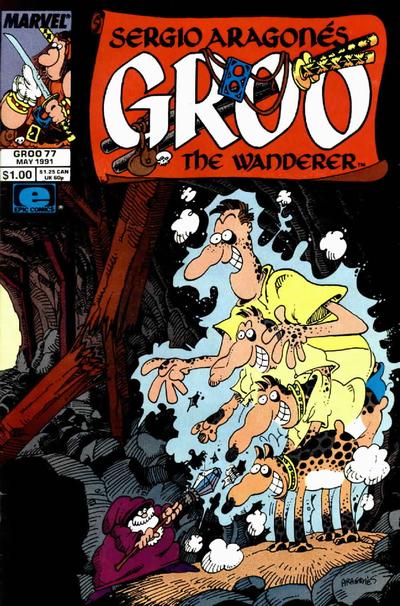
Groo the Wanderer #77
By Sergio Aragones, Mark Evanier, Stan Sakai (lettering), and Tom Luth (coloring)
Published by Epic Comics, 1991


This issue seems like it was influenced by Mark Evanier's work in animation, since it sort of resembles the plot of a half-hour cartoon in which something big happens to the characters, but everything is restored to the status quo by the end of the episode, with lessons learned, hearts warmed, yada yada yada. That big change: Rufferto gets turned into a human after rescuing a magical gnome who was trapped in a mine. That seems like it should be a big deal, with the newly humanized companion finally able to talk to his friend and hero, and the two of them able to go on adventures like never before. But no, they just hang around and work in a mine, and while Rufferto-the-human makes friends with Groo, he keeps his "true identity" a secret for no real reason. Then, when they get trapped in a cave-in, Rufferto is too big to squeeze his way out and get help, so he wishes he was a dog again and saves the day. It's a bit too easy and pat (especially since the gnome indicated that he wouldn't be able to undo the wish, and also that Rufferto would regret it, which wasn't really the case either), without any real exploration of the idea of Rufferto's greatest wish being granted, only to turn out different from what he expected. This didn't have to be a long, multi-issue arc exploring the ramifications of how the change in status quo affected the characters' emotional relationships, but there's barely even a shrug in that direction (Groo wonders where Rufferto went, and Rufferto smiles because he knows Groo loves him, and that's pretty much it). It ends up being kind of a cheap contrivance, something that should have more resonance but feels glib and superficial instead.

I can't presume to tell the Groo Crew how to do their jobs, so I'll refrain from complaining about missed opportunities and point out what I did like. There's a good scene in which Groo insists on a job in the mine, which leads to a fight with a bunch of the workers:


That's a good joke, but I also like Groo's expression in this subsequent panel during the fight; it's like he's in a state of pure bliss when beating the hell out of a large group of people:


And here's a depiction of Rufferto's idea of what life with Groo will be like now that he's a human, making one imagine the sort of thing that could be explored in a story like this:


And that's about it. In the end, the story seems to be a celebration of Rufferto's loyalty and his friendship with Groo, which is nice; I guess I just wanted something deeper and more meaningful. Of course, I might have been looking in the wrong place; this is Groo, after all...

Next: Groo fights censorship in "The Book Burners".
-----

This issue's stats:
Recurring characters: None. But look, here's a book written by Weaver:


Hidden message(s): Nope, didn't find it. In fact, Mark notes that they're stopping the tradition of hiding them as of this month, and he doesn't think there's one in this issue.
Moral: None, although the poem, which is featured in captions throughout the issue rather than just on the title page this month, ends with "The greatest gift to wish for/If your magic wish comes true--/A friend who's as devoted/As Rufferto is to Groo," and that's a pretty good moral.
Spanish words: None.
Running jokes: None, really, unless you count various jokes about Groo being dumb, like him not being able to count or responding to someone saying that only an idiot would want to work in the mine with "Well, I want to work there!"
Mark Evanier's job(s): "Written by" (!!!)
Letter column jokes: When David Sutherland asks how old Groo is, Mark says nobody knows, even Groo, since Groo can't count, but he does use the opportunity to plug the forthcoming The Life of Groo graphic novel. Kenneth Wakfield notes that Mark has no life, since he spends it writing silly jokes for comic books, so he advises Mark to get out, take a walk, and do something else with his life. Mark doesn't respond, but when "Wald/Scott/Rex Moss" asks if he knows a good mental health professional, he suggests Kenneth Wakfield. Doug Cuff notes that according to the copyright information in every issue, all characters and their likeness are owned by Sergio, which includes Mark. Mark responds that it's gotten really bad, with Sergio suing Mark's mother for taking his photograph and demanding a royalty every time Mark looks at somebody, but Mark is getting back at him by filing a patent on facial hair.
Miscellaneous: I was amused by the artwork accompanying some video games this month. First, there's this alien eating a Game Boy:


And this goofy photo of Cobra Commander:

Monday, March 11, 2013

Art What I Like: One Piece Is Awesome, Example #7

In a shonen manga, there's kind of a guarantee of action (even if the series isn't all about fighting), so it can be fun to see what sort of unique styles the creators can bring to the table. And if anybody is unique, it's One Piece's Eiichiro Oda, with his goofy elongated characters and penchant for exaggeration. There are too many examples of awesome action to choose from in each volume of the series, but among all the speed lines, blood splatters (and by the way, there's something about the copious blood flow in this series that keeps it from being gratuitous and gross like it is in so many modern superhero comics, but that's a discussion for another time), shouted proclamations, exciting moves, and shattered rubble, there's an occasional moment that stands out, at least for me. Here are a couple from volume 11:


In this one, I just like the way it looks like Luffy is kicking the "WHAM!" sound effect and making the letters scatter across the panel. The translated sound effects in the English-language version of the series are really well done, integrating with the art in a way that's readable while still remaining in the style of the original Japanese characters, and this is a good example.


And here we see what is probably the biggest and most satisfying wallop of the volume, a surprisingly cheerable moment, even though it's being delivered to someone other than the main villain by one of the supporting characters, and it's a case of a guy being beaten up after he's already down. But sometimes you just want to see despicable characters punished, and man, it looks like this guy is being hit so hard he's going to fly off the page and smack into the reader's forehead. Oda engages in some crazy distortion in his artwork, and this is one of the most extreme cases I've seen in the series, with Nami's body contorting like a twisted rag, her staff stretching to look like it's thirty feet long, and the guy's face being smashed so hard it looks like the pieces of his shattered skull are going to erupt out of his head. It's awesome. And you can see more like this every few pages, or so it seems when reading the comic, which sets up situations with real stakes and seemingly impossible battles, then builds to moments of incredible catharsis through earth-shaking violence. What more do you need in a comic?

Sunday, March 10, 2013

Art What I Like: One Piece Is Awesome, Example #6

The ninth volume of Eiichiro Oda's One Piece contained a devastatingly effective emotional moment, one that took an entire volume to build as we learned about the past of Nami, one of the series' main characters who apparently betrayed her friends and sided with some heinous villains, but, as we learned, she had good reasons for doing so, and when forces beyond her control destroyed years of her life and left her helpless, the way her friends still stepped up to stand behind her was incredibly moving. I would discuss it more, but instead I'll refer you to this post by David Brothers from a few years back, since it was one of the essays that got me interested in trying out the manga.

Instead, I'll just point out this short bit from the middle of the battle that resulted from that moment, which raged throughout the tenth volume and beyond. At this point, the good guys are struggling, and Arlong, the leader of the evil fish-man pirates they are fighting offers Nami a choice: join him and he'll spare the people of her village, or continue fighting him and he'll slaughter everyone:


I don't know why, but the way everyone joyously celebrates their certain deaths cracks me up. At this point in the battle, the time for anguished emotions is past, so the idea that they'll all die fighting together is cause for celebration rather than angst. Oda already resolved Nami's emotional conflict, so he doesn't need to rehash it here, and slowing things down for a long bit of soul searching would ruin the momentum he has built up, so it's just a quick moment that gets us fired up to enjoy the fighting which is about to shift in the heroes' favor. Oda definitely knows what he's doing; he plays the audience like an instrument, and we love him for it.