

Written by Brian Clevinger
Art by Scott Wegener
Published by Red 5 Comics
Man oh man, what an end to a great arc of this ongoing series (which, in the style of Hellboy and BPRD, is delivered as a series of miniseries). Large-scale action that actually threatens the main character's life, with a mystery of ever-increasing scale slowly revealing itself in between moments of a global chase, culminating in the unveiling of a villain that connects perfectly with Robo's life, goals, and personality, making for a nigh-unstoppable threat that resonates beyond whether it can be blown up real good. With the century or so of time that the creative team has to work with, the range of stories that can be told is pretty great, typified by the jump from the last story's young, naive Robo to this one's confrontation of a huge threat challenging him at the height of his abilities and resources. Man, give me whatever these guys can dish out.
-----

Written by Viktor Kalvachev, Kosta Yanev, and Andrew Osborne
Art by Viktor Kalvachev, Toby Cypress, Robert Valley, Peter Nguyen, and Andy Kuhn
Published by Image Comics
I enjoy this noir story for the most part, with its goofy characters, occasional violence, and themes of Hollywood crime, but the most interesting aspect is probably the art, which shifts randomly, sometimes even within a single page, between each issue's contributors. Nathan Fox has been the highlight of the series, but he's not in this issue, so Toby Cypress is probably the star this month. One highlight is a moment in which a character's reaction to having a gun pulled on them is described like a car accident, and that's illustrated by a panel that ends up happening later in the issue when that character does get into a car crash. I don't know if I would recommend this series, since it's so idiosyncratic, but I usually have a pretty good time reading it. High praise?
-----

Written by David Hine
Art by Shaky Kane
Published by Image Comics
Not sure what to say about this one. It's one of those bits where characters tell stories that might or might not be "true", apparently meant to be an example of the sort of story you might find in the comics described and sampled in the first volume of this series, with the hint that the various characters are all going to come together for some sort of metatextual crossover by the end of the series, perhaps to confront their creators or something. Whatever; I mostly just enjoy the crazy way that Shaky Kane depicts the weird (or sometimes just unfortunate) shit that happens to people, with the hairy monster of the last story being the highlight. Good times.
-----

By Mike Mignola & Joe Querio, Brian Wood & Kristian Donaldson, Paul Pope, Tony Puryear, Richard Corben, Rich Johnston & Simon Rohrmuller, Alan Gordon & Thomas Yeates, Steve Horton, Caitlin R. Kiernan & Steve Lieber, and M.J. Butler & Mark Wheatley
Published by Dark Horse Comics
Aside from the standard comment about anthologies being a mixed bag, I'm definitely digging this new incarnation of Dark Horse's house mag, which contains samplers of their best creators' work, along with other stuff that I'm guessing they thought was cool enough to print. There's no chapter of Neal Adams' batshit-crazy "Blood" this month, but I'm hoping that one comes back soon, since it's totally nuts. Howard Chaykin's "Marked Man" also ended, so it's mostly new or standalone stuff here. Mike Mignola has a Lobster Johnson short that's pretty cool, even if it ends kind of obviously. Brian Wood and Kristian Donaldson's "The Massive" continues to be introduced; I'm guessing that the stories here are intros to the various characters in the regular series, which is coming later, right? I do like Donaldson's ultra-clean art, especially an eerie underwater moment in this chapter. Paul Pope is as awesome as you would expect with a story about Apollo 12, the second moon landing, full of distinctive lunar landscapes, that weirdly sketchy-yet-realistic machinery that he does so well, and the surprise appearance of a naked lady. Richard Corben adapts an Edgar Allen Poe story as well as you would expect; it's pretty great, with lots of horrified faces, desiccated corpses, tangled scenery, the usual. I like the beginning of Steve Horton's "Amala's Blade" too; it's a cool sci-fi/fantasy/pirate thing with some great designs and stylish art, plus what seems like a good female lead. Caitlin R. Kiernan and Steve Lieber's "Alabaster" is cool too, although I'm not sure if this is a character that has shown up anywhere before. I guess she's an albino monster-hunter that might or might not also be crazy? She sees a freaky four-faced angel at one point, and she also gets confronted by a werewolf lady. I'm not sure what's going on, probably by design, but I love Lieber's moody art.
On the other hand, I can't really figure out what's going on in Tony Puryear's "Concrete Park"; apparently, it takes place on another planet, and it follows various characters who live in a Los Angeles-like city of crime and gangs and whatnot. It jumps from character to character so much that I can't really follow it, and neither the art or the story are compelling enough to really want to do the work to keep up. Rich Johnston and Simon Rohrmuller's "The Many Murders of Miss Cranbourne" is all right, with a decent concept of a vigilante-killer old lady who presents herself with the air of an amateur detective, although this chapter focused on a policeman who falls for all her cover-ups, which isn't that interesting when we've already seen what really happened. The art is kind of generically cartoony too, not really expressive enough to be either humorous or deadpan. I'm fine with Alan Gordon and Thomas Yeates' "The Once and Future Tarzan", with its interesting concept of an immortal Tarzan living in a post-apocalyptic future, but it's been kind of staid and workmanlike so far, nothing to grab the reader and sell them on the coolness of the concept. And finally, M.J. Butler and Mark Wheatley's "Skultar" is a pretty dumb spoof of Conan and other barbarian-themed stories, but it does manage to hit on an amusing joke or two in each chapter. You have to get past the muddy art to see them though.
So yeah, good reading overall, and it will have to take a real dip in quality for me to even consider quitting. I suspect I'm there for the long haul.
-----

Written by Joe Casey
Art by Nathan Fox
Published by Image Comics
I never expected to be reading this Todd McFarlane series about a ghost mashup of Spider-Man and Spawn, but when Joe Casey and Nathan Fox took over, I had to at least give it a try. And luckily, they appear to have jettisoned everything except the basic concept, which is about a couple of brothers (one of whom is a ghost) that can combine into some sort of ectoplasmic monster. I think they used to work for a spy agency or something, but Casey had that aspect of the book just disappear in his first issue, then killed off the living brother's love interest, instead having the character kidnapped by some sort of evil church and then rescued by a badass spy/mercenary who is like an ultra-competent version of Jeff "The Dude" Lebowski. It's been mostly non-stop action, which is pretty great stuff for Nathan Fox to handle, all ghost tentacles carving up bad guys left and right, lots of blood, gore, and intestines flying everywhere in the midst of mysterious architecture and crazy technology. There's also a bit of character development, as the ghost brother starts to get distanced from the living, caring less and less about morals and emotions and such, which makes for an interesting personal note in the midst of all the crazy action. I'm digging this, for now.
-----

By James Stokoe
Published by Image Comics
Good god, do I love the crazy world James Stokoe has created here, full of weird creatures and cultures, random violence and destruction, bizarre structures, unique landscapes, and a sense that anything can happen, at least within the constraints that have been set up for the milieu. It's a nonstop barrage of mindblowing imagery, all the characters colored with inhuman tints and bristling with sickly pustules and gross scales, machines sprouting tentacles, everything up to and including rocks and mountains seemingly made of reptilian skin, characters getting smashed and sliced up with giant hammers, knives, and spiky hair (?), bright, yet somehow sickly, colors slathered all over the page, just a constant assault on the senses (well, the sense of sight at least, but the comic is so visceral, the mind imagines sounds, scents, and who knows what else). It's amazing, one of my very favorite comics of the moment. Damn.
-----

Written by Brandon Graham
Art by Simon Roy
Published by Image Comics
Speaking of worldbuilding, Brandon Graham and Simon Roy are going nuts on their revival of this 90s series. I have no idea what the Rob Liefeld issues of this series were like, and I don't really have any desire to find out, unless I'm seized with morbid curiosity at some point; the world created here, a desolate future Earth populated by various aliens and monsters, covered with the wreckage of long-dead civilizations, is amazingly well-realized, and just watching the main character wander through it on his mostly-undefined mission is fascinating. I'm kind of blown away by the level of thought that has gone into the series, all the various creatures that interact with each other in the weird ecosystem and mix of cultures, most of them using gross biological technology that really emphasizes the utterly alien world. I can't wait to see where this goes, even if it continues to kind of freak me out.
-----

By Jeff Smith
Published by Cartoon Books
I think this series is reaching some sort of endgame, a final confrontation between its universe-hopping protagonist and the evil government forces that exploited his inventions. I think we've finally been caught up on the details of the plot, which is nice, but the best part is probably the images of a town merged with several parallel universe counterparts, resulting in people and animals that are gross conglomerations of bodies sprouting multiple arms and heads, all screaming in hideous agony as they die miserable deaths. Fun! Jeff Smith can draw whatever he wants, and I'll read the hell out of it.
-----
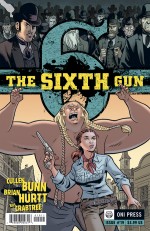
Written by Cullen Bunn
Art by Brian Hurtt
Published by Oni Press
This series has become one of my favorite current comics, but unfortunately, it's so consistently good that I don't know if I have much to say about it. I do like that Cullen Bunn continues to build the world as the series goes on, adding new elements with each arc, details slowly accumulating to create a rich mythology that includes mystical weapons, warring religious factions, demons, sorcerers, monsters, and all sorts of cool details that make the Old West setting come to life. It makes me trust that there's a plan for the whole series, and I can't wait to find out where it's going each month. Brian Hurtt on art definitely helps; he's a monster, filling out and solidifying all those details while maintaining a great sense of character and place, and lending an appropriately creepy, moody air when it's called for, which is most of the time. I love it, and I always want more when it's over.
-----

Written by Brian Azzarello
Art by Eduardo Risso
Published by DC Comics/Vertigo
Brian Azzarello and Eduardo Risso are near-bulletproof for me after 100 Bullets, and they sure don't disappoint with this new Vertigo series, which is a completely different sort of thing, yet recognizably their work, full of that unique combined personality, all cryptic wordplay and encompassing atmosphere. The plot here, for those who don't know, follows a human-ape hybrid who was designed to work in space but has ended up scavenging the slums of a flooded earth as he ends up in possession of the kidnapped child of a celebrity couple. There are a bunch of twists and turns, and probably some secrets to be uncovered at inopportune times, but the most enjoyable part of the comic is getting to experience the future that Azzarello and Risso have created, trying to decipher the slang that everyone speaks in, marveling at the busted-up locales where the people survive and the believable technology that they use, enjoying the expressive characters and sudden, shocking violence. I expect nine issues is going to be too short of a time to spend in this fucked-up, all too possible future.
-----

Written by Antony Johnston
Art by Justin Greenwood
Published by Oni Press
Interest in this title may have been flagging around these parts due to the erratic schedule over the last year or so and the loss of artist Christopher Mitten, but things kind of snap back into place in this issue, with a revelation that brings many of the series' themes into focus, namely the emphasis on belief systems, the supernatural, creation stories, and religions. Suddenly, this isn't (necessarily) the sci-fi post-apocalyptic story that it appeared to be, but a sweeping history of mythological proportions. Huh, how about that? Color me reinvigorated.


