Showing posts with label Eddie Campbell. Show all posts

Saturday, November 27, 2010

The Playwright: Oh, to be an aging, celibate, wallflower

Sorry to anybody who cares, but life has been crazy as of late.  I hope to have more new reviews up soon, but for now, I've got several that I wrote a couple months ago to be published elsewhere that did not end up being used, so I'll be posting them over the next couple weeks.  Enjoy:

The Playwright
By Eddie Campbell and Daren White


So, you want some literary comics? Well, this is your lucky day, since this new Eddie Campbell graphic novel is like the comics version of a Philip Roth novel, all about a boring middle-aged writer and his sexual hangups. That should get The New Yorker’s attention! But don’t despair, it’s not a stodgy attempt to win a Pulitzer, it’s an Eddie Campbell comic, which means plenty of striking imagery, some very enjoyable wordplay (assisted by Daren White, who also worked with Campbell on Batman: The Order of Beasts), and some interesting use of comics to make a mostly internal story lively and fun.

And yes, this is a very inwardly-focused story, taking place almost entirely inside the eponymous character’s head, with captions hovering over almost every panel detailing his thoughts, desires, worries, and fantasies, although they are related in the third person, providing some remove from the intimate details and making it less of a confessional and more of an examination of a subject. But it’s far from dryly analytical, instead painting a very human portrait of a flawed, lonely man who can’t help but constantly think of sex, when all he really wants is somebody to share his life with. He’s intelligent, and he’s managed to pour all his hang-ups and difficulties with relationships (especially his family) into his art, ending up successful and recognized, but still unhappy. He might be kind of pathetic, addicted to internet pornography, imagining every woman he sees naked (yet judging them for their imperfections, though he isn’t exactly an Adonis), and being too timid to form a bond with anyone outside of a obligatory interaction (his social life consists of hanging out at a local bar so he can imagine himself part of the crowd that comes in to watch soccer).


In anyone else’s hands, this would be a depressingly sad story of an achingly unhappy man, but Campbell manages to use just the right tone, making the flights of fancy funny and relatable and exaggerating the sexual obsessions to a degree that they seem kind of ridiculously recognizable rather than horrifying. The art varies from lusciously smooth curves depicting the fantasies, to harsh scratchiness when concentrating on the playwright’s awkwardness, always exhibiting a wonderful grasp of posture and fluid movement. The Campbellian details and flourishes are all here, but they fit within the structure of the narrative, contained within the regular panels marching steadily across the landscape-oriented pages.


While the potential is there for this to be a navel-gazing exercise straining for acceptability from the literary establishment, it’s anything but, full of live and spirit, recognizable in its exploration of human foibles and the difficulty of forming meaningful human relationships. One must exit one’s safety zone in order to make contact with another, and while that’s a big step, it’s a worthwhile one. That such a notion can be communicated so subtly, movingly, and entertainingly is a testament to Eddie Campbell’s skill. He’s a keeper.

Thursday, August 21, 2008

The Amazing Remarkable Monsieur Leotard: Eddie Campbell could illustrate the phone book and I would buy it

That's kind of a cliche, isn't it? I don't know if I would really buy an illustrated phone book, no matter who drew it. Hmm, maybe I'll pitch that to Image as a new anthology series. Anyway:

The Amazing Remarkable Monsieur Leotard
Written by Eddie Campbell and Dan Best
Art by Eddie Campbell


Eddie Campbell has such a unique style of comics storytelling, both in his distinctive artwork and the manner in which he tells stories. While he is still probably best known for his dark, moody work on Alan Moore's From Hell, most of his other stories aren't like that book at all; they use a freewheeling, enjoyable style, given to wit and whimsy. This new graphic novel definitely fits that paradigm, seeming like a Campbell sort of story even in its genesis (which can be read about here) and it plays out according to his whims.

As described in the link above, the book takes its title from the real-life acrobat Jules Leotard, who invented the article of clothing that bears his name and inspired the song "The Daring Young Man on the Flying Trapeze". But as interesting a character as he is, he dies at the beginning of the book, leaving his nephew Etienne with his last words: "May nothing occur." And that's pretty much what happens to Etienne throughout the rest of his life (and the book); nothing of consequence occurs, but he certainly has a colorful time carrying out that prophecy. He tries to continue his uncle's name and legacy, performing while wearing a false moustache. But he never really finds fame and fortune, and ends up wandering around and getting tangentially involved in various historical events, living out the rest of his life in obscurity.

It's an episodic sort of story, with each chapter seeing Etienne and his circus pals get involved in some sort of business, like the Jack the Ripper murders, or the sinking of the Titanic. But Campbell acknowledges this, titling almost every chapter with some variation on "The Next Episode" and ending each one by having a character make a remark like "I wish we'll all do well in the next episode." It's a knowing, playful style of storytelling, and Campbell goes all out with fun techniques, filling the margins with little drawings that sometimes comment on the story itself, along with occasional footnotes delivering scientific and historical information. One episode, "The Episode of Sleeping", even sees pages dominated by the image of Etienne in bed, while a tiny dream version of himself converses with his uncle, and Campbell and Best pop in to discuss the direction of the story:


The whole thing is full of that kind of whimsy, and it makes for a wonderful, enjoyable read. I particularly liked a scene in which Etienne loses his virginity to Lenore, the tattooed woman, told in a text excerpt from his diary presented as if it was written on her torso. Another scene sees him try to come up with a different invention to bear the name Leotard, a set of spring-heeled shoes. When he presents himself to Queen Victoria while wearing them, he keeps bobbing around the frame amusingly:


And of course, there's Pallenberg, a talking bear whose intelligence is never explained; he's simply another member of the cast. His involvement in the Jack the Ripper murders ends up being another good source of comedy. There's also an excellent section in which an Charles Blondin recounts the tale of a rivalry with another circus performer that involved a series of increasingly difficult tightrope walks across Niagara Falls:


Eventually, the tone of the book shifts to a more somber one, as Etienne and his friends begin to age and near the end of their lives. They all go on one last adventure together, attempting to rescue a colleague of theirs who was (wrongly?) imprisoned for stealing the Mona Lisa. It's a sad series of scenes, but it still ends up being sweet and touching; eventually, Etienne learns that while he might not have become rich and famous, he was happy because of a rich life spent doing what he loved in the company of good friends. Of course, Campbell doesn't make it as sappy as that description; he simply portrays them all reconnecting, and the history which we've already witnessed adds gravity to the situation. It's a beautiful way to close things out.

It doesn't really end up being a very complex story, but it's a satisfying one, due to Campbell's skill at telling it. He makes every scene feel fully-realized, due to the amazing, detail-filled art. The vast landscapes he splashes onto the page are beautiful, somehow seeming both tossed-off and incredibly meticulous. And his character art is always wonderful; he manages to convey motion and gestures wonderfully, while not making them look over-rendered. It seems like a few simple lines and dabs of paint were used in each drawing, but they combine to capture true-to-life details like the way people hold themselves while standing and talking, or facial expressions that can convey a huge range of emotion. And other details can't be ignored: the lettering is wonderfully done, as well. Campbell has a distinctive style of handwriting that works beautifully to convey the way words are being spoken (see the image above for a good example). One of my favorite scenes sees Pallenberg the bear singing while dancing with his handler/lover Ursula on the Titanic, and the letters that form the words of his song seem to dance around the speech balloon along with him:


With Campbell, you get the whole package; not a page of the book gets wasted, and there's something to entertain at every glance.

It's just a gorgeous book, a great bit of comics storytelling that uses the form like nothing else out there. Campbell makes comics like nobody else, and the world is richer for having his work in it. Hopefully, he'll be able to keep delivering beautiful works like this for years to come.

Monday, July 28, 2008

Eddie Campbell and I are totally pals now

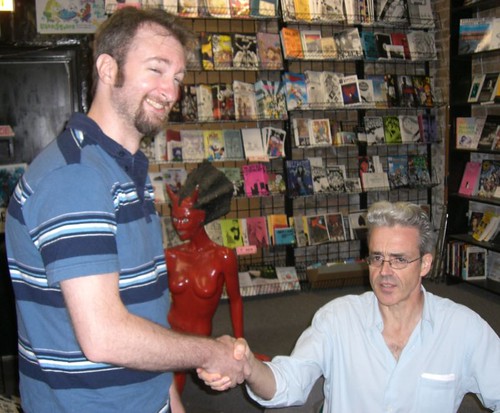
Tonight, I attended an appearance by comics artist extraordinaire at Quimby's Bookstore in Chicago (a cool independent bookstore where, if I had the money, I could drop a small fortune on all the small-press, indie comics that don't show up at my local comic shop). Campbell was promoting his recently released book The Amazing Remarkable Monsieur Leotard, and it was a fun little evening, with a small audience for him to discuss his works, take some questions, and sign various books. He's an immensely enjoyable speaker, talking with a charming Scottish accent and prone to plenty of tangents and digressions that never cease to be entertaining.

Monsieur Leotard certainly looks like an enjoyable story, and Campbell shared its genesis in a conversation between (he thinks; he can't remember the specific source) Will Eisner and Michael Chabon, in which one of them speculated that all superheroes could be traced back to the circus. As Campbell said, this doesn't seem right until you think about it. Take, for instance, the Fantastic Four: you've got the India rubber man, the strongman, the fire-breather, and the magician's assistant who appears to disappear. There are also parallels in characters like the Beast (patterned after animals like bears and lions) or the Golden Age trend of midget sidekicks like Woozy Winks, Ebony White, and Doiby Dickles.

All this talk about circuses led Campbell to formulate an adventure story centered in the circus along with his friend Dan Best. They found out about the real-life Jules Leotard, the inspiration for the song "The Daring Young Man on the Flying Trapeze" and the inventor of the skin-tight garment which was named after him. Unfortunately, Leotard died young, at the age of 28, too early for Campbell and Best's plans for a character that would "Forrest Gump" his way through history, getting involved in events like the Jack the Ripper murders (watch for an Inspector Abberline cameo appearance in the book) and the theft of the Mona Lisa. So they invented a nephew for him who would attempt to take up his mantle, performing in disguise while wearing a fake moustache. It sounds like a great read; I can't wait to plow my way into it.

Campbell spoke about many of his other works, including a long talk about The Fate of the Artist. In a lengthy, incredibly amusing story, he talked about how his propensity for using the likeness of his designer, Mick Evans, and then killing the characters based on him, led him to name Evans as Campbell's murderer in the book. Campbell originally intended to leave the mystery of "his" disappearance in the book unanswered, since it was obviously a joke anyway, but the editor insisted on him solving the mystery, saying that he had to "follow the rules" and deliver a payoff. So Campbell figured he would allow Evans to get him back for murdering him so many times. It's a funny story, but for the final punchline about Evans' revenge on Campbell, you'll have to attend an appearance and hear Campbell tell it. That's personal-appearance-exclusive content, at least until somebody spills the beans about it elsewhere.

Campbell also talked about working with Alan Moore (the two questions he gets most often when meeting fans are "where do you get your ideas?" and "just how mad is Alan Moore?"), stating that in his opinion, Moore's best work is The Birth Caul. After Campbell heard Moore's performance of the spoken-word piece, he asked to do a comics version of it, and Moore wasn't sure at first, because he thought it wasn't possible to adapt. Campbell envisioned something like Dave McKean's more complex work, and he did a few pages as an example, after which Moore agreed. Unfortunately, Moore didn't save the original text, to Campbell had to listen to the recording and transcribe it, which led to at least one instance of wondering what the hell Moore meant when he misread his own writing. Campbell also talked about how much fun he had creating some of the imagery, like an image of a boy wearing striped pajamas that he made by obtaining some actual pajamas, cutting them up, and assembling them in the shape of the outfit on the page:


Or a page depicting a broken clock, for which he bought an antique clock and smashed it with a hammer, removing the spring and spray-painting around it to create a cool, shadowy image:


Campbell also spoke about the forthcoming Alec (Life-Size Omnibus), which will be published by Top Shelf in 2009. It will collect all the extant Alec books in chronological order, along with other hard-to-find and previously-unpublished stories, and a new 35-page story which Campbell says is his best work in years. I've actually only read a small portion of the Alec books, so I can't wait to be able to read the entire saga.

There were plenty of other stories told, but that covers the most interesting bits. Campbell also signed books for everybody, and I took a picture with him:


Flatteringly, he remembered linking to me about a year ago, and we talked blogging a bit. We also chatted about his habit of referring to his wife as "the wife of my bosom" in his blog writing, a cute (my word, not his) pet name from Victorian times that he read and decided to use, since it was a nice term that didn't sound stupid. I like how he pronounces "bosom" as "boozum".

So, it was a nice evening, revealing Campbell as a nice, friendly guy who is also incredibly talented. He should go a long way in this business.

Tuesday, June 12, 2007

The Black Diamond Detective Agency: or, Eddie Campbell Is Awesome

It seems like this book is getting some mixed reviews, maybe due to the fact that it's kind of different from some of Campbell's previous work. But I for one loved it, so let's see if I have anything coherent to say:

The Black Diamond Detective Agency
By Eddie Campbell


This is actually an adaptation of a screenplay by C. Gaby Mitchell, and I'll be curious to see how the possible film differs from Campbell's version of the story. It takes place at the end of the 19th century in the United States, telling about a man with a mysterious past going on the run after being framed for bombing a train. He is pursued by the titular agency, and even joins their ranks in disguise at one point to try to capture the real culprits. It's a fun, fast-moving story, with lots of action and adventure, and it's given a dirty authenticity by being depicted in Campbell's unique style. And I think that's what I want to talk about: the cool touches that Campbell brings to the story.

Let's start with the cover. I love the old poster-style layout, and there are some good jokes that come from such an old style being used on a modern book, like the line, "A tale so filled with twists, turns, and heart-stopping thrills, that its telling is best experienced through the modern wonder of the graphical narrative." The inclusion of "Orphans!" is apparently a big selling point, getting equal billing with "Mayhem!" and "Terror!" That's pretty amusing, to me at least.

But let's get into the actual content of the book. I like the little touches that Campbell provides, like depicting the main character with the walls of the building he's in cut away to reveal his surroundings:


That's a cool effect. Or the way small details in the art are pointed out through captions or little magnified boxes:


And the use of the color red is wonderful in depicting violence (blood, sound effects) or strong emotions, but especially in the oft-seen double page spread (which I noticed is upside down on the page of Wizard's interview with Campbell) of the train bombing and characters' remembrances of it. There's a lovely bit in which the main character (he goes by at least three different names in the book, but I'll call him Harte) enters a room in the agency and sees a red-tinted image of the wreckage covering the wall. But on the next page we learn that the red was only in his perception; it's actually a composite image from a bunch of different photographs.

There are several silent sequences that are beautifully done, but my favorite was probably the one immediately following the bombing, with the absence of word balloons simulating Harte's loss of hearing. There are some other action scenes that are mostly silent, told through character movement and panel layouts. There are a couple of double-page spreads of panels in particular that are amazing, with several "paths" of small panels interconnecting to create an entire scene. I'm having trouble describing it (and I don't want to spoil it by just scanning the page), but trust me, it's pretty awesome.

That leads me to the panel layouts, which are also beautifully done. Campbell has a real skill at leading the eye across the page through the placement of word balloons and characters. But even wordless panels are beautifully done:


I love the simplicity of that page, and the way the eye is led in a Z pattern across the panels, with the angle of the text in the center panel leading you to from the upper right to the lower left. Sure, we know that's where our eyes are supposed to go anyway, but this elegantly facilitates the process. And I like how the "Black Diamond Detective Agency" sign is shown in the lower left panel without much detail; we can identify it instantly due to the diamond shape on the sign, but our focus is on Harte as he is looking at it.

And then you have the action scenes. With the square panels providing a rigid structure through most of the book, Campbell provides a visceral, disorienting depiction of the chaos of a shootout by angling the panels and distorting them into weird shapes:


I didn't want to spoil the main scene, so I went with that exterior shot; I think it still illustrates my point pretty well. I've seen that effect quite a bit (Joe Sacco does it especially well), but I really like the way Campbell pulls it off.

And finally, the locations are beautifully illustrated. I mentioned one nice panel a couple days ago, and there are plenty of other examples of buildings and landscapes that just take your breath away:


Wow. So, it's an excellent book, and I highly recommend it. Lovely art, good writing (I didn't even mention how funny much of the dialogue is), a great package. Check it out!
-----

I have at least one other book to review, but I doubt I'll get to it tonight. There's always tomorrow!

Monday, June 11, 2007

My current favorite panel

From Eddie Campbell's The Black Diamond Detective Agency:


Beautiful. I'm working my way through the book now, and I'll have a review up when I'm finished. It's a lovely book, and I'm enjoying it quite a bit. Later!

Tuesday, May 8, 2007

Eff Cee Bee Dee

I'm late on this, but here are my thoughts on books I liked from Free Comic Book Day 2007. I didn't get the Peanuts book, which was too bad, and I suppose I could have read the Spider-Man book, but not getting that one is no big loss. But here's what I did like:

The Umbrella Academy
Written by Gerard Way
Art by Gabriel Ba


I was a bit skeptical about this, because who would expect a cool comic from the frontman of My Chemical Romance? But this was actually pretty fun, and it's sold me on the upcoming miniseries. Good job with this one, Dark Horse. The book is about a team of superheroes (or supernatural detective types, at least) who attend the titular school. Here's a scan of the title page, which gives a goofy description of each character that sounds like it was translated from Japanese (click to enlarge):


The story involves the team's discovery of the dead body of one of the members (which is odd, because she is also at the scene, alive) and their subsequent confrontation of the villainous Murder Magician, who is making a talk show appearance. It's a short story, which fits a free giveaway, but the dialogue and art are quite good. The whole thing reminds me of Matt Fraction's writing on Casanova, but that might just be because the art here is also by Gabriel Ba. Dave Stewart's colors really liven the art up though. Here's a good sample:


Awesome. And the writing is good too, with lines like, "The Murder Magician's hypnotized Lucifer Clark and his audience, and set a murderbot to 'careless brutality'". Lots of fun; I'll definitely be checking out the miniseries, whenever it shows up.

The book also has previews of Pantheon City and Zero Killer. The former is a futuristic tale by Ron Marz and Clement Suave. The art looks nice, but I'm not exactly a fan of Marz's writing, so I kind of doubt I'll pick it up. As for the latter, it's written by Arvid Nelson, who created Rex Libris, which I've never read but hear is really good. Art is by Matt Camp, and it seems nice enough. It's something about a post-apocalyptic New York overrun by weirdos, and the short story here doesn't really do anything for me.
-----

Comics Festival 2007


This is a sampler of various Canadian artists who (I assume) will all be attending or participating in the Toronto Comic Arts Festival. Lots of nice pieces, including a couple Scott Pilgrim-related stories by Bryan Lee O'Malley, a nice story by Darwyn Cooke (who also contributed that awesome cover), an Apocalypstix short featuring art by Cameron Stewart, several pages of snow-related poetry by Hope Larson, a beefcake-laden sci-fi strip by J. Bone, and a "Monster Cops" one-pager by Chip Zdarsky. Cool stuff! There's other stuff too, but those were my favorites.
-----

The Train Was Bang On Time
By Eddie Campbell


This was one of the ones I wanted to get most, and now it has me really excited about Eddie Campbell's new book, The Black Diamond Detective Agency. This is an excerpt from that book, and it looks really nice, with color and everything. I had a bit of trouble following the story, but I'm hoping that won't be a problem with the full book. It involves the bombing of a train and the false(?) accusation of a man who ends up going on the run from the titular (I like that word, if you can't tell) detective agency. As for the art, it's very nice, of course. I was especially impressed with the double page spread of the explosion; I was tempted to scan it and show it here, but it works best as punctuation against the art on the pages surrounding it, with stark black lines on a bright red background. Instead, I'll show this image of the aftermath:


I love Eddie Campbell's art and writing, so I'm really stoked to read this in its entirety.
-----

Mickey Mouse
By Floyd Gottfredson


Before I got into superhero comics in my teenage years, I used to read Disney comics voraciously, especially those starring Donald Duck and Uncle Scrooge. But there was one story in an issue of Walt Disney's Comics & Stories that I really liked; it was a reprint of an old Mickey Mouse newspaper strip story, with Mickey discovering a floating island and fighting his nemesis Big Bad Pete for control of its scientific advances. The story was by Floyd Gottfredson, of course, and the fact that it has stuck with me is a testament to his skill. He wrote and illustrated the tales of Mickey Mouse back before all the sharp edges were filed off the character; these days Mickey doesn't really have a personality, but back then he was irascible and temperamental, seeming to pick fights at the drop of a hat. I would love to read a treasury edition of Gottfredson material, but stuff like this will have to suffice for now. In this story, Mickey invents a chemical that increases and reduces the size of plants. It also affects living things, enlarging a fly to the size of a cat and shrinking Mickey to the size of, um, a mouse. He ends up taking refuge in the pages of a book, and he ends up stepping right into the pictures and entering the world of Robin Hood. Hey, why not? (or, as Chris Sims might say, because Floyd Gottfredson, that's why). He ends up joining Robin Hood's band of merry men, robbing travelers and rescuing maidens (although nothing turns out like he expects it to), and it's all a bunch of goofy fun until it gets too intense for him and he has to leave. I love the crazy stuff that Gottfredson comes up with, like the scenes of Mickey fighting:


Or the way Pluto is freaked out by Mickey's antics:


We also get another story, about Mickey's rival for Minnie's affections, Mortimer. In one scene, Mortimer plays jokes on Mickey and makes him look like a fool. So Mickey bets him he can make Mortimer fall over without touching him:


Ah, a classic gag. Man, I need to look and see if this stuff is available in collected editions.
-----

So that's the stuff I liked. I also enjoyed the Nexus book, but that's because I've never read any Nexus, and it helped me get caught up. Now I might actually read the upcoming series. I got the Owly book for my wife, and she was pretty excited. I tried reading it, but man, it is just not my style. So that's pretty much it. I should be back tomorrow with other stuff to talk about. Stay tuned!