Showing posts with label 3-D. Show all posts

Wednesday, June 9, 2010

More proof that I am a nerd, of some sort or another

In yesterday's review of Super Spy: The Lost Dossiers, I mentioned a comic that required the reader to cut up the pages and rearrange the panels in order to be read, but I managed to cheat a bit, just to see what it looked like to actually do so.  I made copies of the relevant pages and cut those up, laying them out in the indicated pattern, with the following results:


There it is, all laid out on my basement carpet, and while it's not readable in this image, there are at least a few notable details, if you care to look.  It's fascinating to figure out which direction the story should be read in, with the action moving up, down, left, right, and diagonally, criss-crossing throughout the whole layout to make a grand whole.  It's a crazy, innovative use of space, with panels in the middle tracking cannonballs through their trajectories, stretching time out into tiny increments, while taking huge leaps through the years at the edges (note the family tree segueway in the far right column). The story involves a shipwreck, which, while taking place in the past, manages to lay a foundation for the short spy story that takes up the top row of the layout.  This makes for an interesting visual cue, with the history of the events lurking under the surface and forming a foundation for it.  Hell, even the layout itself vaguely resembles an upside-down ship.  It's an ambitious example of non-traditional comics storytelling, and while the story is pretty slight, it's as exciting for the possibilities it indicates as for the brief bits of action and violence it contains.  Let's hope Kindt continues to push the limits of comics storytelling in this manner, because it's tons of fun to experience.
-----

Bonus!

While I was scanning stuff and goofing around with imagery, I made this animated version of one of the 3-D images from the book.  Enjoy, and try not to get dizzy:

Monday, January 19, 2009

This week, more stuff appears

Hmmm, getting behind again.  Lots of books to write about.  But in the meantime, here's some links and whatnot:

Apparently Kyle Baker is doing a biography of Barack Obama.  I don't know how he'll be able to work in his signature slapstick humor.  Nah, I'm sure it will be good; Baker is an excellent cartoonist.

Here's an image of Tony Moore's art from The Walking Dead rendered in 3-D.  Neat.

Okay, here's the main event:

New comics this week (Wednesday, 1/21/08):

100 Bullets #99

Oh man, the clip is almost empty.  Nobody spoil this for me.  Is DC going to collect the rest of the series in the next trade, or do I have to wait for two more volumes.  Damn, that's going to be tough.

Astonishing X-Men #28

I guess Warren Ellis and Simone Bianchi's series is still coming out, slowly.  I think it's gotten into stuff like parallel universes and whatnot now, which is interesting, if not all that X-Men-y.  I still like when Ellis gets into the crazy sci-fi, so maybe I should read this at some point.  Maybe.

Final Crisis Superman Beyond #2 

One week too late, the finale of this Superman spin-off from the main Final Crisis series shows up.  I should read this at some point, since I almost always dig Morrison, and I like Doug Mahnke's art, and at least some of it is/was in 3-D, which is cool.  Again, maybe.

Garth Ennis Battlefields Night Witches #3

The final issue of Ennis' latest war series, about female Russian bombers.  I love his war comics, so I'll definitely have to get this when it gets collected.  I hope it's one of the good ones.

Madman Atomic Comics #13

Looks like this is still going on.  I kind of regret not continuing to buy this series, but I've kind of gotten tired of it, which is a bummer.  Jog seemed to like the previous issue (I think), so maybe I should try to catch up.

Mysterius: The Unfathomable #1

A new ongoing series from Jeff Parker and artist Tom Fowler from Wildstorm, this one takes more of an adult sensibility than Parker's usual stuff for Marvel, following a magician and his assistant as they get caught up in interdimensional shenanigans.  Or something like that.  I like Parker's work a lot, and Fowler's artwork looks excellent (see some concept art here and a six-page preview here).  It should be interesting to see Parker try something new.  I'll definitely have to check it out.

Ruins #1

The "#1" is misleading here, because this new printing collects all of Warren Ellis' two-issue series that was sort of a dark opposite of Marvels, positing a terrible end for everything in the Marvel universe.  I read it a while back, but I don't remember much of it, so it might not be the greatest thing ever or anything.  Still, if I was buying monthly comics regularly, I would probably pick it up.

Uncanny X-Men Annual #2

Matt Fraction writes this, if you're interested.  Art by Mitch Breitweister, with a story about Emma Frost and her participation in Marvel's Dark Reign event (yawn).  Who knows, maybe Fraction can liven it up a bit.

Angora Napkin GN

A graphic novel from IDW about the titular all-girl band who unwittingly unleash a zombie apocalypse on earth.  Could be cute.  You can email creator Troy Little for a free preview copy if you like; details here.

Batman The Strange Deaths Of Batman TPB

If you thought punching a helicopter and getting Omega Effected was bad, here's a collection of goofy old Batman stories where he died, or at least appeared to.  Fun?  I think it includes the Bob Haney-written story where the Atom climbed inside Batman's brain and controlled his comatose body like a puppet.  If that's not the best Batman team-up ever, I don't know what is.

Capacity GN

This got a bit of attention last year, and it looks like it's available in comic stores now.  Cool.  It's by Theo Ellsworth, and I hear it's full of crazy, detail-packed imagery.  I don't really know what it's about though, but I wouldn't mind reading it sometime.

Flaming Carrot Collected Ltd HC Vol. 1

I've never really been into the Flaming Carrot, but maybe I just haven't read enough.  Here's my chance, I guess.  Fifty bucks gets you some of "the early first stories" (but who knows how many), along with a new ten-page story, a foreword by Dave Sim, and other extras.  

Immortal Iron Fist Vol 3 The book Of Iron Fist tpb

The final volume of the Brubaker/Fraction Iron Fist, although I think this one just collects the Fraction-written issues about the Iron Fists of times past, which makes the $17 price tag seem hefty.  I still haven't read volume 2; I should try to catch up.

Powers HC Vol. 02 Definitive Collection

The next volume of the fancy hardcovers collecting the first volume of the series.  This one has #12-24 for $30.  Those are some good stories, and a nice package, so it's not a bad deal.  Give it a try if you haven't before, I guess.  Your reaction depends on your tolerance for Bendis though, but since this is his creator-owned work, it fits his sensibilities well.

Never Bad As You Think HC

Stuart and Kathryn Immonen's webcomic series gets collected here, and given the quality of their other work, I expect it's quite good.  I'll try to write something up about it soon, so keep an eye out.

Ted McKeever Library Book 2 Eddy Current The Complete Series & The Lost Finale HC

Another older McKeever work that I haven't read, but I sure wouldn't mind.  It's about an escaped mental patient and his crazy adventures.  $35 for 12 issues worth of material.  I bet it's a good read.

Tokyo Days Bangkok Nights TPB

This collects two Vertigo miniseries, Vertigo Pop! Tokyo and Vertigo Pop! Bangkok, which came out in 2003.  They were both written by Jonathan Vankin, with art by Seth Fisher on Tokyo and Guiseppe Camuncoli on Bangkok (a third miniseries, Vertigo Pop! London, by Peter Milligan and Philip Bond, isn't included in this volume).  I've read Tokyo, which was fairly enjoyable, but mostly for Fisher's artwork.  I guess it's worth checking out, but it might be just as easy and possibly cheaper to just hunt down the back issues.

Will Eisner Reader GN WW Norton Edition
Will Eisners Name Of The Game TP WW Norton Edition
Will Eisners The Dreamer TP WW Norton Edition
Will Eisners To The Heart Of The Storm TP WW Norton Edition

A bunch of Eisner volumes.  All good stuff, I think.  I've only read To the Heart of the Storm, but I think all of these are included in the Life, In Pictures volume (which I have but haven't gotten around to reading yet, for fear of spending another week obsessing about Eisner).  Check em out, if you haven't before.

Gantz Vol 3 TP

Lots of good manga this week.  I don't know when I'll be able to get to this series, but I do hope to try at some point.  Lots of sex and violence.  Enjoy.

Gon Vol 7 TP New Printing

More dinosaur antics.  What animals will he beat the shit out of this time?

Oishinbo Japanese Cuisine GN

Viz has this new version of the long-running cooking series.  This translated series is a best-of of sorts, collecting popular stories, similar to Viz's Golgo 13 series.  Does the "Japanese Cuisine" in the title mean that's the focus of this volume?  Maybe.

Path Of The Assassin Vol 14 Bad Blood TP

I haven't read any of this Kazuo Koike/Goseki Kojima series (I still need to finish Lone Wolf and Cub, not to mention Samurai Executioner), but it's yet another one that I hope to read at some point.  Ah, someday.

Real Vol 3 GN

The new volume of Takehiko Inoue's wheelchair basketball series.  The first two installments were some of my favorite comics of 2008, so I expect this third one will also be quite good.  I've got it on my pile of books to read, so hopefully I'll get to it soon.  Nishi High!  Go! Go! Go!

Shojo Beat Vol 5 #2 Feb 2009

I still haven't received my subscription copy of this, in case anybody is wondering about my monthly review.  I might have to call them and figure out what's up.

Yakitate Japan Vol 15 TP

And in the category of series that I've heard good things about but haven't read, here's the new volume.  Again, maybe someday.
-----

And that seems to be everything that I deem worth mentioning.  That's it for today, but hopefully I'll have something up tomorrow.  Lots of stuff to write.  Hope you don't get sick of me.

Thursday, December 20, 2007

The League of Extraordinary Gentlemen: The Black Dossier: What ho, Magus! Or, Alan Moore is an old dirty bastard

I was going to wait and review one or two other things before I got to this, but I got thinking about it today and have to get my thoughts down. So, enjoy. And by the way, this is post number 420. Duuude, enjoy the trippiness.

The League of Extraordinary Gentlemen: The Black Dossier
Written by Alan Moore
Art by Kevin O'Neill


I gotta say, this book makes me feel pretty dumb. I'm sure at least half of the references here go way over my head, so when I do get one, I clap my hands like a second-grader receiving a gold star. That's the power of Alan Moore: he makes me feel stupid, then slightly smart. But I'm probably not alone there; he's woven so much literary and artistic history into this series, pretty much nobody is going to get all of it. Even Jess Nevins got lots of help with his annotations. And by the way, those annotations are invaluable; I read most of the book without looking at them, then went back to see what I was missing, and it was a lot. I'm sure I would have never figured out that "Mr. Night's daughter" was Emma Peel, for instance. And I would never have realized the incredible, almost obvious awesomeness of connecting a comic strip about British schoolkids to Orwell's Big Brother and The Third Man's Harry Lime. On the other hand, I'm sure some of the fun here is trying to see how much you can figure out on your own, so maybe they should only be a last resort. And they do get a little bit pedantic at times; I didn't really need the meaning of "Oodles O'Quim" explained to me, and I could figure out for myself what "will-gill" means. But overall they really enrich the reading of the book.

Which I suppose I should talk about, since this is a review of that book, after all. It seems to be meeting a somewhat poor reception in critical quarters, but that might be due to extremely high expectations. Me, I found the whole thing to be delightful, a rousing adventure tale and an amazing collection of Moore-ian impersonations of other authors. And the comic surrounding the dossier sections is no slouch either. The previous volumes of the League's adventures have been some really good comics, but they were large-scale adventure tales, smart, epic, action-movie-style stories utilizing every possible literary reference that could be crammed in. But here, Moore is going for something different; he seems to be trying to expand what is possible in this Wold Newton-esque world that incorporates every fictional character ever created. He's giving us a history, filling in the margins with stories and details that we've only previously imagined. And he's not just reciting dry facts, he's doing it in the style of more stories, since that's where all these characters and settings originally came from anyway. It's like opening your eyes to an aspect of this universe that you never even considered.

The framing story works pretty well too, letting us know what Mina Murray and Allan Quatermain, the last surviving remnants of the League as we know it, are up to in 1958. They start the book off by stealing the titular Black Dossier, and as the story progresses, they read through it, and we get to see what they're reading. But every so often, they pause in their reading so they can have more adventures, escape the clutches of the British government, and discover more secrets, leading to the big ending revelation, which will surely have a big impact on future League stories. I'll get to more about that later, but I wanted to look at the contents of the Dossier. It's an amazing collection of diverse works, so I figured I would look at each of them and give my thoughts, starting with:

The first page: Large red block letters reading: "THIS WARN YOU", and a bunch of 1984-ian Newspeak that had me cracking up. "Everything not banned compulsory. Everything not compulsory banned." It's a great beginning.

On the Descent of the Gods: This is "written" by Oliver Haddo, which was apparently a pseudonym of Aleister Crowley. Gotta love those annotations! It's an essay about occult mythology, seemingly tying Lovecraftian extra-dimensional beasties into pretty much every instance of gods, faeiries, or supernatural beings in human history. A good way to begin the Dossier, since it makes known the themes of supernatural beings that dominate this book. Pretty interesting, too.

The Trump: A British-style comic, most of which tells the life of Virginia Woolf's immortal, multisexual Orlando. But the first page has a funny strip about the sisters from Whatever Happened to Baby Jane? that manages to reference Joan Crawford's wire hangers and Rock Hudson's homosexuality. It's kind of a throwaway gag (or several), but it's funny. The real content is the Orlando stuff, which is incredibly dense, since it covers 3000 years of history in eighteen pages. I got a lot of the references, but missed many more. I think the gag about the Mona Lisa was my favorite bit:


I didn't really know anything about Orlando before reading this, except that he/she was a creation of Virginia Woolf, so it was pretty interesting. And, like the whole book, impressive, in that Moore managed to make him/her fit in so many other stories and historical events. The scope of the section is pretty impressive. And I should mention Kevin O'Neill's excellent art here; the level of detail he puts into this section is amazing. He's using a slightly different sort of style to fit the type of comic being emulated, and it's wonderful stuff. Oh, and the back page is a jokey strip about a family visiting a zoo full of aliens, and it contains Triffids and Tralfamadorians! Awesome!

Faerie's Fortunes Founded: This supposed lost Shakespeare play (or portion thereof) is pretty enjoyable, but I don't know if it's all that Shakespearean. For one, it's supposed to be the entire first act, but there isn't really any conflict introduced or hint of a plot. It's really just an excuse to tell the story of the formation of the League in an enjoyable manner. And it is pretty fun, with some nice dialogue and good jokes. But it doesn't seem like actual Shakespeare to me (although I'm hardly an English scholar, so I could be way off here). And naming characters Pysse and Shytte is funny, but seems a bit "on the nose". Sure, Shakespeare had plenty of dirty jokes, but that's a bit too obvious, if you ask me. But some of the lines are great, like Orlando's wowing of the doormen with orchid-based rhymes (which reminded me of V's alliterative soliloquy in V for Vendetta), or Queen Gloriana's dissembling about her genitalia. And it's cool to see the origin of the League, along with 007 and M.

There's also an essay about whether the play is genuine or not, which is amusing, recalling the debates about whether or not Shakespeare actually existed.

The New Adventures of Fanny Hill: I also wasn't previously familiar with Fanny Hill, but, man, it must have been dirty. This is prose with illustrations, and its very funny stuff, with the titular (pun intended this time!) character having sexual escapades all across the fictional world. On the second page, she meets Moll Flanders, who advises her to use euphemism when describing her adventures so people won't be too scandalized. And use it she does! Every pages is chock full of double entendres, and they're hilarious. "Mound of Venus", indeed! This is another spot where Moore makes tons of references that I don't get, but he still tells an entertaining story. And once again, Kevin O'Neill provides some incredible illustrations, full of dirty, dirty details:


There's a joke about Brobdingnagians here that had me gasping at its pornographic audicity. The section is also printed on a thicker paper stock to make it seem like a printed pamphlet, I guess. The only think I wonder about is its length; it seems pretty short. Was the original Fanny Hill over so quickly? I know we don't need a full-length novel here, but it might have seemed more authentic if we had just seen an excerpt. These are the kinds of nitpicks I'm reduced to making here, when presented with brilliance. Sorry, folks.

Gulliver's Travails: A scatological political cartoon. Funny. See the annotations for an example of a similar 18th century cartoon. I don't have much else to say about this one.

A True and Faithful Map of Ye Blazing Worlde: It's interesting-looking, and sort of heightens the mystery about this "blazing world" that has been mentioned here and there in the book so far, but there's not much to it. I did try looking at it with the 3-D glasses to see if there was somehow some hidden information (since there is a note about wearing "variously glass'd pince-nez...comprised of ruby and of em'rald both"), but I didn't see anything. It's probably just a warning about wearing the glasses when you read the bit at the end.

Shadows in the Steam: A report about the formation of "the Murray League", which is the version of the team we're most familiar with. It's kind of dry, until it gets to an excerpt from Mina's report about her mission to recruit Captain Nemo. That's interesting enough, but not exactly essential stuff.

The Nautilus, a cutaway schematic: A double-page spread with lots of details of the Nautilus. It's cool, but not my favorite bit at all. I was never one for the Official Marvel Handbook, or whatever those books were that had all the diagrams of comics characters' equipment and whatnot.

A Prospectus of London, 1901: Like a tourist map, showing significant spots where the League had adventures. Stuff from the first two volumes of the series. Interesting, but still inessential (although I liked the "here be south Londoners" gag).

The Murray Group, Correspondence, 1899-1913: Now that we're getting into the League's undetailed (so far) adventures, it gets more interesting. In an official report, we learn about Mina and Allan's travels after the events of the second volume, and the other Leagues they formed, with Raffles, Carnacki, and Orlando (again). It's interesting stuff that will probably be explored further in future volumes (and maybe some of it in the text pieces of volume two, which I haven't read), and there are some nifty postcards that they sent from places like Arkham, Toyland, and the Paris Opera. Cool!

The Sincerest Form of Flattery: A description of two other League-like groups, from Germany and France. The German one has Dr. Mabuse, Dr. Caligari, and the robot from Metropolis. The French group has characters like Arsene Lupin and Fantomas. Pretty cool, especially the description of the League's battle with the French group in the Paris Opera. I don't know if we'll get to see more of this in a future volume, but I hope so.

What Ho, Gods of the Abyss: Oh, man, this is probably my favorite part of the book; it's absolutely hilarious. Combining P.G. Wodehouse's Jeeves and Wooster with Lovecraftian horror is a stroke of genius, and some of the descriptions here had me laughing out loud. A bit where Wooster has a conversation with a gardener who has been possessed by an Elder God (or whatever; I'm not a Lovecraft expert) is gold; he keeps talking about an Indian chief named Cool Lulu who is sleeping at a place called Riley. Funny, funny stuff.

When They Sound the Last All Clear: A report about Mina and Allan's activities between the first and second world wars, with an bit "written" by Mina about meeting with the Prime Minister and deciding to flee to the United States to escape the impending Big Brother regime. Interesting information, but the best bit is a propaganda picture that says "Watch Out - Adenoid's About!" I love that Moore has replaced Hitler with Charlie Chaplin's Adenoid Hitler in his universe.

The Warralson Team, 1946-1947: A description of a failed version of the League assembled in Mina and Allan's absence. This one's pretty interesting, since it seems (to me) to be a commentary on poor imitations of The League of Extraordinary Gentlemen, the comic, perhaps even the movie that was based on it. The powers-that-be assembled a facsimile of the original team, including a strong woman leader, an explorer/rifleman, a guy with a submarine, and invisible man, and a hulking monstrosity. It was a pale, slavish imitation, and it failed, not having the charm or staying power of the real thing. I might be reading too much into it though, but the message should at least be that if you're going to try something similar to this series, do your own thing rather than imitating others' success.

The Crazy Wide Forever: Oh, boy. This was probably the only part of the book I found tedious, and somewhat of a chore to finish. Of course, I haven't read any Beat writing, so I'm not familiar with the style, but this jumble of language is so hard to follow that it's almost not worth it. But after I stuck with it for a while, I started to be able to follow the rhythm of the language, and it worked okay. But it's still pretty rough going. I dunno, maybe it's a good Kerouac impression, but it makes for some slow going. I do like the "cover illustration" though:


Is that what the cover of something like On the Road would look like? It seems more like a pulp novel or something. Anyway, there is also a mention of a song that was written about Mina and Allan, and I believe that's the song that will be sung by Alan Moore and released on a vinyl record in the Absolute edition of the book. That should be interesting to hear; somebody upload it somewhere so I can listen to it.

Workbelt Crimepoke!: A "Tijuana Bible" that takes place in the world of George Orwell's 1984. Funny stuff, especially lines like "Oh! Our sacred, shameless act of desire defeats them! Their oppression is meaningless before our lust!" Dirty stuff, like much of the book, but a pretty good joke. Its placement in the middle of "The Crazy Wide Forever" is probably intentional, since it breaks the tedium of that section.

Director's Summary: A final report about Mina and Allan, detailing speculation about their exploits in America. My favorite bit is a line from Barney Fife. Who expected that? They also met some Golden Age superheroes, apparently.

And that's that for the contents of the Dossier. Overall, it's excellent stuff, especially since it isn't just random pastiches that Moore wanted to do, but actually conveys a lot of information about various incarnations of the League, filling in gaps in our knowledge (but leaving plenty to the imagination).

And then there's the ending (I guess there might be SPOILERS after this point, so watch out). Mina and Allan successfully escape their pursuers (in some exciting, beautifully illustrated action scenes), and make it to the Blazing World, and that's when the 3-D section starts (helpfully indicated by the characters also donning their 3-D glasses). And man, does it look beautiful. There are mind-bending vistas and tons of crazy characters and details, all presented in 3-D glory. And they even pull off some neat tricks, too, like a series of portals that show different scenes depending on which eye you have open, or the appearance of an emissary from Yuggoth (a.k.a. Lovecraft Land) who looks like a man through one eye and a tentacled monster (with freaky alien speech balloons) through the other. Beautiful stuff. Moore, always one to reuse a good idea, also works in an appearance by Mary Poppins where she's travelling through time in the opposite direction; he used the same idea in one of the issues of 1963.

(By the way, if you want to weird people out, read the 3-D section in your office lunchroom while wearing the glasses. That's what I did, and I think the business is still trying to recover from fits of laughter.)

The book ends with a speech delivered directly to the reader by Prospero. It's a fitting ending, with a Shakespeare character giving a Shakespearean monologue in a Shakespearean ending. But it's a revelatory speech that I'm still trying to process; Prospero (looking somewhat like Moore himself) talks about the role of fiction in the world, how it provides an escape and an outlet for imagination, but also how fictional ideas inspire real-world progress ("Whence came thy rocket-ships and submarines, if not from Nautilus, from Cavorite?"). It's a cyclical process, made all the richer through exploration. It's like a mission statement for the series, with the imagination (Immateria?) providing a perfect world in all our minds. "Here is our narrative made paradise, brief tales made glorious continuity." It's a rallying cry for lovers of fiction and those who believe stories can change lives and make a difference. Whatever the book's faults, whether you like it or not, it ends beautifully and movingly, with a celebration of the sheer possibility of all the great stories that are still out there, waiting to be told.

Sunday, April 15, 2007

It'll poke your eye out

I saw a pretty cool movie yesterday, so here's my thoughts on

Meet the Robinsons (in digital 3-D) (2007, directed by Stephen J. Anderson):

I had heard the 3-D version of this movie was cool, but I didn't expect it to be as awesome as this was. It was downright amazing, comparable to the experience of watching the original Toy Story. That was the first full-length computer-animated movie, and I remember being amazed at the visuals, thinking it was one of the coolest things I had ever seen. However, while the beginning of the movie was almost overwhelming in the level of visuals, by the end of the movie I had gotten used to them and become more focused on the story. Meet the Robinsons was a similar experience, with the depth of the graphics wowing me at the beginning, but eventually becoming almost commonplace as the story became the real focus.

But I'm getting ahead of myself. The program is put together really well; after the usual previews, there's a short sequence in which the robot character Carl (voiced by Harland Williams) tells the audience to don their 3-D glasses. He then extends his head right out of the screen and literally gets in your face, joking about people putting their glasses on wrong. He seems so close that you could reach out and touch him. It's a real "wow!" moment; I think I even heard a couple kids crying because it scared them. After this sequence, there's a preview of a 3-D version of The Nightmare Before Christmas (I think it comes out around Halloween), and a presentation of a short Donald Duck/Chip and Dale cartoon that was made back in the 50's when 3-D was first becoming popularized. It's a fun little amusement, but it really serves to show how far the technology has come. In the two-dimensional, hand-drawn cartoon, the 3-D looks kind of awkward; the illusion of depth often makes two or three flat layers seem to be "in front of" or "behind" each other. While it's kind of cool, it doesn't look realistic at all. But it's a smart move, because when the feature presentation starts, we're amazed at the sense of reality. The opening scene features a woman dropping off a baby at an orphanage on a rainy night, and the illusion of depth is amazing. The buildings, streets, cars, and even raindrops all look perfect; it's like you're watching the scene through a window. It's a good way to get used to the look of the effect, since there will be plenty of fast-paced action later; this serves to immerse us in the world of the film.

As for the story, it's pretty good too. The main character is Lewis, the child who was dropped off in the opening scene. He's a mechanical whiz, always coming up with wacky inventions. Of course, these often malfunction and wreak havoc around the orphanage, so he has been unable to charm and prospective adoptive parents. He gets the idea to look for his real mom by inventing a memory scanner that will be able to dredge an image of her from the recesses of his brain. But things don't go as planned, and disaster strikes when he tries to present his invention at the school science fair. A strange man with a robotic bowler hat (he's known as "Bowler Hat Guy" for most of the movie) sabotages his presentation, making him feel worthless and wanting to give up inventing. But a strange kid named Wilbur shows up, tells him it's important that he fix his invention, then whisks him away to the future to see how his actions will change the world.

In the future, he ends up hanging around with Wilbur's family, a collection of misfits headed by the absent Cornelius Robinson, who is apparently the shaper of the world of the future. And it's a cool world, filled with inflatable buildings and people transporting themselves around via giant soap bubbles and pneumatic tubes. The Robinson family is sure bizarre though. In trailers for the movie, I was kind of put off by the manic atmosphere that was hinted at; it seemed like the typical wacky kids' movie characters. But in the movie itself, they fit pretty well. Lewis is taken on a breakneck tour of the nutso family, meeting a couple guys who live in flower pots, a giant squid butler, a superheroish pizza delivery guy (voiced by Adam West!), a man who races life-size model trains by shooting himself out of a cannon, a fat slob who can't get up from his TV chair, a guy whose "wife" is a hand puppet, and a woman who conducts a band composed of frogs. It's so insanely bizarre, I couldn't help but be charmed by it.

Much of the plot involves Wilbur trying to get Lewis to fix the time machine in which they came to the future, while Bowler Hat Guy (who stole the family's backup time machine) tries to kidnap him. He's a hilarious villain, by the way. He's quite insane, thirsting for nonsensical vengeance and coming up with ridiculous plans. Probably my favorite character in the movie (due, I suspect, to the Snidely Whiplash mustache). Morals soon emerge (specifically Don't Give Up and Family Is Important), but they're pretty seamlessly integrated into the plot, never feeling like characters have to stop the action to give a speech. Nicely done all around.

I'm not sure if I would feel the same way about the movie in 2-D, but if you see the 3-D version it's a great experience. I'm as surprised as anyone to see a good non-Pixar animated movie from Disney, but Pixar's John Lasseter was involved, so maybe the company is turning around. I'll definitely give it my recommendation; bring some kids and have a swell time!
-----

Comics reviews later today, I hope. Come back and see!

Monday, November 13, 2006

In which much destruction occurs

Here we go, my first real post!
***

So here's a comic I just read:


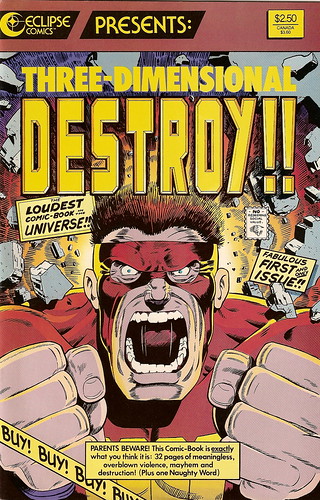
Destroy! #1
by Scott McCloud (Eclipse Comics, 1987).

I'd read about this comic before, probably in McCloud's Understanding Comics or Reinventing Comics, but I had never read it, so when I saw it on Ebay I snapped it up. It is pretty crazy. A full-fledged rampage of mayhem through Manhattan. In 3-D! That's right, it comes with 3-D glasses and everything. Hopefully you'll be able to see any of these images that I post. If you bought Superman Confidential #1 from a couple weeks ago, you can use those annoying 3-D glasses that came with the Heroscape ad.

Anyway, I think at the time McCloud had heard complaints that comics were too violent, so he decided to prove the critics right and make the most mindless, destructive, violent comic he could. I believe Alan Moore said later that he started the 90's a few years early. However, this wasn't the 90's yet, so it's not quite as dark and nihilistic as some of those comics would get. I dunno, maybe there were some really nasty comics back then, but this doesn't seem to compare to the likes of Darkchylde or Purgatori. Of course, the violence in this is not sexualized (not even a ripped costume on the male combatants); it's merely destructive (I'm going to have to hit a thesaurus and find some synonyms for destroy if this goes on for long). And, I think McCloud was going for a strange dichotomy between the innocence (or is it just two-dimensionality?) of the characters in most superhero comics and the violent, destructive fights they have.

So, to synopsize, the comic is pretty much just a fight scene between two superheroes, the Red Basher (that's him on the cover), and Captain Maximum. The Basher has apparently gone nuts, and is charging around New York, smashing everything in his path, and screaming "DESTROY!!" over and over. We learn later that he might be crazy about being rejected by Captain Maximum's girlfrien
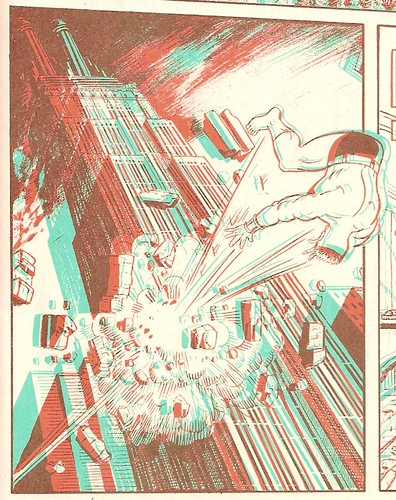
d, Babs, but the text never really says. Soon enough, Maximum shows up and tries to calm him down, but Basher just punches him, which leads to the two of them pounding each other throughout Manhattan, past (and often through) many famous landmarks. For instance, here's a shot of the Basher bouncing off the Empire State Building:


(By the way, you can click on these images to see a larger version that probably looks better in 3-D)

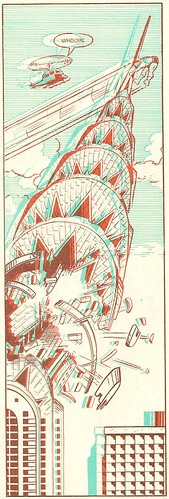
Later, the Basher is punched near the Chrysler building (which McCloud appears to be a fan of), and he grabs onto it:


Then he uses it as a baseball bat:


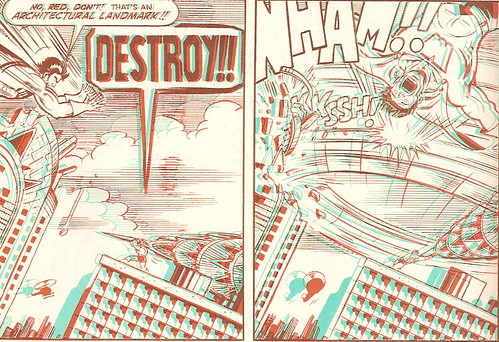
This sends Captain Maximum flying out into the harbor, and here's his comeback:


So, as you can see, some people might be uncomfortable reading this. I think somebody would pause before making this comic today, but I'm sure at the time nobody imagined the tragedy that would later happen in New York. Even so, it's a little disturbing seeing all the mayhem and thinking about how many people would really die in an event like this. And here's the kicker:


That's what happens after the Basher hits Captain Maximum so hard he flies all the way to the moon, then Max jumps back to earth and lands a reentry-speed punch on him. That's right, complete destruction of the city. Pretty much. Of course, everyone gets up, the Basher regains his senses and agrees to be taken in, and the police chief says, "Well, at least nobody was hurt!" So I guess this exists in that Incredible Hulk realm of comic fight, where the authorities managed to evacuate the city and nobody was injured. Pretty silly, but really quite enjoyable to read.

I have to mention the art, which is a good Kirby-style level of superhero violence and destruction. And the 3-D really adds to the experience, for the most part. Some of the effects just make the pictures look weird, like people's faces are floating in front of their heads. I wonder if 3-D technology has improved at all in the last 20 years, and if they could make it look better today with computers. But much of the destruction looks amazing, like the rubble is flying right off the page. There's one two-page spread (at the center of the comic) of four panels with the two "heroes" pummeling each other that I really liked. There were rocks and stuff flying all over the place, and one of the rocks looked like it was floating over the staple in the spine. That made me laugh.

Another thing that struck me was the specificity of the geography. The police who are watching often narrate the action to each other over the radio, saying things like, "Holy Toledo, Chief! The Red Basher just punched Captain Maximum ten blocks north, right through City Hall! Now he's coming out over Washington Square! I'll be damned! Still going! Just took out some trees and -- wait...I lost sight of him...no! Here he is! Just piled through the Flatiron Building at 23rd and -- Wow! That's another eighteen blocks!" McCloud even includes a map of Manhattan on the inside back cover, showing the path of destruction and commenting on which comics company headquarters would be destroyed. Weird.

So, I would recommend getting it if you like ridiculous destruction that pretends nobody actually got hurt, Jack Kirby-style superhero brawls, 3-D comics, or Scott McCloud.