Showing posts with label webcomics. Show all posts

Saturday, May 11, 2013

C2E2 2013: Some comics which were acquired

Manta Dad #1
By Chad Sell
Self-published


Chad Sell's Manta-Man webcomic is a fun goof on superheroes, starring a guy with the semi-useless power of being able to turn into a flying manta ray, and following his adventures as he gets involved with ninjas, monsters, homophobic closet-case rivals, and his supervillain girlfriend who constantly picks fights with him as a form of foreplay. It seems like a fun lark for Sell, allowing him to throw whatever crazy ideas he has onto the page/screen, but as the series has progressed, he has built up an interesting world full of crazy concepts and well-drawn relationships between the characters. And now, with the spinoff/flashback series Manta Dad, he's developing things further, going back to detail the early years of Manta-Man, as he accompanies his Freddie Mercury-like oceanographer father on a sea voyage that involves as much, er, canoodling with his beefcakey documentary crew as it does actual filming of weird sea life. When the kid's shapeshifting abilities are revealed to his father, the two of them end up bonding in a surprisingly touching manner, although the time Manta Dad spends with his son ends up causing some jealousy issues with the rest of the crew, setting the stage for more conflict in future issues. The extra space that a full issue provides (as opposed to the one-strip-at-a-time pace of a webcomic) lets Sell play out the story at a nice pace, resulting in a wonderful slice of nicely-illustrated character work that also includes plenty of snappy dialogue and cool creatures like shadow sharks and robo-whales. Sell is a fairly new talent on the comics scene, but this comic demonstrates that he's improving his skill at an impressive pace, and I'm excited to watch and see as he continues to create quality work.
-----

Solution Squad #1
Written by Jim McClain
Art by Rose McClain
Self-published


It seems mean to complain about a well-meaning comic like this, which stars a team of superheroes who fight crime using math-based powers with the intent of educating the (presumably youthful) reader, but it's just so darn square. The characters and their designs are incredibly generic, the plot is a goofy bit of fluff involving a villain robbing a museum and capturing the heroes in an easily-escapable death trap, and the story is structured in the least imaginative way possible, with an especially hokey introduction to all the characters via a two-page spread that consists of images of each person surrounded by lengthy captions that explain everyone's names, powers, and relationships (a scene which seems especially superfluous given the Official Handbook of the Marvel Universe-style profile pages in the back of the issue that provide every possible detail you would ever need to know about each character). That said, it's hard to fault the comic too much, because whatever its shortcomings, it's really sincere, seeming to meet its goal of providing a reasonably entertaining story that educates about simple mathematical concepts (this issue's being the prime number sieve). The art is clean and crisp, and while the characters are generic, there's still an effort made to create a racially-diverse team made up of people that are more than just names and basic traits (the time-traveling "cool guy" from 1984 is a nice touch, providing catch-phrases and attitude but having a reason for seeming kind of dorky). It's probably not going to set the world on fire, but as a cute educational concept, it might be something that kids could be interested in. That's something, right?
-----

Bird Witch #1
By Kat Leyh
Published by Yeti Press


Well this is just charming. It's an all-ages comic about a young girl witch who, while exploring an enchanted forest, makes friends with a tengu, and the two of them cavort around the woods, racing and exploring and showing off their respective magical powers. Kat Leyh's art is gorgeous, consisting of deceptively simple linework and lush colors that really make the setting come to life. As a first chapter, it's wonderful, an enthralling chance to get to know some cute characters as they begin their friendship, with some ominous hints about the magical dangers they might face providing the impetus to seek out future chapters. It's a lovely little book, enough to make Leyh a talent to watch closely. I'll be sure to pick up the other available issues in the series the first chance I get.
-----

Cat-LE Drivers #1 (Free Edition)
By Kevin D. Bandt
Self-published


Whether you're perusing the selection in a comics convention Artist Alley or clicking randomly through some of the thousands of webcomics, you're bound to come across something like this, a comic that's trying to be offensive and edgy, but isn't really all that different from its peers. Kevin D. Bandt's big inspiration for grossing people out here is to center his comic around the idea of eating cat meat (although it's tempered by said meat coming from genetically-modified felines in a future where beef is scarce), which is probably supposed to be horrifying, but it's just about the only unique aspect of his post-apocalyptic story, and everything that surrounds it is highly generic, from people having to cross a wasteland ruled by bandits and vampires, to "badass" heroes with an attitude, to gross villains who swear a lot (using bleeped-out symbols, of course) and sexually harass treat female underlings. The story itself is put together kind of amateurishly as well, beginning with a caption reading "Yesterday" without ever specifying when "today" is supposed to take place, and having characters state their motivation outright (a character suddenly announcing that she used to have a drub problem is especially egregious). Even the title itself is a tortured bit of wordplay, the term "Cat-LE" meant to be pronounced like "cattle" with the "LE" standing for "Luxury Edition". The black-and-white art in the free version of the comic is a bit muddy, but the color pages which can be seen online do look much better, and while the artwork is nothing special, there are occasional panels with some pretty good character art and expressions. Bandt does seem passionate about what he's doing, including an editorial about how the documentary PressPausePlay inspired him to put out a free version of the comic in order to get his ideas out to people, so it's commendable that he's trying to be creative, but he's got a ways to go before he can rise above the massive cluster of mediocrity that is all to easy to get lost in. Here's hoping he doesn't quit before he gets there.
-----

The VIP Room
Written by Amy Chu
Art by Silvio DB and Cabbral
Published by Alpha Girl Comics


This is an interesting little story about three seemingly-unrelated characters who suddenly appear in a dining room, unsure how they got there or what they are supposed to do next. Is this some version of the afterlife? What is their connection, and is there any way to escape? As they converse, they slowly learn enough details about each other to figure out at least a little bit about what is going on, eventually leading to a Twilight Zone-ish reveal that makes for a fairly satisfying ending. It's kind of slight, but it's a neat little riff on the sort of mysterious, possibly supernatural morality tale that that show made famous, and the moody artwork gives it some nice atmosphere. I could do without the one-page epilogue that goes over the top with the premise, almost turning it into a bit of wish-fulfillment comeuppance highly recognizable villain, but overall, it's not a bad little comic.

Thursday, March 7, 2013

God Hates Astronauts: An intimate conversation with Ryan Browne


I've been a fan of Ryan Browne ever since I discovered his hilariously insane superhero comedy webcomic God Hates Astronauts, and I'm excited to see his star continue to rise as he develops his unique sensibility of absurdist comedy, mockery of superheroes and other comics tropes, and unsettlingly detailed artwork. After the success of the Kickstarter campaign for Blast Furnace, his other webcomic, he recently launched another Kickstarter campaign for a hardcover collection of God Hates Astronauts, and it was funded within 24 hours, which allowed for the addition of a number of stretch goals and reward levels that reflected his strange comic sensibilities. It's great to see him receive some recognition for the years of work it took to bring this project to completion, and as the campaign marches toward completion (with 12 days remaining, as of this writing), I contacted Ryan with some interview questions:

I love your take on superheroes, which pushes them into full-on absurdity and pointless violence. Is this at all meant to be a comment on or reaction to the current state of the "mainstream" comics industry, or is it just your own take on the genre?

I think it's just a natural avenue for comedy. The ridiculous costumes, the celebration of violence and the male power trip are all hilarious subjects to me. I almost couldn't do anything serious with a spandex clad he-man... almost.

According to the Kickstarter description of the series, the backstory involves NASA hiring the characters to stop farmers who launch rockets into space, but I don't think this is ever explicitly mentioned in the comic itself. What happened there? Was this something from an early script or the "development" stages of the comic, when you were creating the characters, and it ended up getting pushed into the background?


No, it's an attempt to describe the actual "plot" of the book. There are a couple of scenes in the book that mention this mission objective, but honestly as the series was going on, it became the joke that no one was doing their job. You will see the team doctor, Dr. Professor, complain from time to time that people aren't addressing the issue at hand.

How much of this series is you cramming all of your personal obsessions (or just stuff that you like to draw) into the story, like old-timey wrestlers, owls, animal-people, or mustaches?

100%. I'm super happy that people like my jokes and drawings, but honestly I'm just doing it all to make myself laugh.

How much of the comic is improvised? Did you have the plot structure laid out beforehand and inserted jokes and funny scenes as you thought of them? Did you have certain moments in mind and tried to fit the story to accomodate them? Or did you have the whole thing scripted out in your head exactly as it ended up on the page?

It's largely just certain moments and ideas that pop into my head. I then work to figure out how they are all intertwined, Seinfeld-style. Some things just fall into my lap—like one character losing his head, and another character who is just a head which then equals them combining forces. My best skill as a writer is making things connect story wise. I always hesitate to say that I am a writer because me can't not talk English no good. I think of myself as more of a storyteller.

Do you find yourself "pushing the envelope" and trying to come up with the most absurd or profane thing possible? For instance, the titular "head that wouldn't die", which I would call the book's signature visual, is rather viscerally disgusting, and you seem to enjoy coming up with nastier and nastier things to do with it. Do you find it a challenge to make things gross and offensive, but also really funny? Or does that all just come naturally?

I don't really try to gross people out. I don't want people to be uncomfortable when they read my stuff, I try and write things that are more ridiculous in nature than disgusting. Mainly I want people to laugh at how stupid and nonsensical everything is in the GHA world and yet how deadly serious everyone is about it.

You've got an affinity for drawing animals (and animal-human hybrids, and bizarre combinations of animals, etc.) and making them really expressive. Do you do research, consult photos, or practice drawing animals, or is this something you're just naturally good at?

I usually do research an animal the first time I draw it but after that I just kind of wing it and make it my own. That's why Blue Grass at first looks like a cow, and then a horse, and then a donkey, and then a donkey-cow-horse. Obviously, I love drawing animals, but usually they are the Ninja Turtle style of animals. 

Who or what would you say are your influences, whether in the world or comics or outside of it? You pay pay homage to Jack Kirby via sound effects, and it seems like the superhero deconstruction of people like Adam Warren or James Kochalka might be an inspiration, but are there any others that helped shape your style of art and writing?

Geof Darrow and Rob Schrab are both pretty influential to me. I think Big Guy [and Rusty, the Boy Robot] and Scud damaged my brain in some way at some point and I've never recovered. A lot of the other inspiration comes from film and television. I think The Simpsons is my biggest inspiration, as well as Spaced, Upright Citzens Brigade, and the Coen Brothers' films.

How did you manage to round up such an array of talented guest artists for the hardcover collection? Are they all friends of yours, or did you have to bribe/threaten/blackmail some of them to get them to participate?

Everyone in the book is either a friend or a fan of GHA. It did take a lot of favor trading to get people involved and a ton of work managing and making sure everybody stayed on task. The end product is something that I'm very, VERY proud of.

What's next for you? It seems like you're dipping a toe into the "big time" with Smoke and Mirrors and guest art on The Manhattan Projects; is there anything else coming down the road, or are you going to keep doing personal projects like GHA and Blast Furnace? Please don't tell me you're going to get stuck drawing Green Lantern Corps or something...

Oh man, Green Lantern Corps would be awesome!!! Currently, I am drawing a second issue of Manhattan Projects and after that I will be taking over for Riley Rossmo full-time on Bedlam. It's exciting to see that things are finally starting to work out, and I hope people will be patient while I work on other stuff than GHA and Blast Furnace for a little while.

Now that I think about it, Green Lantern Corps, or some other book featuring a bunch of weird aliens, could be a neat project for you, especially if you were allowed to add some humor and as long as you didn't have to just draw a bunch of monochromatic guys shooting lasers at each other. Would you be interested in doing something like that, illustrating a well-known character or franchise? Do you have any characters that you would love to get your hands on? Or would you prefer to stick to your own creations or other creator-owned comics?

HAH! I don't think anyone would let me touch their characters! I'd love to at some point get a chance to play in the superhero world like Seth Fisher did, but I need to get a lot better first to allow that to happen. Also I'm pretty sure I'd have to tone down the offensiveness a great deal.

You've got a theme song for the comic as part of the Kickstarter, but have you ever considered doing an audiobook version, considering the "suggested voice talent" that you list for all the characters? Would you want to try to record an audio track of yourself or others doing imitations of the various voices, or is that something better left up to the imagination?

I'm pretty sure I couldn't do it justice. Maybe if the Kickstarter breaks the ten-million dollar mark I can spend it to hire all the actual actors to read their rolls. Wouldn't that be something? Come on people! PLEDGE!


Tuesday, February 19, 2013

Help a brother out: Salgood Sam deserves to finish Dream Life

I've been a fan of the artist Salgood Sam (a.k.a. Max Douglas) for a few years now, at least since reading the excellent graphic novel Therefore Repent!, for which he provided the art. For the last couple years (at least), he's been working on a book called Dream Life: A Late Coming of Age, which features more of his stunning artwork, and he's on the home stretch, hoping to have it finished and printed in time for the Toronto Comic Arts Festival in May 2013. In order to make that goal, he's asking for some help, so if you've got any funds to spare that can be put toward quality comics, please drop by his site and buy something from him. He's got all sorts of neat stuff for sale, including original artwork and commissions, and even the art from an unpublished Ghost Rider 2099 story written by Warren Ellis!


Right now, you can get a free sketch with any order over $40, but even if you don't want to spend that much, you can pick up digital copies of the aforementioned Therefore Repent! or his anthology series Revolver. Every little bit helps, and if we can do anything to assist in getting artwork like this out into the world, I think this Internet thing can be called a success.

Wednesday, April 18, 2012

C2E2 2012: Talents deserving of further consideration

One of my favorite aspects of comics conventions is that no matter what else happens, I always discover creators and comics that I didn't know about before and want to learn more about. Here's just some of what was to be had at C2E2 this year, and I'm sure there was plenty more that I completely missed.


Katie Shanahan has a wonderfully cartoony style, full of energy and humor. I really need to check out her book Silly Kingdom, as well as her contributions to the anthologies Cautionary Fables and Fairy Tales and Womanthology: Heroic.


The work of Outland Entertainment looks pretty cool, including the series Windfall (pictured above) and Ithaca. I talked to Jeremy Mohler, who does layouts, lettering, and coloring, working alongside other artists in the "collective" on what looks to be quality comics. He and I share a lot of opinions about webcomics, and comics in general, so it should be really interesting to see this work develop. I expect great things.


Scott Brown and Enrique Rivera's Bananas and Binary seems like a fairly standard webcomic (it stars a monkey and a robot, of course), but I do like Rivera's cartoony art style, and he had some pages of a proposed graphic novel on hand that were pretty great. I'd love to see that finished at some point, but this series looks pretty entertaining for now.


I liked what I saw of Blunderbuss Wanderlust, an educational book about the adventures of the time-traveling Coloner Victor Von Vector by David Shapiro and Christopher Herndon, who also have several other nice-looking books out under their Craigmore Creations label.


Surreality, a new webcomic by Caleb King, Carla Wyzgala, and Andy Evans, also looks really gorgeous. It appears to be a slice-of-life story with a lot of nerdy references, and maybe some magic or something? It launches on May 8, so check it out.

And for other stuff I thought was interesting, but might or might not turn out to be ready for prime time:

Mike Roll's art on the Apooka series of books, which star "The World's Most Adorable Zombie", is really cute, with a color palette that reminds me of Frank Espinosa, but I'm not sold on the stories themselves, and I've been over the various iterations of zombies for a few years now. Still, it's worth a look

I like the style of Dave Wheeler and Samir Barrett at Mindwave Comics, although I don't know if their actual comics are really up my alley.

The Vescell series from Image sounds pretty cool, a sci-fi concept involving the transfer of people's minds/consciousnesses between bodies. The art seems like it might be a bit computery, but I'll check it out, given the chance.

I don't know if the webcomic Keeper, by Geoffrey D. Wessel and Jeff Simpson, is any good, but it's about a soccer goalkeeper who is also a serial killer, and it has some nice painted coloring.

I kind of like the art of Michael Arthur, even if it seems like it might sink into the bog furry-oriented perviness. He's got an expressive style that's just a bit weird, in a good way. Oh, and it looks like he also contributes to my friend Noah Berlatsky's site The Hooded Utilitarian!

I wouldn't mind checking out more of Modern Tales of the Future, from Dread Arts Company.

Antonio Romero has kind of a cool style, combining dense cross-hatching and scribbly shading with stark, woodcut-style imagery. I'm not sure if I really get what's going on in his comics, but they certainly look unique and worthy of further investigation.

Ryan Dow's Introspective Comics looks to be a cute autobiographical webcomic in which he regularly converses with a little apparition of Buddha. That's nice.

Gavin Smith has a really polished, realist style that could turn into something amazing, given practice. I'm not so sure his comic Human City, which is some sort of post-apocalyptic, mutant-fighting thing, is for me, but there's some cool stuff going on in the art nonetheless. He's one to keep an eye on.

Nidhi Chanani apparently just does illustration, rather than comics, but her art is gorgeous, well-composed images featuring simple characters and beautiful coloring. I could look at it for hours.
-----

That's far from everything I saw, but even this taste is a lot to process. I look forward to following these creators and seeing what they do next.

Tuesday, February 28, 2012

Webcomics shoutout: Hey, have you guys heard about Kate Beaton?

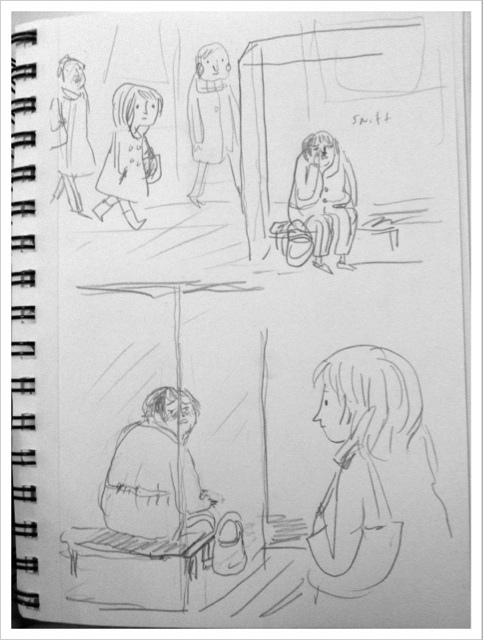
Yes, yes, I know, everybody is always talking about Kate Beaton, and how great she is, and I completely agree. If any web-cartoonist deserves the acclaim, it's her. But what I want to talk about isn't her most visible stuff, the history/literature/whatever comics she "officially" posts on her website, but the more off-the-cuff, diary-style stuff she posts on Twitter. (EDIT: of course, when I go to her site, I see that the strip I'm talking about has been posted there too. Whoops.) That's one of the great advantages of our current information age, at least for art-process junkies like me: artists being able to share their napkin doodles, life drawings, sketchbook pages, and random nonsense with the world. Beaton's output at this sort of thing is unceasing, and now that she has scaled back the posting schedule of her regular work, it's one of the few places to see her new stuff on a regular basis. I love the way she captures interesting moments or scenes from her life, sometimes just transcribing scenes on paper before they disappear in the mists of time and memory, like this scene of an old woman crying at a bus stop:


And other times exaggerating events and turning them into running jokes, like this super-cute polite kid who she imagines going around doing good deeds:


But I especially love the strips in which she interacts with her family. The way she depicts her parents as slightly clueless and eccentric, but good at heart and full of love toward their children, it ends up being a beautiful reciprocation of that familial affection, a depiction of the willingness to accept those closest to you despite (or because of) their occasional weirdness and aggravating tendencies. This recent strip in which she remembers building a birdhouse with her dad is wonderful for all sorts of reasons (the body language, especially of present-day Kate climbing a tree; the dialogue that manages to relate a certain accent and cadence even if you haven't heard it spoken; the wide-eyed, open-mouthed cuteness of lil' Kate), but what really gets me is how the depiction of her dad in the flashback is so obviously the same character that I've come to know and love (which is weird to say, since he's a real person that I've never met, but I do love when he shows up in her comics), but at an earlier time in his life. In the present day, he's usually depicted with a sort of gruffness communicated through slouched shoulders, a bushy moustache, and opaque glasses that somehow also function as a furrowed brow:


But in the past, he's recognizably the same guy, just younger:


Without glasses, his face seems more open, his dotted eyes lifelike and active. His moustache is still there, but smaller and neater-trimmed. His hair seems darker and fuller. Even his body seems bulkier, a subtle way of showing how parents can seem so large when you're a child, but so small once you're grown. The whole thing is a marvel of subtle storytelling, a figure pulled probably unconsciously from Beaton's memory, but one that even complete strangers like me find familiar.

That's what I love about Beaton's work: it seems like she just has to get certain moments, stories, thoughts, and memories down on paper, even if they're not fully fleshed out, but she's good enough that she can capture so many details and nuances of her life and what happens around her without making a big deal about it or making it seem like it takes a lot of effort. She's a marvel, an ever-increasing talent and a cornerstone of the modern comics scene, and her apparent need to keep making art and sharing it with the world benefits us all.

Tuesday, January 3, 2012

Webcomics shoutout: The Last Romantic Anti-hero

Billy Dogma: The Last Romantic Anti-Hero
By Dean Haspiel
Published online at Trip City


I never feel like I fully understand any of Dean Haspiel's "Billy Dogma" comics, but I certainly find them fascinating. They seem to be written straight from the subconscious, allowing Haspiel to pour his emotions straight onto the page (screen?), examining modern life through the lens of a bombastic action comic filled with honest, completely non-self-conscious romantic feeling. This installment sees the hero and his girlfriend, Jane Legit, trapped in a post-apocalyptic wasteland apparently caused by the narcissism of a society obsessed with "social" technology, deciding to fix things through the power of their explosive lovemaking. I think. It can be hard to tell, what with all the goofy symbolism and over-the-top weirdness (there's something about destructive satellites labeled with the word "AMGOD", which seems to be both a comment on man's self-centeredness, or maybe just "Dogma" backwards), but the centerpiece of this story is a trip through Billy and Jane's romantic history, which is where the series usually shines. The larger-than-life style Haspiel uses here takes the ups and downs of a love affair and gives it seismic, world-shaking importance to externalize the feelings of the participants.


It's lovely work, the kind of comic that invites immersion and interpretation, lingering in the subconscious and grabbing hold of universal emotions to add resonance to conflicts shared among all of humanity. This seems like the most personal work of Haspiel's career, but that relatability is what makes it so great.

Monday, January 2, 2012

Webcomics Shoutout: Blast Furnace

Blast Furnace
By Ryan Browne
Published online, but also available in minicomics format


Full disclosure: I'm friendly with Ryan Browne "in real life", so feel free to take the effusive praise directed his way with a grain of salt. I do really dig his comics though, really!

Ryan Browne's God Hates Astronauts is a comic masterpiece of a superhero parody, but he's got plenty more goofy humor to share with the world, so he recently set out on a quixotic quest to create a year-long webcomic off the top of his head, posting new pages every weekday, ostensibly following the adventures of the eponymous flaming-tied, handlebar-mustached master thief, but often charging off on random tangents, flashbacks, fantasies, and non sequiturs. In fact, those non-main-plot bits seem to have taken over the story, with a good deal of the comic so far being devoted to several nested flashbacks involving an outlaw owl, the naive bear she drags into a life of crime, and an Indian warrior named He Who Looks Like A Horse But Is Actually A Hideously Deformed Man, and also a separate plotline involving a pair of villainous henchmen who resemble the turtle and pirate from old comic book "Can you draw?" ads.


Blast Furnace himself has spent most of the comic killing or maiming everyone he comes across, making enemies and getting involved in ridiculous plots, possibly all leading up to a climax that ties everything together, if Browne can manage to wring a semi-coherent throughline from all this weirdness. No matter; it's all hilarious stuff, with Browne unleashing all the nonsense that's apparently cluttering up his head, including silly sound effects, horrifically funny violence, talking animals, barely-covered nudity, and goofy concepts like a giant businessman robot made of other combined businessmen robots, all delivered at a breakneck pace, concepts and jokes spilling onto the page at such a rate that nobody, apparently even Browne himself, have any idea what's coming next. That's webcomics heaven, if you ask me.

Thursday, December 29, 2011

Webcomics Shoutout: Curio

Since posting has been light lately (insert standard excuses here), here's an attempt to get the writerly juices flowing:

Curio
By Mai K. Nguyen
Published online


It's always impressive to see the quality comics that are posted online for free reading, making for a great avenue to discover new talent. Mai K. Nguyen appears to be one such undiscovered gem, if the pages that have been published of her comic Curio so far are any indication of what she can do. With fewer than two chapters of what could stretch into a long-form masterpiece posted so far, she has already established a likable character, run her through an emotional wringer, and nudged her into a fantastical world full of gorgeously-designed supernatural detail.


It's beautiful work, seeing an almost-ten-year-old girl named Vivi struggling with the ramifications of her mother's sickness, frustrated that nobody believes she is old enough to handle the truth of the situation, and desperate to regain a gift which her mother had just implored her not to lose, thrust suddenly into one of those fantastical haunted houses which are bigger on the inside than the outside and granted mystical knowledge and a quest to regain not only her own property, but the soul of a friendly ghost, and probably also defeat an evil wizard of some sort. It's fast moving stuff, but Nguyen makes it work beautifully with her clear-lined designs and gorgeous coloring, lending an appealing energy to the story that spurs one to keep on clicking to see what's coming next.

Her character design is something special too; Vivi is a marvel of expression and childlike vulnerability, her thin legs and rosy-cheeked face protruding from a bulky sweater and scarf, unkempt hair topping her frame like a cute mop, large eyes and mouth conveying sadness, fear, anger, and determination as only a kid can.


The story is only just getting started, with Nguyen hinting at much fantastical adventure to come, but with this beginning, there is every reason to expect a satisfying romp that doesn't spare the emotion. I can't wait to read more.

Tuesday, August 30, 2011

Little Nothings: I think they're somethings

Link: I forget who, but somebody pointed out the cartoonist Seamus Heffernan to me, specifically the excerpt from his soon-to-be-released Xeric-funded comic Freedom, which is excellent, and has me really wanting to read the whole thing. It's historical fiction, set prior (and maybe eventually during?) the American Revolution, and just the few pages previewed there demonstrate a real facility with storytelling. This guy is someone to watch.


Little Nothings, volume 4: My Shadow in the Distance
By Lewis Trondheim
Published by NBM


Lewis Trondheim is a pretty great cartoonist, and his ongoing series of journal comics is a wonderful demonstration of his skills. He manages to capture interesting, humorous moments from his life and travels and lay them out in panel form such that the essential comment, conversation, observation, or experience is perfectly communicated. Considering that most of the experiences being related here involve world travels, pretty much every page here is interesting and enjoyable, with Trondheim covering a wide variety of experiences, from travel and sightseeing to conversations and human observations. It's wonderfully done, just from a writing perspective, with the cartoonist's humor and particularly French viewpoint on life shining through even in translation.


And then there's the art, which is as much of a draw as the stories being told, if not more so. Trondheim starts from a goofy position, depicting himself as a sort of bird-man, and everyone else as some sort of animal-person, which is a delightfully odd conceit, but works quite well in terms of reader identification. Once you accept that Trondheim's version of reality is populated by strange animal-human hybrids, it's fun to see what sort of creature will pop up next, and they all seem to fit together as normal people, found wherever one travels.


And since those travels take Trondheim all over the world (he visits Utah, Las Vegas, San Francisco, Argentina, Angouleme, Germany, and the African island of Mayotte in this volume), he gets plenty of opportunities to draw the sights, which end up being beautiful representations of reality, grounding the goofy anthropomorphism in the real world and, along with the relatable details (that is, irritations) of travel, emphasizing Trondheim's feet-on-the-ground experiences. Trying to go off-roading in a rental car in a Monument Valley desert, viewing the Atlantic and Pacific oceans simultaneously from Tierra del Fuego, and remarking on the way Prague transcends its tacky touristy-ness from eight feet up are just a couple of the many moments that are wonderfully captured here.

And yes, the art which delineates all of this on the page is gorgeous stuff, fluid linework that manages to wring all manner of expression out of animal eyes, beaks, and snouts, and especially the absolutely beautiful watercolors that give such depth and texture to everything, especially the breathtaking skies:


The coloring also works excellently to separate Trondheim's borderless panels from each other and make them stand out on the page, as well as to emphasize his own individual character within those panels. There's an interesting recurring motif in which the colors encircle Trondheim, yet drop out in the center, leaving the area around him uncolored to emphasize a particular moment, or perhaps to isolate him against other people:


And I love the way the colors often fill a panel boldly, centering attention on the important details in the middle, but fade at the edges, seemingly depicting the fuzzy periphery of Trondheim's memories:


It's a beautiful-looking book, and while it's not exactly groundbreaking or "important" in what it captures, it's a wonderful example of the autobio/journal comic, capturing interesting, funny moments in the life of somebody who is so good at relating that sort of scene, whether real or fictional. After four volumes, one supposes Trondheim could keep doing this in perpetuity, and if he does, the comics will almost certainly be worth reading.

More examples from the book can be found at NBM's blog.

Thursday, August 25, 2011

Shorties: Porn, Teens, Birds, and Elephants

Chester 5000 XYV
By Jess Fink
Published by Top Shelf


Well, this is certainly a pornographic comic. Yep, it's a full-on, hardcore, penetration-and-ejaculation sex-fest, and one that does its job, at least when it comes to stimulating arousal (TMI?). But luckily, it's a really good story as well, full of nice, stylish artwork, humor, and character development. Plus, it's pretty unique, being a steampunk story about an inventor who builds the eponymous robot to pleasure his wife so he can have more time in the lab, only to see her and Chester fall in love, leading to jealousy and retribution, all with sexy complications.

As naughty as all this is (and I can't emphasize the naughtiness too much, with most of the book being taken up by sex scenes that last dozens of pages), it's great to see Jess Fink's style unleashed, as she distorts her figures in orgasmic pleasure and surrounds them with expressively decorative panel arrangements, but still making every emotion and action perfectly clear while keeping the story completely wordless (outside of sound effects, of which "Vert!" is an unforgettable addition to the lexicon). It's a lovely object, and while it's not for kids (or prudes), it's a really fun read and a great example of the unlimited potential of comics.

The comic can be read online at Fink's site, but I recommend the physical version.
-----

Lucille
By Ludovic Debeurme
Published by Top Shelf


Maybe it's the European tradition this comic comes from, but it takes a little getting used to. The borderless panels aren't laid out in a consistent manner, so each page has a unique arrangement of cloudlike images that do read intuitively, but are definitely different from the comics norm. And within the panels themselves, the thin, somewhat bobble-headed characters live lives of quiet desperation, such that there doesn't seem to be much going on for a fair portion of the story, at least at first. But sticking with the story yields rewards; French cartoonist Ludovic Debeurme quickly establishes his teenage characters, an anorexic girl and a somewhat delinquent boy with an alcoholic father, then, after letting readers cringe at their awful lives for a while, throws them together and lets the inevitable young romance blossom.

While it's very cute and romantic and everything, what's nice about the book is that it doesn't end with their escape from their lives. They quickly and believably connect (Lucille's appreciation of Arthur's goofy teenage antics makes perfect sense for someone who has been forced into an environment of life-or-death seriousness), and it does seem like running off together will solve all their problems, but Debeurme sticks with them and shows that emotional issues don't instantly disappear when one runs away from them, and maturity doesn't instantly bestow itself on one either. Lucille still struggles with anorexia, and Arthur is still antisocial and prone to anger, and while their attempt at a new life is appealing, it seems doomed to fail. Interestingly, the book ends on a "to be continued", so while the story does come to something of an end, Debeurme evidently still has more to tell about these characters. This thick volume is a quick read, but it feels pretty substantial, and it's nice to see such confident storytelling in a style that isn't often seen on this side of the Atlantic.
-----

Reunion
By Pascal Girard
Published by Drawn and Quarterly


Pascal Girard is kind of a jerk, but at least he recognizes it. Or maybe he's just exaggerating in his self-deprecation, portraying himself as an arrested adolescent still mired in popularity contests at his ten-year high school reunion. Either way, he comes off as a doofus who obsesses over his perceived coolness (both in the past and the present), starts exercising just so he can lose weight to look good to his old friends, stalks girls he used to have crushes on (even though he currently has a girlfriend), cheaps out on the beer he brings to the reunion, attempts to ingratiate himself by bringing along some pot, and almost skips out on the whole thing, even after all his frantic preparations. It's not a pretty picture, but it is a funny one, with Girard making himself look like a fool, capturing his uncertainty and worriedness through the jittery lines of his artwork and delivering plenty of comeuppance to himself as he constantly fails in his attempts to make himself look cool. It's an amusing portrait of a near-universal experience, a relatable depiction of the way returning to your roots can make you fall into old roles, even as you are trying to demonstrate how you've risen above them. One comes away from the book wanting to spend more time with Girard, even as he's endeavoring to make himself look like the worst person in the room.
-----

Elephant Man
By Greg Houston
Published by NBM


Man oh man, Greg Houston's comics are hilariously weird and silly, full of grotesque imagery, funny names, dumb jokes, random plots, and constant absurdity. This one takes the form of a superhero parody, but the parodic aspects are kind of weak and halfhearted (Stupid codenames! Corny catchphrases! The old "nobody recognizes Superman when he wears glasses" gag!), with the real appeal being the exuberantly odd art and humor, the book full of ramshackle storytelling that seems to consist of whatever Houston felt like drawing next, scratchy lines cohering to form crazily distorted characters (even those that are supposed to be good looking sport jutting foreheads, squinty eyes, protruding teeth, and greasy hair), word balloons and captions full of irascible, rambling text, and any chance for silliness being jumped on and flogged to exhaustion. It's a pretty unique sensibility, and Houston certainly seems to be having a ball coming up with funny concepts like a villain who is a walking punchline, being the fused-together body of a Rabbi, a priest, and a duck, or a group of girl vigilantes who sport baroquely detailed hairstyles, as if the hairstylists of the court of Louis XIV worked on the cast of Jersey Shore. It's a stupid comic, but purposefully so, with the "hero" apparently attaining his fame purely out of pity, the villains being incompetent morons who only commit crime out of jealousy, and pages filled with wonderfully detailed grime and ugliness. This is a highly entertaining bit of nonsense, and I wouldn't have it any other way.
-----

What I Did.
By Jason
Published by Fantagraphics


Of the three books collected in this volume, Hey, Wait... is a really evocative portrait of how childhood experiences can affect one throughout his entire life, and The Iron Wagon (which adapts an early-twentieth-century Norwegian novel) is a pretty good murder mystery that makes good use of Jason's deadpan style, but it's the middle entry, Sshhhh!, that really sticks with me, immediately jumping to the top of my favorites among the cartoonist's works. It's a silent comic, making excellent use of Jason's facility with pantomime as it follows a bird-man throughout his life, taking an absurdist approach to events that somehow makes things like a baby arriving via mail or a skeleton following the main character around seem relatable and poignant. The universality of the circumstances that Jason depicts is what is so striking here, so that even though the character is inhuman and inexpressive, we recognize things like the acceptance of death's inevitability, the loneliness of lost love, or the combination of pride and sadness felt when a child leaves home. Being one of Jason's longer books, the chapters of the story accumulate until the bird-man becomes a sadly human figure, somebody scrabbling to maintain his unique person-hood under the assault of life. It's sad, wonderful, exhilarating work, a great example of how amazing Jason is at what he does, and how nobody else can do it like him.

Tuesday, August 16, 2011

Wizard Chicago 2011: Comics to read

Yes, comics were acquired at the recent comic convention, and here are some words about them:

God Hates Astronauts #1-2
By Ryan Browne


The superhero genre has pretty much become a dead end, an endlessly recycling series of convoluted plots and ridiculous conflicts, with even the "innovative" or "satirical" seeming tired and played out by this point. If there's anything left, it's full-on absurdity, and that's what Ryan Browne is doing with this webcomics-turned-print series, to hilarious effect, making his characters profane, moronic, squabbling, violent doofuses with stupid powers and ugly costumes, fighting over petty things and doing nothing much of any worth or positivity. It's laugh-out-loud funny, full of silly gags, jokey sound effects (a personal favorite is "Fucked!"), and nonsensical details that are funnier for their lack of emphasis, like Dr. Professor, the moustache-sporting Rhino scientist. The escalating nastiness that happens to the ostensible hero over these two issues is pretty horrifying, yet more imaginative, memorable, and gross than any number of Geoff Johns dismemberments, while still being gut-bustingly funny. This is great comics, full of personality, silliness, and really nice art. Get in on this party now before Browne gets gobbled up by the corporate comics machine.

God Hates Astronauts can be read online, but I recommend purchasing the print editions, which are really nicely done. Also recommended: Blast Furnace, Browne's other ongoing webcomic, which is written off the top of his head, with new pages appearing daily, planned to continue for a full year.
-----


My Deadbeat Dad
Written by Ian Boothby
Art by Nina Matsumoto


This handmade minicomic introduces a compelling idea that may or may not ever receive a follow-up, but even in this small space, it does receive more than just a basic introduction, which is nice. The story follows a girl whose parents are divorced but whose dad signed a really binding custody agreement that still gives him visitation rights even though he is dead and in hell. That's a great idea, and writer Ian Boothby (of various Simpsons comics) could have just described it and stepped back, happy with a job well done, but he does come up with some nice ideas regarding the ramifications, including the reason why the version of hell seen here is kind of cartoonish rather than horrifying. Artist Nina Matsumoto (also of some Simpsons comics, but also her own series Yokaiden) turns in some nice art, especially the screen tone shading and a few bits of fast-moving action. If we're lucky, we'll see more of this story someday. Here's hoping.
-----

Do Not Disturb My Waking Dream #2
By Laura Park


The autobio comic has long been the red-headed stepchild of the indie comics scene, easily-mocked as full of boring, self-centered, trite observations about the daily lives of artists as if they are interesting to anyone but the creators. Interestingly, this minicomic fits that description to the letter, but Laura Park is such a good artist that even the hastily-sketched depictions of unremarkable activities are fun to read, just to see how well she can make simple shapes and shading do so much to convey her emotions, insecurities, joys, and irritations. It's delightful stuff, sometimes seeming like stream of consciousness "this is what I did today" journaling and then skipping to well-realized strips capturing funny or memorable moments, then zooming out for more detailed images that demonstrate an excellent facility with cross-hatching. The simple minicomics format is perfect for this sort of thing; what might not fit well in a slick hardcover works wonderfully on simple white stapled paper, a wonderful little collection of moments from somebody's life, presented without any attempt at profundity or self-importance, just a record of stuff that seemed interesting enough to get down on paper, and is definitely worth a look, if only to examine how good Park is at dashing this stuff off and making it cute, enjoyable, and visually appealing. Any longer work from her would be welcome, but keeping it short, sweet, and simple has its appeal as well.

Wednesday, August 10, 2011

A Bride's Story: I'd marry her

Elsewhere: If you're curious as to what choices I submitted to The Hooded Utilitarian's Best Comics Poll, they can be seen here. Check the comments there for some thoughts from me about those choices. That whole affair has been a really fun exercise; I love seeing all the stuff that people voted for.

One link: I really liked this comic about Nirvana's Nevermind by Jonathan Bennett.

A Bride's Story, volume 1
By Kaoru Mori


One wouldn't necessarily expect a story about an arranged marriage to be a showcase for a strong female character (no, not one of those Strong Female Characters), but that's exactly what Kaoru Mori's latest manga series is. It follows Amir, a young woman living in central Asia in the nineteenth century, as she adjusts to her new life following her marriage into a neighboring clan of her family's. Mori quickly establishes her as spunky and competent in household duties, and before long we are marveling at how well she handles her strange situation, both as an outsider and as a twenty year old married to someone eight years her junior. While the reason for her late marriage (which would normally have come several years earlier, the better to start a family as young as possible) has yet to be revealed, it provides another level of interest, as both she and Karluk, her young husband, are still figuring out how their relationship works.


Maybe it's her impulsive, take-charge nature that made Amir a poor bridal candidate, but that aspect of her personality, along with the joy that she takes in life, that makes her absolutely enchanting to readers. In the first chapter, the idea of cooking her family's traditional rabbit soup leads her to grab her bow and rush out to do some hunting, and later, when she and Karluk take a trip to meet some of his nomadic relatives, she excitedly munches on some found pomegranates and demonstrates skill at herding sheep, all in a way that makes the reader marvel at her along with her husband. One can see why people would want her to be a part of their family.


Readers will love to spend time with her, but Mori has fleshed out far more of this setting than just Amir's character. She fills the story with detail upon detail of the era, lingering lovingly on clothing, household decorations, food, animals, and social interactions. It all seems to be very well-researched, but comes from a genuine fascination with the time and place, a passion that is beautifully communicated to the reader. In fact, that attention to detail provides what might be the most exhilarating sequence in the volume, in which one of the younger members of the family becomes obsessed with the work of a decorative woodcarver, providing the opportunity for page upon page of panels filled with intricate woodwork, both finished and in progress, with an emphasis on the tactile nature of the carvings and the work that goes into making them:


In a book filled with brisk-moving family drama, it's surprising that the most exciting thing is an old man with a hammer and chisel, but that's a testament to Mori's skill, especially in conveying her enthusiasm to the reader.

That's far from the extent of the appeal, however; the family dynamics that Mori establishes are really interesting, with conflicts and complications both light (a disobedient child) and heavy (a life-threatening illness). As of the end of this first volume, the big continuing plot involves Amir's family deciding they made a mistake in marrying her to Karluk and choosing to take her back, which should lead to some big moments in the next installment, but for now, we mostly get to watch as she continues to settle in to her new life. And that's fine; as satisfying as big, dramatic confrontations can be (this volume sees a good one, when the family's grandmother, who entered the family in a similar manner to Amir, chases off the interlopers who intend to reclaim their bride), the real pleasure of this series is in the small details, the interactions between brothers, sisters, sons, and daughters, the conversations over the dinner table, the intricate detail of the clothing and wall hangings, the emotion so plain on people's faces. Mori handles all of this so well that one is content to just bask in the world she has (re-)created here. While life's complications, as ever, will have to intrude, any time spent among these pages is a true pleasure.

Tuesday, July 12, 2011

Garden: I hope this isn't offensive

Links: Ryan Browne, creator of the hilarious God Hates Astronauts, has a new webcomic called Blast Furnace, updated daily seemingly wherever his muse takes him. Check it out, if profane goofiness is your thing (or even if it's not).

Also, Christina Strain, whose color work I've really enjoyed on books like Runaways and Spider-Man Loves Mary Jane, has a new webcomic called The Fox Sister, apparently based on Korean mythology. It looks really nice.


Garden
By Yuichi Yokoyama


This is completely uninformed speculation, but reading this book makes me wonder if Yuichi Yokoyama is autistic (or, as my wife, an elementary-school educator, would say, "on the autism spectrum"). This is the only one of his books I've read, but from what I've seen and read about him, he seems to try to eliminate any sort of emotion, or even humanity, from his comics altogether, instead focusing on interesting physical constructions, designs, and motions. It makes for some fascinating art, a near-obsessive detailing and exploration of his mental creations, with so little in the way of narrative that at least this book can barely be said to have a plot or characters at all.

Well, that's not really true, since there are dozens of "people" (or human-like figures, at least) populating this book, and the story, such as it is, has a beginning and, if not an ending, at least a stopping point. We follow a group of figures as they wander through the eponymous garden, which is actually an expansive man-made area full of strange buildings, objects, and terrain, all there for unexplained purposes. There seems to be an urge to explore and question everything that is seen, but it's all done completely without affect, as the people describe everything they see in what seems to be a monotone ("We've now arrived at a round pond." "There are jagged objects floating in the water." "This embankment is made of bags of some sort." "There are strange mountains over there."), occasionally asking "What could the purpose of this be?" without ever receiving any answers. And that's the whole book, 300 pages of strange shit that eventually just ends.


As the characters might ask, what could the point of this be? Yokoyama seems to have an urge to delineate the odd geography filling his head, but without any emotional aspect to the presentation, simply conveying information as if it's being recorded from some sort of alien transmission. It's fascinating stuff, often grouped in collections of things that look like other things (structures shaped like houses, artificial trees and mountains decorated in varying patterns, "rivers" full of flowing balls, and so on), detailed from multiple angles, and using the comics format to verbally describe objects, depict motion, and indicate other sensory input through ever-present sound effects.

Then there are the characters, scores of interchangeable (in terms of non-existent personality) figures that take what seems to everyone but Yokoyama to be every conceivable form aside from regular human. There's a man with a coin-shaped head, one made of balls, one whose body looks like an umbrella, one with a pyramid head and a hairy cloak, one made of rocks, one whose body is a board with a human-shaped cutout, and all manner of head shapes, patterned bodies, and other wackiness. As with the landscape itself, these seem like designs clogging up Yokoyama's head which are begging to get out onto the page, and this rudimentary narrative, with its cast of hundreds, provides the opportunity to do so.


Whatever the reasons for the book's existence, the imagery that Yokoyama has managed to pull from the ether and finely explicate on the page is, for the most part, gorgeously bizarre. There's the occasional object or action that doesn't quite read like it is supposed to, but most everything makes sense, from the houses on wheels to the giant wave of photographs, and they provide plenty of opportunities for meticulously detailed scenes, even within the uniform line weights and expansive white space that Yokoyama favors. Scenes such as the one in which everyone falls down a steep, sandy slope:


Are obsessively detailed, with rows of near-identical guys all tumbling in unison. But even more arresting are the occasional bits in which Yokoyama plays with appearances even more, such as when the group is surrounded by soap bubbles:


It's a strange combination of otherworldly and mundane, with the fascinating thing being that the otherworldliness comes from something most everyone has experienced, while the mundanity comes from the inexpressiveness of the impossible characters. Maybe this is Yokoyama's particular artistic genius: that he manages to flip our expectations in such a way that the weirdness seems normal and the normal seems weird.

Whatever the case, it's a strangely compelling read, with the reader turning pages eagerly to find out what will come next, even though they know it won't make much sense. It's an abstract sort of storytelling, even though the words and images are understandable, since Yokoyama manages to use them to create something inexplicable and beautiful. It's weird shit, but of the sort that accumulates in the brain and invites attempts at analysis, even when it's obvious that no explanation will ever come.