Showing posts with label Joe Casey. Show all posts

Tuesday, March 6, 2012

Pamphleteering: This selection apparently reflects my tastes

Here's what I brought home from the comic book store last week; it's about a month's worth of floppies, I think.

Atomic Robo: The Ghost of Station X #5 (of 5)
Written by Brian Clevinger
Art by Scott Wegener
Published by Red 5 Comics

Man oh man, what an end to a great arc of this ongoing series (which, in the style of Hellboy and BPRD, is delivered as a series of miniseries). Large-scale action that actually threatens the main character's life, with a mystery of ever-increasing scale slowly revealing itself in between moments of a global chase, culminating in the unveiling of a villain that connects perfectly with Robo's life, goals, and personality, making for a nigh-unstoppable threat that resonates beyond whether it can be blown up real good. With the century or so of time that the creative team has to work with, the range of stories that can be told is pretty great, typified by the jump from the last story's young, naive Robo to this one's confrontation of a huge threat challenging him at the height of his abilities and resources. Man, give me whatever these guys can dish out.
-----

Blue Estate #9
Written by Viktor Kalvachev, Kosta Yanev, and Andrew Osborne
Art by Viktor Kalvachev, Toby Cypress, Robert Valley, Peter Nguyen, and Andy Kuhn
Published by Image Comics

I enjoy this noir story for the most part, with its goofy characters, occasional violence, and themes of Hollywood crime, but the most interesting aspect is probably the art, which shifts randomly, sometimes even within a single page, between each issue's contributors. Nathan Fox has been the highlight of the series, but he's not in this issue, so Toby Cypress is probably the star this month. One highlight is a moment in which a character's reaction to having a gun pulled on them is described like a car accident, and that's illustrated by a panel that ends up happening later in the issue when that character does get into a car crash. I don't know if I would recommend this series, since it's so idiosyncratic, but I usually have a pretty good time reading it. High praise?
-----

The Bulletproof Coffin: Disinterred #2 (of 6)
Written by David Hine
Art by Shaky Kane
Published by Image Comics

Not sure what to say about this one. It's one of those bits where characters tell stories that might or might not be "true", apparently meant to be an example of the sort of story you might find in the comics described and sampled in the first volume of this series, with the hint that the various characters are all going to come together for some sort of metatextual crossover by the end of the series, perhaps to confront their creators or something. Whatever; I mostly just enjoy the crazy way that Shaky Kane depicts the weird (or sometimes just unfortunate) shit that happens to people, with the hairy monster of the last story being the highlight. Good times.
-----

Dark Horse Presents #9
By Mike Mignola & Joe Querio, Brian Wood & Kristian Donaldson, Paul Pope, Tony Puryear, Richard Corben, Rich Johnston & Simon Rohrmuller, Alan Gordon & Thomas Yeates, Steve Horton, Caitlin R. Kiernan & Steve Lieber, and M.J. Butler & Mark Wheatley
Published by Dark Horse Comics

Aside from the standard comment about anthologies being a mixed bag, I'm definitely digging this new incarnation of Dark Horse's house mag, which contains samplers of their best creators' work, along with other stuff that I'm guessing they thought was cool enough to print. There's no chapter of Neal Adams' batshit-crazy "Blood" this month, but I'm hoping that one comes back soon, since it's totally nuts. Howard Chaykin's "Marked Man" also ended, so it's mostly new or standalone stuff here. Mike Mignola has a Lobster Johnson short that's pretty cool, even if it ends kind of obviously. Brian Wood and Kristian Donaldson's "The Massive" continues to be introduced; I'm guessing that the stories here are intros to the various characters in the regular series, which is coming later, right? I do like Donaldson's ultra-clean art, especially an eerie underwater moment in this chapter. Paul Pope is as awesome as you would expect with a story about Apollo 12, the second moon landing, full of distinctive lunar landscapes, that weirdly sketchy-yet-realistic machinery that he does so well, and the surprise appearance of a naked lady. Richard Corben adapts an Edgar Allen Poe story as well as you would expect; it's pretty great, with lots of horrified faces, desiccated corpses, tangled scenery, the usual. I like the beginning of Steve Horton's "Amala's Blade" too; it's a cool sci-fi/fantasy/pirate thing with some great designs and stylish art, plus what seems like a good female lead. Caitlin R. Kiernan and Steve Lieber's "Alabaster" is cool too, although I'm not sure if this is a character that has shown up anywhere before. I guess she's an albino monster-hunter that might or might not also be crazy? She sees a freaky four-faced angel at one point, and she also gets confronted by a werewolf lady. I'm not sure what's going on, probably by design, but I love Lieber's moody art.

On the other hand, I can't really figure out what's going on in Tony Puryear's "Concrete Park"; apparently, it takes place on another planet, and it follows various characters who live in a Los Angeles-like city of crime and gangs and whatnot. It jumps from character to character so much that I can't really follow it, and neither the art or the story are compelling enough to really want to do the work to keep up. Rich Johnston and Simon Rohrmuller's "The Many Murders of Miss Cranbourne" is all right, with a decent concept of a vigilante-killer old lady who presents herself with the air of an amateur detective, although this chapter focused on a policeman who falls for all her cover-ups, which isn't that interesting when we've already seen what really happened. The art is kind of generically cartoony too, not really expressive enough to be either humorous or deadpan. I'm fine with Alan Gordon and Thomas Yeates' "The Once and Future Tarzan", with its interesting concept of an immortal Tarzan living in a post-apocalyptic future, but it's been kind of staid and workmanlike so far, nothing to grab the reader and sell them on the coolness of the concept. And finally, M.J. Butler and Mark Wheatley's "Skultar" is a pretty dumb spoof of Conan and other barbarian-themed stories, but it does manage to hit on an amusing joke or two in each chapter. You have to get past the muddy art to see them though.

So yeah, good reading overall, and it will have to take a real dip in quality for me to even consider quitting. I suspect I'm there for the long haul.
-----

Haunt #21
Written by Joe Casey
Art by Nathan Fox
Published by Image Comics

I never expected to be reading this Todd McFarlane series about a ghost mashup of Spider-Man and Spawn, but when Joe Casey and Nathan Fox took over, I had to at least give it a try. And luckily, they appear to have jettisoned everything except the basic concept, which is about a couple of brothers (one of whom is a ghost) that can combine into some sort of ectoplasmic monster. I think they used to work for a spy agency or something, but Casey had that aspect of the book just disappear in his first issue, then killed off the living brother's love interest, instead having the character kidnapped by some sort of evil church and then rescued by a badass spy/mercenary who is like an ultra-competent version of Jeff "The Dude" Lebowski. It's been mostly non-stop action, which is pretty great stuff for Nathan Fox to handle, all ghost tentacles carving up bad guys left and right, lots of blood, gore, and intestines flying everywhere in the midst of mysterious architecture and crazy technology. There's also a bit of character development, as the ghost brother starts to get distanced from the living, caring less and less about morals and emotions and such, which makes for an interesting personal note in the midst of all the crazy action. I'm digging this, for now.
-----

Orc Stain #7
By James Stokoe
Published by Image Comics

Good god, do I love the crazy world James Stokoe has created here, full of weird creatures and cultures, random violence and destruction, bizarre structures, unique landscapes, and a sense that anything can happen, at least within the constraints that have been set up for the milieu. It's a nonstop barrage of mindblowing imagery, all the characters colored with inhuman tints and bristling with sickly pustules and gross scales, machines sprouting tentacles, everything up to and including rocks and mountains seemingly made of reptilian skin, characters getting smashed and sliced up with giant hammers, knives, and spiky hair (?), bright, yet somehow sickly, colors slathered all over the page, just a constant assault on the senses (well, the sense of sight at least, but the comic is so visceral, the mind imagines sounds, scents, and who knows what else). It's amazing, one of my very favorite comics of the moment. Damn.
-----

Prophet #22
Written by Brandon Graham
Art by Simon Roy
Published by Image Comics

Speaking of worldbuilding, Brandon Graham and Simon Roy are going nuts on their revival of this 90s series. I have no idea what the Rob Liefeld issues of this series were like, and I don't really have any desire to find out, unless I'm seized with morbid curiosity at some point; the world created here, a desolate future Earth populated by various aliens and monsters, covered with the wreckage of long-dead civilizations, is amazingly well-realized, and just watching the main character wander through it on his mostly-undefined mission is fascinating. I'm kind of blown away by the level of thought that has gone into the series, all the various creatures that interact with each other in the weird ecosystem and mix of cultures, most of them using gross biological technology that really emphasizes the utterly alien world. I can't wait to see where this goes, even if it continues to kind of freak me out.
-----

Rasl #13
By Jeff Smith
Published by Cartoon Books

I think this series is reaching some sort of endgame, a final confrontation between its universe-hopping protagonist and the evil government forces that exploited his inventions. I think we've finally been caught up on the details of the plot, which is nice, but the best part is probably the images of a town merged with several parallel universe counterparts, resulting in people and animals that are gross conglomerations of bodies sprouting multiple arms and heads, all screaming in hideous agony as they die miserable deaths. Fun! Jeff Smith can draw whatever he wants, and I'll read the hell out of it.
-----
The Sixth Gun #19
Written by Cullen Bunn
Art by Brian Hurtt
Published by Oni Press

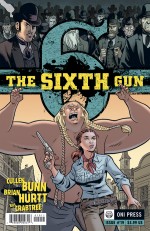
This series has become one of my favorite current comics, but unfortunately, it's so consistently good that I don't know if I have much to say about it. I do like that Cullen Bunn continues to build the world as the series goes on, adding new elements with each arc, details slowly accumulating to create a rich mythology that includes mystical weapons, warring religious factions, demons, sorcerers, monsters, and all sorts of cool details that make the Old West setting come to life. It makes me trust that there's a plan for the whole series, and I can't wait to find out where it's going each month. Brian Hurtt on art definitely helps; he's a monster, filling out and solidifying all those details while maintaining a great sense of character and place, and lending an appropriately creepy, moody air when it's called for, which is most of the time. I love it, and I always want more when it's over.
-----

Spaceman #4 (of 9)
Written by Brian Azzarello
Art by Eduardo Risso
Published by DC Comics/Vertigo

Brian Azzarello and Eduardo Risso are near-bulletproof for me after 100 Bullets, and they sure don't disappoint with this new Vertigo series, which is a completely different sort of thing, yet recognizably their work, full of that unique combined personality, all cryptic wordplay and encompassing atmosphere. The plot here, for those who don't know, follows a human-ape hybrid who was designed to work in space but has ended up scavenging the slums of a flooded earth as he ends up in possession of the kidnapped child of a celebrity couple. There are a bunch of twists and turns, and probably some secrets to be uncovered at inopportune times, but the most enjoyable part of the comic is getting to experience the future that Azzarello and Risso have created, trying to decipher the slang that everyone speaks in, marveling at the busted-up locales where the people survive and the believable technology that they use, enjoying the expressive characters and sudden, shocking violence. I expect nine issues is going to be too short of a time to spend in this fucked-up, all too possible future.
-----

Wasteland #34
Written by Antony Johnston
Art by Justin Greenwood
Published by Oni Press

Interest in this title may have been flagging around these parts due to the erratic schedule over the last year or so and the loss of artist Christopher Mitten, but things kind of snap back into place in this issue, with a revelation that brings many of the series' themes into focus, namely the emphasis on belief systems, the supernatural, creation stories, and religions. Suddenly, this isn't (necessarily) the sci-fi post-apocalyptic story that it appeared to be, but a sweeping history of mythological proportions. Huh, how about that? Color me reinvigorated.

Monday, August 30, 2010

Collection catchup: Gods and suicides and lesbians, oh my

Elsewhere: I reviewed the second volume of Demo at IndiePulp; it's really good (and hopefully the review isn't bad either).

Links:  This Sophia Wiedeman (The Deformitory) comic at Top Shelf 2.0 is quite good.

This partly animated comic by Vincent Giard is also pretty great, a cool example of the way animation can be used effectively in comics rather than as a distraction.  I've got to check out more of this guy's work.

I'm also curious about this new Japanese comics anthology which is available in English for the Kindle (or really any platform, since Kindle books can be read on Iphone, PC, etc.).  It got attention because Shintaro Kago has some comics in it, which makes it his first officially available English work, but from what I understand, it's only a few gag strips, but he'll have a longer-format story in the second issue.  I dunno, maybe I'll get a subscription or something.

So, here's my latest collection of (probably) shorter looks at stuff I've read recently:

Godland, volume 5: Far Beyond the Bang!
Written by Joe Casey
Art by Tom Scioli


Some comics hit my buttons just right that I love them intensely while having trouble expressing the reasons for doing so beyond "Wow, that's awesome!"  The Jack Kirby riff that Joe Casey and Tom Scioli do here is a perpetual winner, and they manage to nail the feel of the King's cosmic bombast perfectly, with the shouted proclamations and the world/galaxy/universe-shaking implications of the fights made perfectly clear.  They keep things going at a breakneck pace, with hero Adam Archer dragged into interstellar cosmic battle with forces he barely understands, while back on Earth the villainous Friedrich Nickelhead launches a political takeover for the super-criminal set.  There's some weird social/political commentary going on, but Casey never sits still long enough to make it seem didactic, and the gigantic action and bizarre character designs by Scioli constantly dazzle the eye and grab hold of the mind.  It's the almost-too-big-to-comprehend Kirby-style godly morality that I dig most though, as in a scene in which an evil being prepares to influence the evolution of two warring species on some distant planet, declaring "Eventualism now!", before being attacked by two other baroquely attired space-farers who declare, "We bring forth the anti-pillage! Prepare to defend your religion!" before being sent 12,000 years into the future (taking them to our present) to face the results of the evolutionary shepherding that was inflicted on the winners of the species war.  It's totally nuts, and also totally awesome.  I can't get enough of this madness; it's the closest anyone has come to recreating Kirby, and it comes from understanding that you can't just keep trotting out the New Gods or the Fantastic Four and running them through the same old adventures; you've got to push the limits, explore new frontiers, come up with your own exciting ideas.  That's exactly what Casey and Scioli are doing here, and it's glorious to behold.  I wish it would never end.
-----

Sayonara, Zetsubou-Sensei, volume 2
By Koji Kumeta


The second volume of a manga series is often the place where the series really gels, and that seems to be the case here.  The first book was mostly focused on introducing the cast, including the ostensible main character, a suicidal teacher who exudes despair and hopelessness, trying to convince everyone he meets of the pointlessness of life.  The focus often turns to his wacky students though, who include his opposite number, a girl who is so optimistic that she can find a bright side to everything, as well as an ultra-precise neat freak, a shut-in, a boyfriend-obsessed stalker, a panty-flashing immigrant who threatens to sue everyone for sexual harassment, a refugee who barely speaks Japanese, and a girl who tries to stand out, but ends up being completely ordinary.  Having spent the first volume introducing all these goofballs, mangaka Koji Kumeta, who is apparently well-known as a satirist, can now just have goofy stuff happen and see how everyone reacts.  Sometimes a theme is established early on, like when Zetsubou-Sensei refuses to list grades on students' report cards, since life is better when you're ignorant of bad news, or when the Tanabata Festival, in which people write down wishes and hang them from trees, sees everyone sharing their wishes (and culminating in the teacher hanging himself from a tree).  This lets Kumeta riff on a theme, throwing out jokes left and right, having each character do something goofy that fits their personality, and always filling at least one panel with a list of examples of whatever the topic of the day is, usually making obscure references to Japanese culture that have to be explained in the footnotes.  Other times, something bizarre happens, making for a bunch of strange jokes, like a chapter in which a character claiming to be Admiral Matthew Perry (who forcibly opened Japan up to trade with the United States in 1854) shows up and goes around opening everything he sees, including a boy's zipper, the school's pool, and (in a failed attempt) Zetsubou-Sensei's heart.  Another story sees everyone travel back to the teacher's hometown, where his family apparently has an arranged-marriage custom in which anyone who looks into someone else's eyes has to marry them, which leads to all sorts of hijinx.  It's a totally ridiculous comic, but it's frequently really funny, even in the comedy that actually translates.  And that's a qualifier that must be made, since so many of the jokes are based on obscurities of Japanese language and culture, or pop culture and events that nobody on this side of the Pacific knows much about.  The extensive translator's notes do their best to explain things, but even with that resource, one gets the feeling that a lot of material is going right over their head.  But that's okay, since it just seems surreal and strange, and what does work, like the running jokes about things like a line of stalkers or a balding student that everyone ignores, is often laugh-out-loud funny.  It's that brand of odd, deadpan Japanese humor that you see in four-panel strips and the like, mixed with the loud proclamations and elaborate setups of other manga, ending up being a delightfully quirky collection of goofiness that makes just enough sense to be enjoyable. 
-----

Batwoman: Elegy
Written by Greg Rucka
Art by J.H. Williams III


I'm just about the last person on the internet to say this, but this is a pretty damn good comic.  If more superhero books were like this one, the genre wouldn't be a tiresome slog of soap opera plot developments and gratuitous violence.  This is a pretty simple deal about a crime fighter who stops a city-threatening scheme while balancing a private life and discovering a connection to a villain, while making some nods to a larger continuity that seems interesting enough to seek out more information or ignore as suits your purposes.  There's also an origin flashback and hints toward future plots that may or may not get around to happening, but that doesn't matter, because as an introduction to the character, this collected version works really well, telling a rousing story and quickly and memorably defining the characters.  It's really solid storytelling, although I must say that my favorite moment is when a fight between Batwoman and her arch-nemesis, a crazy lady who only speaks in quotes from Alice in Wonderland, is interrupted by a bunch of beast-men that just come rampaging through and start tearing into everybody.  It ends up being explained, but when it happens, it's a crazy "what the fuck?" moment, the kind of thing that can only happen in superhero comics.

But of course, the thing to talk about here is the art, by best-of-his-generation artist J.H. Williams III.  Without him, this would be an above-average exercise in Batman emulation, but he raises it to the level of the sublime, giving people realistic human motions and expressions and filling pages with dazzling layouts that propel the action excitingly across the page while highlighting the heightened-reality nature of superheroics with an art deco flair.  The great thing about it is that he does all this, encapsulating small actions in lightning-bolt-shaped panels, tilting frames and enclosing them in bat-themed shapes, turning panel borders into curlicued swirls of psychedelia when Batwoman is dosed with a hallucinogen, while still making all the action and movement perfectly clear.  During the flashback/origin story, he manages to transform his art into an imitation of David Mazzuchielli's work on Batman: Year One, but as the story progresses toward the present, it subtly metamorphoses into Williams' style, with a bit of Tim Sale or Sean Phillips.  It's pretty gorgeous work, worth all the acclaim it's received.  If the story ever gets finished, I'll try to read it as well, which is more than I can say for most Batman-related nonsense.
-----

Cinderella: From Fabletown with Love
Written by Chris Roberson
Art by Shawn McManus


The Fables franchise must be a tough one to get right, since what seems like a fairly easy story to handle (Cinderella as a spy, working with Aladdin to uncover a magical threat to the "mundane" world) comes off as fairly rote here, with little in the way of suspense or surprise, no real action to write home about, and some especially tiresome attempts to smoosh together fairy tale stuff with the real world.  Maybe it's the first-person narration, which constantly hangs over the proceedings, working in as many fairy tale references as possible, without much wit or humor.  It could be the fast-moving plot, which never sits still long enough to gather any sense of import, or the occasional shoehorning of a dumb moral into things.  The tiresome subplot about Cinderella's shoe-store employee screwing things up by selling magical shoes (like the ones from that fairy tale, you know, the one with the shoes that never stopped dancing) certainly doesn't help.  Whatever the case, writer Chris Roberson just doesn't have the feel for the Fables world that Bill Willingham and Matt Sturges do, as if he's managing to take things both too seriously and not seriously enough.  Artist Shawn McManus does his best to make it work though, turning his style into a reasonable facsimile of Mark Buckingham's distinctive work on the main Fables title, with some nice, thick lines, big expressions, and nicely anthropomorphic animals and monsters.  If it wasn't for him, this would probably be eminently skippable, but as it is, it's worth a look for Fables completists, but far, far from essential.

Saturday, June 27, 2009

Detroit Metal City: Doesn't everybody prefer demon blood to cheese tarts?

Linkages: I'm sure plenty of people have linked to this Art Spiegelman piece about old editorial cartoons dealing with a ship full of Jewish refugees from 1939, and how that relates to the way cartoonists deal with issues today, but I wanted to make sure I pointed it out, since I found it quite interesting.

In other news, Fantagraphics is putting together a couple of collections of some of Jason's books, which is nice. First is Almost Silent, which will include You Can't Get There From Here, Tell Me Something, Meow, Baby!, and The Living and the Dead. The second, which is tentatively titled What I Did, contains The Iron Wagon, Sshhhh!, and Hey, Wait. I'll probably pick up the second one, but I already own most of the first volume, so I'll pass on that one. Still, good values, good production, great comics, don't miss out if you haven't read them. Jason is awesome.

I'm sure people have been talking about this, but I found it interesting and worth mentioning: Longbox, a digital comics platform that seems based on iTunes. I don't know if it will take off, but it seems like a good, multi-company solution for digital distribution, finally making online comics sales something that makes sense. I'll be watching and seeing how it plays out.

I don't know if this is new or not, but you can read Agents of Atlas #0 for free at Marvel's digital comics site; it's a nice prequel to the series that's currently running, filling in the gaps between the miniseries and the ongoing. Go Jeff Parker!

Also not all that new: the official American trailer for Hayao Miyazaki's Ponyo! I can't wait to see this.

And while I'm linking to videos, here's the latest episode of my main man Tucker Stone's show Advanced Common Sense. I saw some of the rough footage from this shoot when I was in New York, and it was quite hilarious. I encourage everyone to email Tucker and demand a release of the deleted scene in which he makes out with a fish.

Also, I reviewed Dark Reign: Zodiac #1 over at Comics Bulletin earlier in the week. That was a pretty good comic; Joe Casey and Nathan Fox!

Okay, actual content:

Detroit Metal City, volume 1
By Kiminori Wakasugi


Ah, the rape joke. Such a classic form of comedy. Why, I remember the nights I would sit around the campfire with my family, aunts and uncles, grandparents and cousins, all relating our favorite rape jokes and laughing uproariously. Such grand times.

Wait, I'm mistaken. I've been informed that rape is a subject never to be broached in comis, much less in jest! How could anyone take it lightly? Only emotionless monsters would ever consider such an outrage!

Well, obviously the truth is somewhere between those extremes, but Detroit Metal City definitely skews toward the former, seeking to make comedy out of its outrageousness. It certainly does contain more uses of the word "rape" than I can ever remember seeing between two covers, but the key thing to note is that makes it really funny. It's got that Japanese style of humor, getting a lot of mileage out of awkward situations and over-the-top silliness. And while the art isn't anything to write home about, its bare-bones stiffness manages to make the goofy antics that much more strange and humorous.

The concept: meek, gentle Soichi Negishi wants to live a chic life in the big city (Tokyo), playing indie rock, hanging out in trendy locations, and meeting cute girls, but somehow he ended up as the lead singer of the titular "evil-core" metal band, going by the name of Johannes Krauser II and dressing in a ridiculous getup (my favorite part of the outfit are the oh-so-dainty ruffles on the wrists and neck) while screaming songs about murder, rape, blood, and mayhem. He hates the music that he plays, but he also happens to be really good at it when he gets into character, and his fans can't get enough of his antics. Each chapter sees some sort of conflict between Soichi's on-stage and off-stage lives, usually to incredibly humorous effect. It usually starts small and builds to a goofy climax that has the reader laughing out loud; for instance, one chapter sees him trying to sing his cute indie songs (which are as cheesily nice as DMC's are nasty) on the street, only to be drowned out by a DMC cover band. Annoyed, he decides to show the punks how it's done, getting into his costume and showing them up as Krauser II. But when the police come to break up the disturbance, he's mortified and tries to turn himself in, only to trip and accidentally brain a cop with his guitar, thus maintaining his reputation as a menace to society.

Other stories continue along those lines, with running gags like a girl Soichi has a crush on continually getting humiliated by DMC, or the band's ridiculous manager, a woman who is constantly urging them to make her panties wet with their rock and shouting lines like "I danced till my pants turned into a bowl of clam chowder." It can get a bit repetitious if read in a big bunch, but take a break between chapters and you'll find yourself laughing at the jokes over and over. I know I did.

As I mentioned above, the art is nothing too special, but it's effective for what it is. The characters are often quite stiff, and one might not realize what sort of ridiculous antics the band was up to if fans didn't provide commentary:


As for facial expressions, Soichi-as-Krauser only seems to have one, an open-mouthed maniacal scream. Without the makeup, Soichi has a couple, usually either a placid smile or a Krauser-esque look of shock and dismay:


It works for the story though, kind of putting a minimalist style on things, tending toward something like Cromartie High School, but not quite reaching those levels of abstraction. The low levels of detail work to make the rock and roll scenes more comedic, since the fans are getting all worked up over what doesn't really seem to be that big of a deal. The goofy costumes and lyrics about "raping all women" are pretty stupid, so to hear a fan react to them by saying "It's like I'm being raped by the music!" just makes the whole thing funnier.

And another nice aspect of the comic is that over the course of the volume, Soichi seems to be growing into his Krauser persona, rather than always hating it and wanting to quit. He finds a few good off-stage uses for the character, and he even seems to be enjoying the release that the shows provide. At the same time, he's progressing in his relationship with his would-be girlfriend, which should provide plenty of humor in future stories, since she's sympatico with his metal-hating trendiness.

Even though this is only the first volume, the series is quite hilarious, always upping the ante on what sort of perversity you expect from the band and coming up with funny ways to mix Soichi's disparate worlds. It might be hard to keep raising the stakes; the antics could get predictable and tiresome, but that's certainly not the case here. I expect future volumes to only get funnier.


Tuesday, June 2, 2009

Godland: I would say words fail me, but obviously they don't. Still, that's probably apt

Godland, volume 4: Amplified Now
Written by Joe Casey
Art by Tom Scioli


While this isn't exactly a new development, the Kirby pastiche has become its own genre, with comics creators trying to ape the King's bombastic action and cosmic ideas. But most examples can't measure up, doing little more than mimicking surface stylistics like squared-off fingers, gigantic machinery, and Kirby dots. But Joe Casey and Tom Scioli's Godland is different; while the artwork definitely has a strong Kirby influence, there's more to it than that. Casey is tapping into the same underlying subconscious themes, giving something extra that leaves an impression far beyond whatever coolness comes from explosions and glowing guys flying around and blasting things with cosmic energy.

But that element is difficult to explicate, much as it's hard to describe the series without sounding like a six year old describing a dream they had. "You see, there's this guy who glows, because he has outer space powers, and there's this huge alien dog who helps him, and they fight monsters and stuff, like a giant insect lady, and there are these three space guys who send an explosive drill into the center of the earth, and the guy's sister also has super powers, and she changes the world to try to make it better, but it doesn't work, and..." It's almost a stream-of-consciousness style of storytelling, with bizarre events piling on top of one another to an exhausting degree.

By this fourth volume, the tone of the series has been established, and it continues from issue to issue without letting up. And while the crazy stories and out-there ideas are what grab the most attention, it's the small touches that Casey throws in that really seal the deal. The three cosmic invaders are named Ed, Eeg-Oh, and Supra, in reference to Freud's "psychic apparatus", and the interesting part of their arc comes when they become infected with human emotion, displaying uncontrollable outbursts of joy or anger, culminating in their decision to massacre the population of Las Vegas and leading to displays of violence that you don't normally see in this sort of Kirby-esque work:


Later scenes play off the ideas of destiny, as Neela, the sister of Adam Archer (the aforementioned glowing cosmic hero), having gained her own cosmic powers, shows up and remakes the world in her image, setting herself up as the Earth's defender before being torn down as a false savior. Also compelling are the continuing revelations about the nature of the cosmic conflicts, as we see that beings are attacking Adam for usurping some sort of natural order, and we even learn more about the nature of this universe, as it was born from exactly the sort of violence that continues throughout the series. There's definitely something going on below the surface here, although Joe Casey is probably the only one who really understands it; the rest of us just have to glean the ideas and try to interpret them as best we can.

Luckily, it's tons of fun to do so, as the action is fierce and wild, the humor is entertaining, and Casey keeps throwing wacky ideas on the page, with the most notable one in this volume probably being a band of gorilla-headed prostitutes that emerge on the scene to defend Vegas from "The Triad" and are instantly slaughtered. Why? Well, why not?

Of course, all this would be moot if the art wasn't up to snuff, but Tom Scioli rises to the occasion honorably, holding up his side of the storytelling with aplomb. He provides page after page of art that retains Kirby-style energy, but goes further, adding his own unique bits of exuberance, like baroquely complex alien machinery that seems to stretch on forever, or an excellently menacing gigantic monster:


Nick Filardi colors really complement Scioli, adding a bright sheen to everything and really making the art pop off the page. The occasional computer-aided touches work well, not overpowering the style, but adding something extra when it's called for:


Yes, it's a veritable feast of cosmic goodness, page upon page of visual and mental treats. Of course, this being the fourth volume, readers are probably either hip to the creative team's vibe, or know that it's not their sort of thing. And it's definitely not for everybody; some will surely be overwhelmed by the breakneck pacing and multitude of crazy ideas that Casey and Scioli are throwing out, while others might not be able (or willing) to put themselves in the unique mindset required to enjoy the immersion in said craziness. But for those of us who can appreciate and revel in the bizarre energy of the comic, it's pure gold. This is the kind of thing that Jack Kirby was talking about when he said that "the Kirby tradition is to create a new comic." Casey and Scioli have certainly done so, building on previously-established foundations to come up with something extraordinary and beautiful. Let's celebrate that while it lasts.

Tuesday, April 29, 2008

Nixon's Pals: With friends like these...

Seems like I'm always behind these days...

Nixon's Pals
Written by Joe Casey
Art by Chris Burnham


Joe Casey seems to do a lot of work in the superhero genre, but he often comes up with some pretty unique, imaginative takes on it, from the existential, postmodern, whatever-the-fuck-was-going-on Automatic Kafka; to the high school drama of The Intimates; to the cosmic, Jack Kirby-inspired craziness of Godland; and even to the “The Thing’s condition as a disease expressing inner emotion” of Rock Bottom (and others besides, like Wildcats 3.0’s take on corporate superheroes). In a stagnant superhero market where the most innovative ideas usually involve adding more violence and rape, it’s always good to see what Casey comes up with next, even if his ideas have little chance of catching on with anybody else.

So what’s the big idea with this book? That would be mixing superhero tropes (or, more accurately, super-powered tropes, since there aren’t any actual heroes in the book) with noir-style storytelling and crime fiction. The book features one Nixon Cooper, a parole officer for supervillains who gets mixed up in dangerous business when he gets too close and emotionally involved with his charges. At the same time as his professional life is in upheaval, his personal life seems to be falling down around him with the discovery that his wife is cheating on him, with a supervillian, of all people.

It makes for a nice bit crime-fiction, and one of the highlights of the book is Chris Burnham's moody black and white art. He pulls off the combination of weird superpowers and gloomy shadows really well; it's a mix that I don't see very often, but it actually works really well here, highlighting the bizarre nature of the varied cast by portraying them as a sort of seedy underworld of crooks and gangsters. He also adds a gritty, dirty touch that emphasizes the street-level nature of the story.

And the great character design helps immensely. Casey and Burnham come up with a diverse array of weirdos, and they all seem to have personalities and histories, from Alchema, the stripper with faces on her breasts (and nipples on her face):


To Maxfield Reactor, the scientist trapped within bulky armor:


Or my personal favorite, a mobster named Rambles whose face seems to have been twisted around his skull in a disturbing fashion:


In fact, not to spoil anything, but a climactic scene sees the reveal of a huge array of freakish characters, and it's a stunning image, crammed full of detail on characters that only make tiny appearances, but seem fully-realized, just by the personality that Burnham imbues in them.

In another wrinkle, a subplot of the story has Nixon experiencing freaky nightmares in which he is being captured by aliens and dissected. Again, Burnham delivers here, making these scenes horrific and nasty. Here's a brief sample, but rest assured that this is pretty tame compared to the images surrounding it:


It's viscerally disturbing stuff, the kind of body horror that triggers almost subconscious revulsion, and it leads up to a final powerful and lasting image. Wow.

Oddly, this does kind of highlight one aspect of the book that bothered me, which is Nixon's seeming resistance to injury. He's meant to stand out as a contrast to all the freaks he has to deal with, but over the course of the story, he takes quite a bit of abuse, almost without feeling it. Sure, he ends up in the hospital, but considering the brutal beatings he receives, it's amazing he doesn't end up dead with a crushed head or exploded heart or something. Instead, he seems to come out of it with only a broken arm and some ugly stitches on his face.

But I suppose that's nothing too terrible to hold against the story. In actuality, while the plot works well enough, I particularly liked some of the smaller relationship elements that factored into the main plot. For one, there's Nixon's antagonistic marriage, which dissolves after he discovers her infidelity. But it's a realistic depiction of a married couple, and we see how they still care for each other even though they've hurt each other too much to remain together. It would have been easy to simply have them hate each other and be glad to get rid of some dead weight, but instead, Casey gives them that bit of humanity that helps us relate and adds a human touch to the fantastical trappings of the rest of the book.

And in the professional realm, Nixon has a touching relationship with one of his charges, a genetically-enhanced professional killer named Sputter Kane. In what might be a commentary about the ease of recidivism for ex-convicts, he is trying to go straight, but the money and allure of a criminal lifestyle seems like it might be too hard to give up. It ends up being one of the central conflicts of the book, as Nixon tries to save him from falling back into the lifestyle he once led. Again, even though the setting is fantastical, this bit of character development adds enough realism for us to relate, giving an emotional focus to a story that could be all surface. Nicely done.

So, yeah, if this sounds like something you might dig, I heartily recommend it. Casey continues to stretch and come up with new ideas while still retaining a human core, and I expect to keep reading the comics he writes.

Tuesday, February 5, 2008

Random artistry talk

Hey, I'm supposed to do reviews and stuff here, right? Well, I might have something up tonight, but I just discovered an artist and project that I wanted to talk about, so I'm spending a post mentioning it. In Rich Johnston's column this week, he posted the cover to an upcoming series written by Joe Casey, Charlatan Ball. I don't believe I had heard of this series previously, so I googled it and came across the blog of the artist, Andy Suriano. And now I'm quite excited to check out this series. That cover made me think it looked similar to another series Casey writes, Godland, which is a Jack Kirby-inspired cosmic adventure series. But Suriano's posts and art samples, while still pretty Kirby-influenced, seem to me to be similar to Frank Espinosa's work on Rocketo. This is especially true in the images from a post about using a limited color palette:


Just look at those streaks of color! That's beautiful stuff. So yeah, color me excited (get it? Ugh.) about this series. I don't even know what it's about, but since I usually dig Joe Casey's writing, and this art looks incredible (hopefully it won't change too much in the final product, which will be colored by a different colorist), I'm all over it.

And since I already did the search, here's another bit info that I found: a Newsarama interview with Joe Casey about the series (and another upcoming book, Nixon's Pals). Enjoy!

Saturday, July 21, 2007

I hope Crack Comics lives up to its name

I found this really cool bit of news via Jog:
This December, Image Comics will publish an anthology featuring characters you haven't seen in a very long time. "The Next Issue Project" will showcase top talent from the world of comics reimagining Golden Age characters that have fallen into the public domain. But it's not quite as simple as that - the series will literally publish the next issue of a great golden age book, with modern interpretations of Golden Age super heroes.
That's from the CBR article about the project, which sounds awesome. Creators involved include Mike Allred, Frank Cho, Kyle Baker, Bill Sienkiewicz, Howard Chaykin, Phil Hester, Ashley Wood, Joe Casey, Frank Espinosa, Steve Gerber, Brandon Graham, Tom Scioli, and plenty of others. I love the idea, with modern creators doing their interpretation of classic, forgotten characters. The Mike Allred one seems to be one of the most notable, since he's illustrating a Stardust the Super Wizard story, and Stardust's creator Fletcher Hanks has been getting a lot of recognition lately. So suffice to say, I'm pretty interested in the project, so I bet I'll be happy when December gets here.

And just for fun, here's a Mike Allred cover: