Showing posts with label Brian Wood. Show all posts

Wednesday, April 25, 2012

Art what I like: Sometimes it's all in the eyes

The most recent (and, sadly, penultimate) collection of Brian Wood's Northlanders features the good stories one would expect, but I found one in particular to be especially nice, at least from an art-based perspective. That would be issue #40, "The Hunt". Illustrated by Matthew Woodson, it's a simple story about a hunter tracking a deer across the frozen wastelands in the north of Sweden. Wood's story sells the life-and-death struggle of the lonely man who is motivated by the need for survival, but goes beyond the normal effort out of some extra, human impulse (Pride? Anger? Desperation?). But what I found especially striking about the story is Woodson's art. He details the snowy forests in a lovely manner, but goes someplace extra when depicting the emotions that cross the hunter's face, especially his eyes. There's something fascinating about how much he is able to convey through silent expressions, with information gathering around the hunter's piercing blue orbs. His look of tired determination near the beginning of the story is an immediate signal of the humanity of his situation:


And when he misses a key shot, the look of anguished defeat he gives is all too relatable, even to those of us who aren't experienced with needing to succeed in our efforts or starve:


Near the end of the story, things get grimmer and grimmer, the hunter's eyes eventually communicating a resigned acceptance of his fate, but with a determination to keep going to the end:


And on the other side of the coin, Woodson even manages to wrangle heartwrenching expression out of the prey:


It's beautiful work, and while I'm not sure I fully understand the ending of the story, it struck me as one that really exemplifies this series at its best, in that it brought the past to life in a way that emphasized the humanity of these characters, real people struggling for survival in a world that's completely different from anything in our modern experience, yet rendered comprehensible through the connection we all share. I'm really going to miss it.

Tuesday, March 6, 2012

Pamphleteering: This selection apparently reflects my tastes

Here's what I brought home from the comic book store last week; it's about a month's worth of floppies, I think.

Atomic Robo: The Ghost of Station X #5 (of 5)
Written by Brian Clevinger
Art by Scott Wegener
Published by Red 5 Comics

Man oh man, what an end to a great arc of this ongoing series (which, in the style of Hellboy and BPRD, is delivered as a series of miniseries). Large-scale action that actually threatens the main character's life, with a mystery of ever-increasing scale slowly revealing itself in between moments of a global chase, culminating in the unveiling of a villain that connects perfectly with Robo's life, goals, and personality, making for a nigh-unstoppable threat that resonates beyond whether it can be blown up real good. With the century or so of time that the creative team has to work with, the range of stories that can be told is pretty great, typified by the jump from the last story's young, naive Robo to this one's confrontation of a huge threat challenging him at the height of his abilities and resources. Man, give me whatever these guys can dish out.
-----

Blue Estate #9
Written by Viktor Kalvachev, Kosta Yanev, and Andrew Osborne
Art by Viktor Kalvachev, Toby Cypress, Robert Valley, Peter Nguyen, and Andy Kuhn
Published by Image Comics

I enjoy this noir story for the most part, with its goofy characters, occasional violence, and themes of Hollywood crime, but the most interesting aspect is probably the art, which shifts randomly, sometimes even within a single page, between each issue's contributors. Nathan Fox has been the highlight of the series, but he's not in this issue, so Toby Cypress is probably the star this month. One highlight is a moment in which a character's reaction to having a gun pulled on them is described like a car accident, and that's illustrated by a panel that ends up happening later in the issue when that character does get into a car crash. I don't know if I would recommend this series, since it's so idiosyncratic, but I usually have a pretty good time reading it. High praise?
-----

The Bulletproof Coffin: Disinterred #2 (of 6)
Written by David Hine
Art by Shaky Kane
Published by Image Comics

Not sure what to say about this one. It's one of those bits where characters tell stories that might or might not be "true", apparently meant to be an example of the sort of story you might find in the comics described and sampled in the first volume of this series, with the hint that the various characters are all going to come together for some sort of metatextual crossover by the end of the series, perhaps to confront their creators or something. Whatever; I mostly just enjoy the crazy way that Shaky Kane depicts the weird (or sometimes just unfortunate) shit that happens to people, with the hairy monster of the last story being the highlight. Good times.
-----

Dark Horse Presents #9
By Mike Mignola & Joe Querio, Brian Wood & Kristian Donaldson, Paul Pope, Tony Puryear, Richard Corben, Rich Johnston & Simon Rohrmuller, Alan Gordon & Thomas Yeates, Steve Horton, Caitlin R. Kiernan & Steve Lieber, and M.J. Butler & Mark Wheatley
Published by Dark Horse Comics

Aside from the standard comment about anthologies being a mixed bag, I'm definitely digging this new incarnation of Dark Horse's house mag, which contains samplers of their best creators' work, along with other stuff that I'm guessing they thought was cool enough to print. There's no chapter of Neal Adams' batshit-crazy "Blood" this month, but I'm hoping that one comes back soon, since it's totally nuts. Howard Chaykin's "Marked Man" also ended, so it's mostly new or standalone stuff here. Mike Mignola has a Lobster Johnson short that's pretty cool, even if it ends kind of obviously. Brian Wood and Kristian Donaldson's "The Massive" continues to be introduced; I'm guessing that the stories here are intros to the various characters in the regular series, which is coming later, right? I do like Donaldson's ultra-clean art, especially an eerie underwater moment in this chapter. Paul Pope is as awesome as you would expect with a story about Apollo 12, the second moon landing, full of distinctive lunar landscapes, that weirdly sketchy-yet-realistic machinery that he does so well, and the surprise appearance of a naked lady. Richard Corben adapts an Edgar Allen Poe story as well as you would expect; it's pretty great, with lots of horrified faces, desiccated corpses, tangled scenery, the usual. I like the beginning of Steve Horton's "Amala's Blade" too; it's a cool sci-fi/fantasy/pirate thing with some great designs and stylish art, plus what seems like a good female lead. Caitlin R. Kiernan and Steve Lieber's "Alabaster" is cool too, although I'm not sure if this is a character that has shown up anywhere before. I guess she's an albino monster-hunter that might or might not also be crazy? She sees a freaky four-faced angel at one point, and she also gets confronted by a werewolf lady. I'm not sure what's going on, probably by design, but I love Lieber's moody art.

On the other hand, I can't really figure out what's going on in Tony Puryear's "Concrete Park"; apparently, it takes place on another planet, and it follows various characters who live in a Los Angeles-like city of crime and gangs and whatnot. It jumps from character to character so much that I can't really follow it, and neither the art or the story are compelling enough to really want to do the work to keep up. Rich Johnston and Simon Rohrmuller's "The Many Murders of Miss Cranbourne" is all right, with a decent concept of a vigilante-killer old lady who presents herself with the air of an amateur detective, although this chapter focused on a policeman who falls for all her cover-ups, which isn't that interesting when we've already seen what really happened. The art is kind of generically cartoony too, not really expressive enough to be either humorous or deadpan. I'm fine with Alan Gordon and Thomas Yeates' "The Once and Future Tarzan", with its interesting concept of an immortal Tarzan living in a post-apocalyptic future, but it's been kind of staid and workmanlike so far, nothing to grab the reader and sell them on the coolness of the concept. And finally, M.J. Butler and Mark Wheatley's "Skultar" is a pretty dumb spoof of Conan and other barbarian-themed stories, but it does manage to hit on an amusing joke or two in each chapter. You have to get past the muddy art to see them though.

So yeah, good reading overall, and it will have to take a real dip in quality for me to even consider quitting. I suspect I'm there for the long haul.
-----

Haunt #21
Written by Joe Casey
Art by Nathan Fox
Published by Image Comics

I never expected to be reading this Todd McFarlane series about a ghost mashup of Spider-Man and Spawn, but when Joe Casey and Nathan Fox took over, I had to at least give it a try. And luckily, they appear to have jettisoned everything except the basic concept, which is about a couple of brothers (one of whom is a ghost) that can combine into some sort of ectoplasmic monster. I think they used to work for a spy agency or something, but Casey had that aspect of the book just disappear in his first issue, then killed off the living brother's love interest, instead having the character kidnapped by some sort of evil church and then rescued by a badass spy/mercenary who is like an ultra-competent version of Jeff "The Dude" Lebowski. It's been mostly non-stop action, which is pretty great stuff for Nathan Fox to handle, all ghost tentacles carving up bad guys left and right, lots of blood, gore, and intestines flying everywhere in the midst of mysterious architecture and crazy technology. There's also a bit of character development, as the ghost brother starts to get distanced from the living, caring less and less about morals and emotions and such, which makes for an interesting personal note in the midst of all the crazy action. I'm digging this, for now.
-----

Orc Stain #7
By James Stokoe
Published by Image Comics

Good god, do I love the crazy world James Stokoe has created here, full of weird creatures and cultures, random violence and destruction, bizarre structures, unique landscapes, and a sense that anything can happen, at least within the constraints that have been set up for the milieu. It's a nonstop barrage of mindblowing imagery, all the characters colored with inhuman tints and bristling with sickly pustules and gross scales, machines sprouting tentacles, everything up to and including rocks and mountains seemingly made of reptilian skin, characters getting smashed and sliced up with giant hammers, knives, and spiky hair (?), bright, yet somehow sickly, colors slathered all over the page, just a constant assault on the senses (well, the sense of sight at least, but the comic is so visceral, the mind imagines sounds, scents, and who knows what else). It's amazing, one of my very favorite comics of the moment. Damn.
-----

Prophet #22
Written by Brandon Graham
Art by Simon Roy
Published by Image Comics

Speaking of worldbuilding, Brandon Graham and Simon Roy are going nuts on their revival of this 90s series. I have no idea what the Rob Liefeld issues of this series were like, and I don't really have any desire to find out, unless I'm seized with morbid curiosity at some point; the world created here, a desolate future Earth populated by various aliens and monsters, covered with the wreckage of long-dead civilizations, is amazingly well-realized, and just watching the main character wander through it on his mostly-undefined mission is fascinating. I'm kind of blown away by the level of thought that has gone into the series, all the various creatures that interact with each other in the weird ecosystem and mix of cultures, most of them using gross biological technology that really emphasizes the utterly alien world. I can't wait to see where this goes, even if it continues to kind of freak me out.
-----

Rasl #13
By Jeff Smith
Published by Cartoon Books

I think this series is reaching some sort of endgame, a final confrontation between its universe-hopping protagonist and the evil government forces that exploited his inventions. I think we've finally been caught up on the details of the plot, which is nice, but the best part is probably the images of a town merged with several parallel universe counterparts, resulting in people and animals that are gross conglomerations of bodies sprouting multiple arms and heads, all screaming in hideous agony as they die miserable deaths. Fun! Jeff Smith can draw whatever he wants, and I'll read the hell out of it.
-----

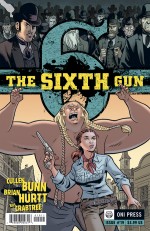
The Sixth Gun #19
Written by Cullen Bunn
Art by Brian Hurtt
Published by Oni Press

This series has become one of my favorite current comics, but unfortunately, it's so consistently good that I don't know if I have much to say about it. I do like that Cullen Bunn continues to build the world as the series goes on, adding new elements with each arc, details slowly accumulating to create a rich mythology that includes mystical weapons, warring religious factions, demons, sorcerers, monsters, and all sorts of cool details that make the Old West setting come to life. It makes me trust that there's a plan for the whole series, and I can't wait to find out where it's going each month. Brian Hurtt on art definitely helps; he's a monster, filling out and solidifying all those details while maintaining a great sense of character and place, and lending an appropriately creepy, moody air when it's called for, which is most of the time. I love it, and I always want more when it's over.
-----

Spaceman #4 (of 9)
Written by Brian Azzarello
Art by Eduardo Risso
Published by DC Comics/Vertigo

Brian Azzarello and Eduardo Risso are near-bulletproof for me after 100 Bullets, and they sure don't disappoint with this new Vertigo series, which is a completely different sort of thing, yet recognizably their work, full of that unique combined personality, all cryptic wordplay and encompassing atmosphere. The plot here, for those who don't know, follows a human-ape hybrid who was designed to work in space but has ended up scavenging the slums of a flooded earth as he ends up in possession of the kidnapped child of a celebrity couple. There are a bunch of twists and turns, and probably some secrets to be uncovered at inopportune times, but the most enjoyable part of the comic is getting to experience the future that Azzarello and Risso have created, trying to decipher the slang that everyone speaks in, marveling at the busted-up locales where the people survive and the believable technology that they use, enjoying the expressive characters and sudden, shocking violence. I expect nine issues is going to be too short of a time to spend in this fucked-up, all too possible future.
-----

Wasteland #34
Written by Antony Johnston
Art by Justin Greenwood
Published by Oni Press

Interest in this title may have been flagging around these parts due to the erratic schedule over the last year or so and the loss of artist Christopher Mitten, but things kind of snap back into place in this issue, with a revelation that brings many of the series' themes into focus, namely the emphasis on belief systems, the supernatural, creation stories, and religions. Suddenly, this isn't (necessarily) the sci-fi post-apocalyptic story that it appeared to be, but a sweeping history of mythological proportions. Huh, how about that? Color me reinvigorated.

Wednesday, July 13, 2011

Art What I Like: Burn, NYC, Burn

The latest collection of DMZ, Collective Punishment, is a good one, but that's not really anything surprising, at least from the standard the series has set for itself. The thing that I really dug about this particular volume was the art, all provided by guests rather than regular artist Riccardo Burchielli, and since this point in the long-running plot is seeing the merciless bombing of New York City by the US military, they all get to show off their own particular takes on the fiery destruction of the most famous city in the world. It's harrowing, arresting, gorgeous stuff (almost) all around, an awful, beautiful spectacle.

The one exception, unfortunately, is Cliff Chiang, who limits his large-scale destruction to a cityscape engulfed by orange clouds:


But everyone else takes the opportunity to dazzle with their destruction. Andrea Mutti eclipses Chiang's idea by rendering the skyline in silhouette and degrading the image to the point that the buildings look like burnt husks of themselves, making for a simple and horrifying image:


David Lapham does something similar in one image, making the whole city seem to be ablaze while death rains down out of the sky:


But he also includes a more visceral, apocalyptic image, including both the cause and effect of all the horrifying destruction in one breathtaking splash page:


Danijel Zezelj provides a long view of the city, and his rough-yet-detailed style takes the aforementioned "burnt out husk" idea and turns it into a city-wide bonfire, with the skyscrapers seeming like the protruding bones of Manhattan turned to smoldering embers:


But for my money, nobody beats Nathan Fox, who turns a birds' eye view of the city into a horrifying inferno, death raining down from above like nonchalantly destructive hailstones:


But he makes the rooftop view even more horrifying, an urban hellscape of flames and explosions:


DMZ has often been a harrowing read, bringing the foreign idea of war home to Americans, but rarely has it been so dismally horrifying, so full of widespread death and destruction. These artists have really risen to their task; I doubt I'll ever forget the awful sights they've shown me.

Monday, August 30, 2010

Collection catchup: Gods and suicides and lesbians, oh my

Elsewhere: I reviewed the second volume of Demo at IndiePulp; it's really good (and hopefully the review isn't bad either).

Links:  This Sophia Wiedeman (The Deformitory) comic at Top Shelf 2.0 is quite good.

This partly animated comic by Vincent Giard is also pretty great, a cool example of the way animation can be used effectively in comics rather than as a distraction.  I've got to check out more of this guy's work.

I'm also curious about this new Japanese comics anthology which is available in English for the Kindle (or really any platform, since Kindle books can be read on Iphone, PC, etc.).  It got attention because Shintaro Kago has some comics in it, which makes it his first officially available English work, but from what I understand, it's only a few gag strips, but he'll have a longer-format story in the second issue.  I dunno, maybe I'll get a subscription or something.

So, here's my latest collection of (probably) shorter looks at stuff I've read recently:

Godland, volume 5: Far Beyond the Bang!
Written by Joe Casey
Art by Tom Scioli


Some comics hit my buttons just right that I love them intensely while having trouble expressing the reasons for doing so beyond "Wow, that's awesome!"  The Jack Kirby riff that Joe Casey and Tom Scioli do here is a perpetual winner, and they manage to nail the feel of the King's cosmic bombast perfectly, with the shouted proclamations and the world/galaxy/universe-shaking implications of the fights made perfectly clear.  They keep things going at a breakneck pace, with hero Adam Archer dragged into interstellar cosmic battle with forces he barely understands, while back on Earth the villainous Friedrich Nickelhead launches a political takeover for the super-criminal set.  There's some weird social/political commentary going on, but Casey never sits still long enough to make it seem didactic, and the gigantic action and bizarre character designs by Scioli constantly dazzle the eye and grab hold of the mind.  It's the almost-too-big-to-comprehend Kirby-style godly morality that I dig most though, as in a scene in which an evil being prepares to influence the evolution of two warring species on some distant planet, declaring "Eventualism now!", before being attacked by two other baroquely attired space-farers who declare, "We bring forth the anti-pillage! Prepare to defend your religion!" before being sent 12,000 years into the future (taking them to our present) to face the results of the evolutionary shepherding that was inflicted on the winners of the species war.  It's totally nuts, and also totally awesome.  I can't get enough of this madness; it's the closest anyone has come to recreating Kirby, and it comes from understanding that you can't just keep trotting out the New Gods or the Fantastic Four and running them through the same old adventures; you've got to push the limits, explore new frontiers, come up with your own exciting ideas.  That's exactly what Casey and Scioli are doing here, and it's glorious to behold.  I wish it would never end.
-----

Sayonara, Zetsubou-Sensei, volume 2
By Koji Kumeta


The second volume of a manga series is often the place where the series really gels, and that seems to be the case here.  The first book was mostly focused on introducing the cast, including the ostensible main character, a suicidal teacher who exudes despair and hopelessness, trying to convince everyone he meets of the pointlessness of life.  The focus often turns to his wacky students though, who include his opposite number, a girl who is so optimistic that she can find a bright side to everything, as well as an ultra-precise neat freak, a shut-in, a boyfriend-obsessed stalker, a panty-flashing immigrant who threatens to sue everyone for sexual harassment, a refugee who barely speaks Japanese, and a girl who tries to stand out, but ends up being completely ordinary.  Having spent the first volume introducing all these goofballs, mangaka Koji Kumeta, who is apparently well-known as a satirist, can now just have goofy stuff happen and see how everyone reacts.  Sometimes a theme is established early on, like when Zetsubou-Sensei refuses to list grades on students' report cards, since life is better when you're ignorant of bad news, or when the Tanabata Festival, in which people write down wishes and hang them from trees, sees everyone sharing their wishes (and culminating in the teacher hanging himself from a tree).  This lets Kumeta riff on a theme, throwing out jokes left and right, having each character do something goofy that fits their personality, and always filling at least one panel with a list of examples of whatever the topic of the day is, usually making obscure references to Japanese culture that have to be explained in the footnotes.  Other times, something bizarre happens, making for a bunch of strange jokes, like a chapter in which a character claiming to be Admiral Matthew Perry (who forcibly opened Japan up to trade with the United States in 1854) shows up and goes around opening everything he sees, including a boy's zipper, the school's pool, and (in a failed attempt) Zetsubou-Sensei's heart.  Another story sees everyone travel back to the teacher's hometown, where his family apparently has an arranged-marriage custom in which anyone who looks into someone else's eyes has to marry them, which leads to all sorts of hijinx.  It's a totally ridiculous comic, but it's frequently really funny, even in the comedy that actually translates.  And that's a qualifier that must be made, since so many of the jokes are based on obscurities of Japanese language and culture, or pop culture and events that nobody on this side of the Pacific knows much about.  The extensive translator's notes do their best to explain things, but even with that resource, one gets the feeling that a lot of material is going right over their head.  But that's okay, since it just seems surreal and strange, and what does work, like the running jokes about things like a line of stalkers or a balding student that everyone ignores, is often laugh-out-loud funny.  It's that brand of odd, deadpan Japanese humor that you see in four-panel strips and the like, mixed with the loud proclamations and elaborate setups of other manga, ending up being a delightfully quirky collection of goofiness that makes just enough sense to be enjoyable. 
-----

Batwoman: Elegy
Written by Greg Rucka
Art by J.H. Williams III


I'm just about the last person on the internet to say this, but this is a pretty damn good comic.  If more superhero books were like this one, the genre wouldn't be a tiresome slog of soap opera plot developments and gratuitous violence.  This is a pretty simple deal about a crime fighter who stops a city-threatening scheme while balancing a private life and discovering a connection to a villain, while making some nods to a larger continuity that seems interesting enough to seek out more information or ignore as suits your purposes.  There's also an origin flashback and hints toward future plots that may or may not get around to happening, but that doesn't matter, because as an introduction to the character, this collected version works really well, telling a rousing story and quickly and memorably defining the characters.  It's really solid storytelling, although I must say that my favorite moment is when a fight between Batwoman and her arch-nemesis, a crazy lady who only speaks in quotes from Alice in Wonderland, is interrupted by a bunch of beast-men that just come rampaging through and start tearing into everybody.  It ends up being explained, but when it happens, it's a crazy "what the fuck?" moment, the kind of thing that can only happen in superhero comics.

But of course, the thing to talk about here is the art, by best-of-his-generation artist J.H. Williams III.  Without him, this would be an above-average exercise in Batman emulation, but he raises it to the level of the sublime, giving people realistic human motions and expressions and filling pages with dazzling layouts that propel the action excitingly across the page while highlighting the heightened-reality nature of superheroics with an art deco flair.  The great thing about it is that he does all this, encapsulating small actions in lightning-bolt-shaped panels, tilting frames and enclosing them in bat-themed shapes, turning panel borders into curlicued swirls of psychedelia when Batwoman is dosed with a hallucinogen, while still making all the action and movement perfectly clear.  During the flashback/origin story, he manages to transform his art into an imitation of David Mazzuchielli's work on Batman: Year One, but as the story progresses toward the present, it subtly metamorphoses into Williams' style, with a bit of Tim Sale or Sean Phillips.  It's pretty gorgeous work, worth all the acclaim it's received.  If the story ever gets finished, I'll try to read it as well, which is more than I can say for most Batman-related nonsense.
-----

Cinderella: From Fabletown with Love
Written by Chris Roberson
Art by Shawn McManus


The Fables franchise must be a tough one to get right, since what seems like a fairly easy story to handle (Cinderella as a spy, working with Aladdin to uncover a magical threat to the "mundane" world) comes off as fairly rote here, with little in the way of suspense or surprise, no real action to write home about, and some especially tiresome attempts to smoosh together fairy tale stuff with the real world.  Maybe it's the first-person narration, which constantly hangs over the proceedings, working in as many fairy tale references as possible, without much wit or humor.  It could be the fast-moving plot, which never sits still long enough to gather any sense of import, or the occasional shoehorning of a dumb moral into things.  The tiresome subplot about Cinderella's shoe-store employee screwing things up by selling magical shoes (like the ones from that fairy tale, you know, the one with the shoes that never stopped dancing) certainly doesn't help.  Whatever the case, writer Chris Roberson just doesn't have the feel for the Fables world that Bill Willingham and Matt Sturges do, as if he's managing to take things both too seriously and not seriously enough.  Artist Shawn McManus does his best to make it work though, turning his style into a reasonable facsimile of Mark Buckingham's distinctive work on the main Fables title, with some nice, thick lines, big expressions, and nicely anthropomorphic animals and monsters.  If it wasn't for him, this would probably be eminently skippable, but as it is, it's worth a look for Fables completists, but far, far from essential.

Monday, August 2, 2010

Collection catchup: Vertigo-go

Elsewhere: I reviewed Jason's Werewolves of Montpellier over at IndiePulp, and I hope it's not a spoiler to say I liked it.

The Unwritten, volume 1: Tommy Taylor and the Bogus Identity
Written by Mike Carey
Art by Peter Gross


If there's any (sub?) genre that gets a free pass (of sorts) from me, it's metafiction, especially stories in which  characters discover their fictional nature.  I don't know why, but that sort of thing really pushes my geek buttons, maybe because of the exquisite existential horror of finding out that you're not actually real, that some unseen higher power is controlling you (this might also explain my atheism).  So I'm kind of predisposed to like this series, which involves a character who was supposedly the inspiration for the hero of a Harry Potter-like series of books, but might actually be that character, somehow pulled into the real world.  There's a lot of mystery and intrigue involving the ways fiction and reality overlap (especially geographically), some violence and gore, and plenty of weirdness, like an assassin who can reduce objects down to their component words, which kind of ties into that fictional/existential horror I was talking about.  At this point in the story, there's much to be discovered and explained, but so far I'm liking the ideas being explored, especially the way a globally popular character can come close to an actual religion.  There's also a one-off story about Rudyard Kipling that establishes a centuries-long conspiracy in which powerful men use writers to reshape world history, which gives the whole thing an even more epic sweep.  So, yes, I'm liking this one, and I'm quite interested to see where it goes next.  I'll keep my fingers crossed for an appearance from Kilgore Trout.
-----

DMZ, volume 8: Hearts and Minds
Written by Brian Wood
Art by Riccardo Burchielli and Ryan Kelly


The chief triumph of DMZ is the way it has made the experience of life in a war-torn country relatable to Americans for whom such a notion is near-impossible to comprehend.  By placing the war zone right in one of the most familiar cities in the country, we get the shock of seeing the violence, damage, and chaos in a familiar context, rather than half a world away.  And Brian Wood has managed to keep exploring aspects of war and conflict, keeping readers on their toes.  This volume sees one of the best examples of this motif so far, in a Ryan Kelly-illustrated story that takes the foreign-seeming concept of suicide bombers and terror cells and makes it seem understandable, which is no small achievement.  Usually, we think of these people as crazed religious zealots, following an inexplicable moral code, but Wood makes us realize that all it takes to exploit people is tragedy.  Someone who has lost everything and feels that he has nothing left can be manipulated into doing terrible things, and Wood shows how through a look at an organization that gathers men whose families have died and combines a support group style of "therapy" that is actually designed to keep wounds fresh along with military training that brainwashes the men into unquestioning puppets, the perfect formula for unfeeling killing machines.  It's horrible to witness, and suddenly the thought of people so broken that they'll indiscriminately sow terror and death makes sense.  All it takes is an onslaught of death that ruins lives, and the soil of fanaticism is fertile for planting the seeds.  It's a short story that seems (so far) to be a kind of pause in the main narrative of the series, but it's one of the most powerful ones that Wood has included in the series so far.

As for the main part of the book, which seems to wrap up the ongoing "Matt works for an increasingly dictatorial political leader" plot, I'm not sure what to think.  It sees like Wood may have rushed to end it, since it all seems to fall apart at once, but that is the way of political fortune.  He does spend time on the plot involving the atomic bomb which Parco Delgado (the aforementioned charismatic leader) acquired in a misguided attempt to be relevant on the world stage, showing how this was basically just a bid for power that overrode all the pure-sounding rhetoric about peace and brotherhood.  And Matty himself follows a similar path, getting caught up in the pursuit of power rather than actually trying to help people, eventually ruining everything he fought for over the course of his years in the DMZ.  It's hard to watch, but seeing all the ways in which he has made the wrong choices, it's kind of expected.  A new character gets introduced here, a female DJ running a station called "Radio Free DMZ", and while we have yet to see her face or hear her name, maybe she's on her way to being Matty's replacement as the voice of the people, the person striving for truth and justice rather than power.  We'll see how it goes; whatever happens, I'm excited to see what happens next.

Wednesday, April 7, 2010

Northlanders: Even Vertigo can do pretty colors

Northlanders, volume 3: Blood in the Snow
Written by Brian Wood
Art by Dean Ormston, Vasilis Lolos, Danijel Zezelj, and Davide Gianfelice


There probably isn't much to say about this third volume of Brian Wood's Viking series that hadn't been said about the previous books, but it's another good collection of stories, this time sticking with small, one- or two-part stories rather than longer epics.  But the focus is still on the humanity of these oft-mythologized cultures, looking at their daily lives and concerns of survival as much as blood and violence.  Danijel Zezelj illustrates one tale that focuses on women, who often get overlooked in all the macho sacking and looting, although they do get to participate in some bloodletting for once.  Davide Gianfelice's return to Sven, the main character from the series' first arc, is a nice follow-up to that story, full of nicely splattered blood and forbidding landscapes.  And the Vasilis Lolos-drawn "The Viking Art of Single Combat" is still one of the best stories in the series history (see this earlier post for a more descriptive review).  But the standout here might be the two-part recounting of the sack of Lindisfarne, which gets sumptuously brought to life by Dean Ormston, who did his own colors, bringing lush, painterly hues to the scenes of an abused boy longing for Vikings to come and take him away from the harsh acceptance of suffering that the Christian religion encourages.  Ormston overpowers the senses with huge splash pages depicting the kid's memories of his dead mother:


Or his imagination's image of the mightiness and power of the Norse gods:


And the violence and slaughter of the inevitable attack don't suffer in comparison either:


It's pretty beautiful, and quite emotionally powerful; the sort of thing this series can do really well.  I'm still happy to see Brian Wood stretching beyond his comfort level, and succeeding beyond all expectations with his well-researched, emotionally-realistic stories.  I hope it continues for a long time to come.

Wednesday, October 7, 2009

Collection catchup: Vertigo plus one

Links: Have I pointed out Kevin Church's new projects? He's got a weekly strip called The Loneliest Astronauts with Ming Doyle, and it looks pretty damn enjoyable. And there's also what appears to be more of a serialized crime story called She Died in Terrebone: A Sam Kimimura Mystery, with art by TJ Kirsch. They both look quite good; that Church fellow is going places.

This Paul Pope strip of a scene from Dune is pretty nice-looking.

Hey, let's make this a regular thing (which probably dooms it to obscurity): short(er) takes on collections of ongoing series, what those in the publishing world (and, inexplicably, the comics community) call trade paperbacks. Go!

Fables, volume 12: The Dark Ages
Written by Bill Willingham
Art by Mark Buckingham, Mike Allred, and David Hahn


There were a couple possible ways to go with Fables after ending the long-running war plot, with the more difficult one seeming to be seeing how things work out in Fabletown and the Homelands after defeating the Empire. What would happen in all the liberated worlds, and how would the new leadership (such as it is) cope? Bill Willingham hints that this might be what is going on in the first issue of this collection, but then he immediately upsets the new status quo in a pretty surprising way, knocking the victorious Fables back on their heels and leaving them scrambling to not only survive against a new threat, but trying to figure out what has happened and who has done it to them. It's pretty canny storytelling, jumping back into the pattern of downtrodden heroes fighting a powerful enemy, but in a much different way than they had been before, and with a lot of new wrinkles to the setup. Yes, the title continues to be as gripping as ever, and I couldn't be happier, even with the tragedy that befalls the beloved characters here.

And that's the other thing that Willingham does: focus on characters, rather than just hitting plot points. The big event here (aside from the main plot developments, that is) has to be the worsening condition of Boy Blue; watching him slowly deteriorate while fighting his war injury until he looks like little more than a desiccated corpse is tough, and the moments he has with friends and loved ones are pretty great, especially his eye-opening confrontation with Rose Red, who also looks to be growing into a major character who is full of fascinating flaws. But even the little stuff is neat to see here, like Fables who were born after the evacuation to the mundane world wanting to gain a birthright by taking over some of the newly-freed worlds, or the way the animal Fables bristle at the way they get brushed aside from being included in big decisions. And the new bad guy, the ominous Mr. Dark, is one hell of a creepy fellow; I'm very interested to spend more time with him.

On the art front, Mark Buckingham is as good as ever, filling pages with tons of gorgeous detail that combines a realistic setting with fantastical characters and still seems like something out of a storybook. His art definitely fits the title of the arc, as it gets increasingly dark over the course of the story, using some interesting toning patterns and lots of inky shadows. Mike Allred also turns in some nice guest art on that aforementioned filler issue, which sees Pinocchio giving Gepetto, the deposed Emperor, a tour of Fabletown while dodging the various angry protesters, shopkeepers who refuse him service, and people who march up to give him a piece of their minds. I'm especially struck by Allred's depiction of Pinocchio as an innocent-seeming, dot-eyed young boy, which stands in contrast to Buckingham's usual cynical-faced miniature adult.

Yes, it's another good volume, and I'm as excited as ever to get to the next one. Interestingly, there is a bit of metafictional exploration here, as characters wonder about the power that mundane storytelling has over them. It hints at the contents of the next arc, "The Great Fables Crossover", which sees Jack of Fables, which usually goes much further in that metafictional direction, and a miniseries about an even more metafictional type of Fable, The Literals, meet up with the main title. I have no idea where it's going, but I can't wait to find out.
-----

Unknown Soldier, volume 1: Haunted House
Written by Joshua Dysart
Art by Alberto Ponticelli


This is one hell of an intense book, and not in a good way. That is, it's full of action and violence, but it's the type of thing that happens in the real world, and it's stomach-turning in its (only slightly exaggerated, I imagine) nastiness. Joshua Dysart famously made a research trip to Uganda to gather material for the story, and it shows, with lots of details that come straight from real life, and a sense of moral outrage at the awful way people can treat each other (both face-to-face and through willful ignorance and unseen advantage-taking). It's the kind of thing that's designed to make one angry at the inhumane acts being perpetrated on people, and mind-boggling to consider that it's only focusing on a small portion of the violence and horror that's going on in the world.

But all that detail is in service to an interesting story about a heroic African-American doctor who has pledged his life in service to the downtrodden refugees (or "internally displaced persons", to use a less headline-grabbing term that keeps them off the world's radar) of northern Uganda, along with his loving and equally-medically-talented wife. But the anger he feels at what he sees seems to be welling up inside of him, assisted by horrifically violent dreams, and one day he snaps after being caught in a standoff with a rebel soldier, with a strange, ominous internal voice urging him to commit his own acts of violence. He complies all too easily, sending him into what seems to be madness, and he ends up taking up a one-man war against the people who would casually rape and murder innocents, sporting the telltale bandaged face of the long-time war-comics character after he mutilates himself in despair at his actions.

There are hints at a story there about how he gained such deadly prowess with weapons and strategy, something about CIA brainwashing, but it's not really necessary; the real focus here is on the actions that spur him to take up arms, including the recruitment of children as soldiers, the rape and kidnapping of girls, and the casual murder of civilians just because they are in the way. There's some gut-wrenching stuff here, and its understandable to see the character want to painfully murder the perpetrators, but the actions he takes are just as horrible. And pointedly, they seem to make matters worse. He does his best to make things right, to stop those who are laying waste to the people and destroying lives left and right, but in doing so, he murders children himself, and only spurs them to retaliate in ever-more-awful fashion. Before his "conversion", he gives a speech about how violence only begets violence, and he just proves it later, turning into more and more of a monster and taking good people like his wife down with him. That seems to be the real message here, that peace needs to be achieved through something other than killing, and Dysart is doing his best to show why that is, and making sure we know it's not just artful speculation, but a very real issue that is killing more and more people each day.

Italian artist Alberto Ponticelli provides the art here, and it's often quite gorgeous, capturing the landscape really well and filling plenty of pages with the dirty details of medical camps and battlefields. The people, on the other hand, can sometimes be awkward, and maybe even a bit cartoony, but his exaggeration really brings out the lost innocence of the child soldiers, as their big heads, spindly limbs, and extreme difference in size from the adults really make them seem tiny and frail, especially when they are carrying huge guns that they seem barely able to lift. Some of the action is a bit hard to follow at times, but the gist is always clear; we understand who is being gutted and decapitated, or just shot, and even when it's a rah-rah action movie moment, there's a real feeling of disgust at what we see. Maybe a more "realistic" artist would have been more appropriate, but Ponticelli still does a good job of filling in all the nasty details, and he makes some of the more surreal touches and dream sequences really work. And who knows, maybe he'll get even better as the series goes on. That's something to hope for.

Ultimately, one wonders why Dysart chose to tell this story in this way. If you're going to do such extensive, dangerous research, why make an action story starring a version of a long-lived
war comics character? But maybe flying something like this under the radar as if it was just another bit of Vertigo violence is sort of the point. I suppose something like Joe Sacco's journalistic comics would have been more "acceptable", but maybe a release from a mainstream publisher will attract the attention of those who don't normally read about what's going on outside of their lives of Western comfort. Those of us who stick to what's comfortable occasionally need something to jolt us out of our complacence and realize the reality lurking beneath our entertainments, and maybe this will be enough to get us off our seats and actually do something, anything, to help make the world a better place. Sure, it might be kind of far-fetched, but it's a nice idea. Maybe Dysart can actually do something to help it happen.
-----

Wasteland, volume 4: Dog Tribe and Wasteland #25
Written by Antony Johnston
Art by Christopher Mitten


By this point, you're probably either on board this post-apocalyptic series or not, but it's still a comic worth discussing, considering the thought and work that Antony Johnston has put into the world-building here. It's much more than just a dusty adventure story; Johnston has crafted several different cultural traditions (so far), and much of the interest comes in seeing them crash together in different ways. And it's fascinating to watch, whether you're trying to understand the nuances of the slang that the people use or the different relationships between people. There's a continuing plot featuring some well-drawn characters and a lot of action and intrigue, but seeing the world they move through continue to be defined is the big treat for me.

The fourth volume sees some continuing development on that front, as Michael and Abi, on their quest to find the fabled A-Ree-Yass-I, almost immediately stumble across and get captured by a couple of "dog tribes" of people who live in close association with packs of dogs that have become much more than just pets. The main characters kind of just sit in the background while an intense drama plays out around them, involving a conflict between the tribes that is now being resolved via a marriage between the chiefs' families. It's another example of the way Johnston defines these characters and cultures so well; we get involved in their conflict very quickly, although we don't necessarily understand what they're talking about or the way they relate to each other right away; flashbacks work to get us caught up in the tragic story.

It's very effective work, with the alien society really coming to life. Johnston does a lot of the work, but Christopher Mitten's art is what really sells it, from the vaguely African tribal fashions of the people to the way they interact with their dogs, and the deference that lower-ranking people show to the chiefs is palpable. It's gorgeous work as always, in Mitten's signature scratchy style that hides a surprising amount of detail.

And then in the twenty-fifth issue of the series, Johnston and Mitten give us one of the regular interstitial stories that doesn't directly affect the main narrative, this time being a flashback to an encounter between Michael and the nomadic trader Sultan Ameer, explaining some of the animosity that we've seen. It's a nice little story, mostly focusing on one of Ameer's wives as she tries to visit her family, who she hasn't seen since she was forced to leave them as a teenager. It's sad stuff, effectively told as always. And the big highlight is Mitten's art, which for this special occasion is in full, painted color, looking quite beautiful, with lots of deep blues and purples and searingly bright oranges. Hopefully this won't just be a one-time treat.

I don't know if the series is still gaining any readers, but hopefully if anybody hasn't kept up with it, they'll give it a second look, because as the series progresses, the creative team's talent for crafting a fascinating world for their tale to play out in becomes more and more apparent. I hope they'll be able to continue to wow readers for as long as they need to finish telling their tale.
-----

DMZ, volume 7: War Powers
Written by Brian Wood
Art by Ricardo Burchielli, Kristian Donaldson, and Nikki Cook


It seems like the intensity never lets up in this series, but it's morphed into intensity of a different type in these later volumes, going from characters trying to survive in a war zone to protagonist Matty Roth trying to navigate the complex world of politics, barely able to understand the forces pulling him in different directions, with dire results not just for himself but for all of Manhattan if he makes the wrong decision. It's hard to watch, and while we can sympathize with his plight, he still seems to be letting others push him around and manipulate him too easily. He does finally take some steps to remedy that trend, but even that seems to be a selfish act, rather than the "right" one. But that shows him to be realistic, acting as a normal person would, which isn't always likable.

The title story of the volume is sort of the main event here, but the volume starts with a two-parter in which Matty travels to a U.S. Army base on Staten Island, where he finds a sort of bacchanal in which the base commander negotiated an unauthorized truce with the rebel army to facilitate some mutual partying. It resembles Rick Veitch's Army@Love, although toned down quite a bit, and with less of a satirical intent. But it's the kind of thing that one can see happening in a war zone, especially when the enemy shares your own culture and values. And when it all inevitably falls apart, it's as hard to watch as anything else in the series, considering that it all seems like it's taking place in the real world, in an alternate universe where these kids are next door rather than on the other side of the world.

And then the main event starts, as Parco Delgado takes power as the provisional governor of the DMZ, immediately making some controversial moves, declaring the region to be a sovereign nation and kicking out both combating armies and severing all military contracts, especially any involving the Blackwater-esque Trustwell Corporation. This leads to plenty of chaos, and Matty is kind of left in the lurch, with nobody telling him what's going on. It turns out that he's an important part of Parco's plans, since he has contacts to Wilson, the Chinese gangster who might have a source of funds for the administration. And after securing those funds, Matty finds that Parco's got a lot of plans that don't necessarily seem to line up with his idealistic campaign promises, and at least one action that seems reprehensible in its "ends justify the means" cynicalness. It's hard to watch, as Matty's dreams of peace seem to get further and further away, but as with everything else in the series, it seems all too real, the stuff of real-world backroom deals and compromises in morality to achieve political goals. And the thing is, Delgado is enough of a charismatic talker that you almost believe him when he explains his actions. And who knows, it might all work out for the best, but given the real-world-imitating nature of this series, that certainly seems unlikely.

The volume wraps up with a single-issue story that follows Matty's (ex-?)girlfriend Zee, who left him and went off on her own into the unpoliced, dangerous area of the city after getting disgusted with the compromises that he was making. But even she can't escape the tough decisions, as she ends up forced to choose between helping out a wounded mercenary or letting her die. She's dragged right back into the conflict, or at least its periphery, as is her nature. As much as she might protest, she's in this for the long haul, like everybody else.

Yes, the quality of this series keeps going at the same level, and it's admirable that Wood is continuing to develop the conflict in new directions, and not take any easy shortcuts. If you can handle the depressing levels of violence and the despair that comes from realizing that the real world is just like this (or worse), the series continues to be required reading. I'm confident that Wood can continue to keep it up, and I only hope I can do the same.

Saturday, August 15, 2009

Series collection catchup

Here are some shorter looks at various trade collections that I recently got around to reading:

The Boys, volume 4: We Gotta Go Now
Written by Garth Ennis
Art by Darick Robertson and John Higgins


I'm not sure why I like this series so much when I tend to get annoyed by the regular attempts to make superhero comics all "realistic" and "edgy". Maybe it's that Garth Ennis doesn't hold anything back; his heroes are exactly what we would expect from celebrities who are not only rich and famous but also have massive power and no consequences for their actions. Ennis seems to enjoy coming up with as much sick and twisted shit as he can, but he still grounds it in humanity, and while the violence and sex can be over the top, when it comes time for real horror, he pushes it right in our face. The dirty secret behind the series' stand-in for the X-Men is pretty damn awful, and while the consequence is horrifying, it still feels deserved, both for the perpetrators and those who aided them by not saying anything. Damn.

I also am enjoying the relationship between Hughie and his girlfriend. That's another way that Ennis grounds this over-the-top story: by developing realistic characters and relationships among all the nastiness and carnage. He's as good at writing tender romance as he is at coming up with funny sex and violence, which is surprising, but also quite nice.

And despite complaints I've heard that this storyline went on too long, I thought it worked rather well. It looks like I made the right decision when I switched to trades on this series.
-----

DMZ, volume 6: Blood in the Game
Written by Brian Wood
Art by Ricardo Burchielli


Reading this collection, I'm left wondering who equates Matty Roth with Brian Wood, since Matty comes off as a naive, easily-influenced doofus, even if he is well-meaning. He does seem to fight for what he thinks is right, but this story sees him get involved with a candidate in the election for a "provisional governor" of New York City, and while the guy seems charismatic, he doesn't appear to have much substance below the surface, riding mainly on the message of "giving a voice to the people". That's nice, but who knows what he's actually going to be able to accomplish, if anything. The series does seem to have taken a turn here, and maybe future stories will see Matty learning about the twisted politics and red tape that have to be dealt with in a tangled situation like this one, not to mention the fact that it's a dangerous war zone.

It's very interesting to see what Wood is doing here; as I've said from the beginning, the real power behind this series is that it takes the real-life violence of war and plops it down in our backyard, where American's don't have that distancing barrier of the TV screen to make it easy to think it doesn't matter because it's happening on the other side of the world. The obvious analogy is Iraq, but there are many more similar areas of conflict, and all of them are full of complex issues like we see here. The plot sees an election for a "provisional government", but what does that even mean? Is Manhattan going to become a new country, separate from the split nations of the U.S.A. and the Free States? Will this government have any power, or is it just listening to the "occupiers"? Does all the fighting and death that springs up around the election have any value at all, or are the people just pawns being fought over by powerful governments and corporations? Sure, this is all fiction, but these exact sorts of questions are very real in conflict zones all over the world, and Wood brings it home for readers and makes us realize how lucky we are that we don't have to face them. Yet.
-----

Powers, volume 12: The 25 Coolest Dead Superheroes of All Time
Written by Brian Michael Bendis and Michael Avon Oeming
Art by Michael Avon Oeming


And so ends the current "volume" of the series. Not volume 12, like it says on the spine, but the volume that has been published by Marvel starting in 2004. Those issues constituted pretty much one long story, and it was pretty damn interesting, seeing major changes for the series' characters and some pretty dramatic events taking place. Even so, I'm not feeling this series like I once was; Bendis' dialogue, which once seemed refreshing, different, and funny, has become much more commonplace now that he has slathered his sub-Mamet-isms across the Marvel universe. It is still good to see him really cut loose though, pumping nasty sex and violence into his stories of superpowered crime and often making things quite disturbing. There's a sort of super-drug-addiction thing going on here that's really gross, and affecting since it's totally based in reality, with people willing to do anything for that next hit.

I dunno, I might be continuing to read this series out of momentum; it's certainly had its moments over the last decade, but it doesn't seem all that unique anymore. Oeming's art, which does do its job pretty well, can grate a little bit, with men mostly conforming to the broad-shouldered, square-jawed look, and women being short and wasp-waisted. I do appreciate the ever-changing nature of the characters though, and the sense of time moving forward and real change taking place. At the end of the volume (which is a natural endpoint and an understandable reason for the forthcoming relaunch and new #1 issue), Walker and Pilgrim are definitely in different places than they were at the beginning of the Icon series, and Pilgrim especially should make for a character to watch. She's stuck with some real guilt about what she has done, and all her relationships have been pretty much destroyed. I don't see her being written out of the series though, so maybe she'll become a PI or something. And Walker's burgeoning relationship with his new partner should be interesting as well, as long as Bendis can keep coming up with interesting cases. So will I keep reading? Yeah, probably. I hope I don't regret it.
-----

Jack of Fables, volume 5: Turning Pages
Written by Bill Willingham and Matthew Sturges
Art by Tony Akins and Russ Braun


It took me long enough to get around to reading this volume, but I'm glad I finally did. This really is a very entertaining series, one that takes the "fairy tales come alive" concept of its parent series and gives it a humorous spin, exploring the limits of the concept and even beginning to introduce some metafictional ideas. It's also slowly moving back toward the main Fables title, just in time to crash right into it for the "Great Fables Crossover", I assume.

Interestingly, the humor gets downplayed in the first of the two stories in this volume, which is a flashback story about Jack in the Old West, when he was a murderous outlaw named Jack Candle. He's always been kind of a lovable bastard, but here he pretty much drops the "lovable" part, and his mayhem spurs Fabletown to send Bigby Wolf to hunt him down and bring him in. It's a striking change for the series, as Jack is seen as kind of a nihilistic misanthrope while still remaining the basically cowardly doofus who mostly gets by on luck that we're used to seeing. When the showdown between him and Bigby finally occurs, he has a sort of breakdown that explains his murderous turn, confessing that after all the death he witnessed in the Civil War, he feels like human life is worthless. It's striking stuff, and a nice bit of characterization and unexpected use of real-world events.

And then it's back to the normal shenanigans, in a three-part story that gives details about the three Page sisters, explains a little bit about the Literals (who will be important in the crossover, getting their own tie-in miniseries), and sees Jack return to the Golden Boughs Retirement Home for what will presumably be a big battle in the next volume. There's some interesting stuff here, including a scary transformation for Humpty Dumpty, a bunch of imaginative "forgotten" Fables, narration directly to the reader by one Eliza Wall (she has three brothers), and some really tumultuous plot developments. It's enough to make me really interested in where things are going next.

I dunno, I really dig the main Fables book, but this one is fun as well, in a different sort of way. It's got kind of a tongue in cheeck attitude, and since it focuses mostly on one protagonist, it's a bit more focused. It's really a different style of storytelling, less epic and more adventurous, but still quite enjoyable all the same. I had been wondering if I wanted to continue to stick with it, but apparently that was just fading memory due to lack of exposure. No, I'm in for the long haul now.
-----

Northlanders, book 2: The Cross and the Hammer
Written by Brian Wood
Art by Ryan Kelly


Wow, here's another book to really get behind. Brian Wood is really stretching and trying to tell different sorts of stories with this series, and if you ask me, he's succeeding wonderfully. This second collection of his series of Viking stories takes place in an occupied Ireland in 1014 AD, splitting between the viewpoint of a self-styled freedom fighter named Magnus, and his pursuer, an educated Norseman named Ragnar. It's a fascinating, intense, and violent story of the latter chasing the former as he carves a swathe of violence across the kingdom in a one-man crusade to rid his country of its occupiers. And while it's just a minor subplot, an actual fight for the freedom of the country is taking place in the background, as an army of Irishmen have risen up to confront the Norse king and drive him out of their land. This might seem distracting from the main confrontation, but as the story hurtles toward its end, we see that it works as a counterpoint toward Magnus, who seems like an unstoppable badass carrying out his principles but is eventually revealed to be a broken, delusional murderer. It's a great conclusion, one that brings new light on everything that occurred over the course of the story.

Ryan Kelly's art is pretty great too, surprisingly full of blood and gore coming from the artist of Local. He rises to the occasion here beautifully, really bringing Wood's script to life through gorgeous landscapes (which, due to the contribution of colorist Dave McCaig, really match the harsh, forbidding vistas of the other artists who have worked on the series) and clearly-read emotions from the characters.

The story ends up being an excellent examination of the mentality of the nationalistic zealot and what constant violence can do to the mind. Wood has outdone himself here, and aside from one apparent error (SPOILER: Ragnar specifically states that Magnus has a companion, but we later find that Magnus' daughter was imaginary. END SPOILER), the whole thing holds together wonderfully, setting up what seems to be a straightforward story and then yanking the rug out from under readers at the end. This series has quickly become one of the best books that Vertigo is publishing.
-----

House of Mystery, volume 2: Love Stories for Dead People
Written by Matthew Sturges, Bill Willingham, and Bethany & Peter Keele
Art by Luca Rossi, Tony Akins, David Petersen, Henry Flint, Berni Wrightson, and Kyle Baker


The best thing about this Vertigo series is probably the various short stories that appear in each issues, usually sold as stories told by patrons of the bar in the titular house. The first story arc saw several of these, and they provided a nice break from the confusing main storyline, often leading to some funny and/or horrific images by a string of excellent guest artists. Unfortunately, they seem to be downplayed in this second volume, with the focus returned to the regular cast and their strange encouters with the weirness of the house in which they are trapped. Sure, the shorts pop up in each issue, but with only one exception, they all focus on backstories of the cast; they're still entertaining (with the Tony Akins-illustrated story of Ann the pirate probably being the best, although Berni Wrightson's art on the story about the hapless maiden in all the monster movies is also pretty good), but they all seem to be in service of the increasingly tiresome main storyline, which is a disappointment. And that story is getting more annoying; weird shit happens, nothing gets explained, characters complain. I think I've had enough of that. It's just not clever or interesting enough, despite all the effort from Matthew Sturges writing and Luca Rossi's moody art.

I dunno; I guess it's just not doing it for me, which is a shame, since it started out well. I could also mention Kyle Baker's story about one character's magical childhood adventures, and David Petersen's fairy tale about a war between the cats and the birds; those were also decent. But I'm just not feeling it anymore; I think I'm done with this.
-----

And there's a dent in my reading pile! Not enough of one though, so I better keep reading.