Showing posts with label Paul Pope. Show all posts

Tuesday, March 6, 2012

Pamphleteering: This selection apparently reflects my tastes

Here's what I brought home from the comic book store last week; it's about a month's worth of floppies, I think.

Atomic Robo: The Ghost of Station X #5 (of 5)
Written by Brian Clevinger
Art by Scott Wegener
Published by Red 5 Comics

Man oh man, what an end to a great arc of this ongoing series (which, in the style of Hellboy and BPRD, is delivered as a series of miniseries). Large-scale action that actually threatens the main character's life, with a mystery of ever-increasing scale slowly revealing itself in between moments of a global chase, culminating in the unveiling of a villain that connects perfectly with Robo's life, goals, and personality, making for a nigh-unstoppable threat that resonates beyond whether it can be blown up real good. With the century or so of time that the creative team has to work with, the range of stories that can be told is pretty great, typified by the jump from the last story's young, naive Robo to this one's confrontation of a huge threat challenging him at the height of his abilities and resources. Man, give me whatever these guys can dish out.
-----

Blue Estate #9
Written by Viktor Kalvachev, Kosta Yanev, and Andrew Osborne
Art by Viktor Kalvachev, Toby Cypress, Robert Valley, Peter Nguyen, and Andy Kuhn
Published by Image Comics

I enjoy this noir story for the most part, with its goofy characters, occasional violence, and themes of Hollywood crime, but the most interesting aspect is probably the art, which shifts randomly, sometimes even within a single page, between each issue's contributors. Nathan Fox has been the highlight of the series, but he's not in this issue, so Toby Cypress is probably the star this month. One highlight is a moment in which a character's reaction to having a gun pulled on them is described like a car accident, and that's illustrated by a panel that ends up happening later in the issue when that character does get into a car crash. I don't know if I would recommend this series, since it's so idiosyncratic, but I usually have a pretty good time reading it. High praise?
-----

The Bulletproof Coffin: Disinterred #2 (of 6)
Written by David Hine
Art by Shaky Kane
Published by Image Comics

Not sure what to say about this one. It's one of those bits where characters tell stories that might or might not be "true", apparently meant to be an example of the sort of story you might find in the comics described and sampled in the first volume of this series, with the hint that the various characters are all going to come together for some sort of metatextual crossover by the end of the series, perhaps to confront their creators or something. Whatever; I mostly just enjoy the crazy way that Shaky Kane depicts the weird (or sometimes just unfortunate) shit that happens to people, with the hairy monster of the last story being the highlight. Good times.
-----

Dark Horse Presents #9
By Mike Mignola & Joe Querio, Brian Wood & Kristian Donaldson, Paul Pope, Tony Puryear, Richard Corben, Rich Johnston & Simon Rohrmuller, Alan Gordon & Thomas Yeates, Steve Horton, Caitlin R. Kiernan & Steve Lieber, and M.J. Butler & Mark Wheatley
Published by Dark Horse Comics

Aside from the standard comment about anthologies being a mixed bag, I'm definitely digging this new incarnation of Dark Horse's house mag, which contains samplers of their best creators' work, along with other stuff that I'm guessing they thought was cool enough to print. There's no chapter of Neal Adams' batshit-crazy "Blood" this month, but I'm hoping that one comes back soon, since it's totally nuts. Howard Chaykin's "Marked Man" also ended, so it's mostly new or standalone stuff here. Mike Mignola has a Lobster Johnson short that's pretty cool, even if it ends kind of obviously. Brian Wood and Kristian Donaldson's "The Massive" continues to be introduced; I'm guessing that the stories here are intros to the various characters in the regular series, which is coming later, right? I do like Donaldson's ultra-clean art, especially an eerie underwater moment in this chapter. Paul Pope is as awesome as you would expect with a story about Apollo 12, the second moon landing, full of distinctive lunar landscapes, that weirdly sketchy-yet-realistic machinery that he does so well, and the surprise appearance of a naked lady. Richard Corben adapts an Edgar Allen Poe story as well as you would expect; it's pretty great, with lots of horrified faces, desiccated corpses, tangled scenery, the usual. I like the beginning of Steve Horton's "Amala's Blade" too; it's a cool sci-fi/fantasy/pirate thing with some great designs and stylish art, plus what seems like a good female lead. Caitlin R. Kiernan and Steve Lieber's "Alabaster" is cool too, although I'm not sure if this is a character that has shown up anywhere before. I guess she's an albino monster-hunter that might or might not also be crazy? She sees a freaky four-faced angel at one point, and she also gets confronted by a werewolf lady. I'm not sure what's going on, probably by design, but I love Lieber's moody art.

On the other hand, I can't really figure out what's going on in Tony Puryear's "Concrete Park"; apparently, it takes place on another planet, and it follows various characters who live in a Los Angeles-like city of crime and gangs and whatnot. It jumps from character to character so much that I can't really follow it, and neither the art or the story are compelling enough to really want to do the work to keep up. Rich Johnston and Simon Rohrmuller's "The Many Murders of Miss Cranbourne" is all right, with a decent concept of a vigilante-killer old lady who presents herself with the air of an amateur detective, although this chapter focused on a policeman who falls for all her cover-ups, which isn't that interesting when we've already seen what really happened. The art is kind of generically cartoony too, not really expressive enough to be either humorous or deadpan. I'm fine with Alan Gordon and Thomas Yeates' "The Once and Future Tarzan", with its interesting concept of an immortal Tarzan living in a post-apocalyptic future, but it's been kind of staid and workmanlike so far, nothing to grab the reader and sell them on the coolness of the concept. And finally, M.J. Butler and Mark Wheatley's "Skultar" is a pretty dumb spoof of Conan and other barbarian-themed stories, but it does manage to hit on an amusing joke or two in each chapter. You have to get past the muddy art to see them though.

So yeah, good reading overall, and it will have to take a real dip in quality for me to even consider quitting. I suspect I'm there for the long haul.
-----

Haunt #21
Written by Joe Casey
Art by Nathan Fox
Published by Image Comics

I never expected to be reading this Todd McFarlane series about a ghost mashup of Spider-Man and Spawn, but when Joe Casey and Nathan Fox took over, I had to at least give it a try. And luckily, they appear to have jettisoned everything except the basic concept, which is about a couple of brothers (one of whom is a ghost) that can combine into some sort of ectoplasmic monster. I think they used to work for a spy agency or something, but Casey had that aspect of the book just disappear in his first issue, then killed off the living brother's love interest, instead having the character kidnapped by some sort of evil church and then rescued by a badass spy/mercenary who is like an ultra-competent version of Jeff "The Dude" Lebowski. It's been mostly non-stop action, which is pretty great stuff for Nathan Fox to handle, all ghost tentacles carving up bad guys left and right, lots of blood, gore, and intestines flying everywhere in the midst of mysterious architecture and crazy technology. There's also a bit of character development, as the ghost brother starts to get distanced from the living, caring less and less about morals and emotions and such, which makes for an interesting personal note in the midst of all the crazy action. I'm digging this, for now.
-----

Orc Stain #7
By James Stokoe
Published by Image Comics

Good god, do I love the crazy world James Stokoe has created here, full of weird creatures and cultures, random violence and destruction, bizarre structures, unique landscapes, and a sense that anything can happen, at least within the constraints that have been set up for the milieu. It's a nonstop barrage of mindblowing imagery, all the characters colored with inhuman tints and bristling with sickly pustules and gross scales, machines sprouting tentacles, everything up to and including rocks and mountains seemingly made of reptilian skin, characters getting smashed and sliced up with giant hammers, knives, and spiky hair (?), bright, yet somehow sickly, colors slathered all over the page, just a constant assault on the senses (well, the sense of sight at least, but the comic is so visceral, the mind imagines sounds, scents, and who knows what else). It's amazing, one of my very favorite comics of the moment. Damn.
-----

Prophet #22
Written by Brandon Graham
Art by Simon Roy
Published by Image Comics

Speaking of worldbuilding, Brandon Graham and Simon Roy are going nuts on their revival of this 90s series. I have no idea what the Rob Liefeld issues of this series were like, and I don't really have any desire to find out, unless I'm seized with morbid curiosity at some point; the world created here, a desolate future Earth populated by various aliens and monsters, covered with the wreckage of long-dead civilizations, is amazingly well-realized, and just watching the main character wander through it on his mostly-undefined mission is fascinating. I'm kind of blown away by the level of thought that has gone into the series, all the various creatures that interact with each other in the weird ecosystem and mix of cultures, most of them using gross biological technology that really emphasizes the utterly alien world. I can't wait to see where this goes, even if it continues to kind of freak me out.
-----

Rasl #13
By Jeff Smith
Published by Cartoon Books

I think this series is reaching some sort of endgame, a final confrontation between its universe-hopping protagonist and the evil government forces that exploited his inventions. I think we've finally been caught up on the details of the plot, which is nice, but the best part is probably the images of a town merged with several parallel universe counterparts, resulting in people and animals that are gross conglomerations of bodies sprouting multiple arms and heads, all screaming in hideous agony as they die miserable deaths. Fun! Jeff Smith can draw whatever he wants, and I'll read the hell out of it.
-----
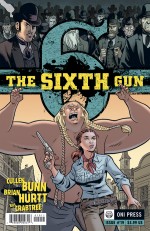
The Sixth Gun #19
Written by Cullen Bunn
Art by Brian Hurtt
Published by Oni Press

This series has become one of my favorite current comics, but unfortunately, it's so consistently good that I don't know if I have much to say about it. I do like that Cullen Bunn continues to build the world as the series goes on, adding new elements with each arc, details slowly accumulating to create a rich mythology that includes mystical weapons, warring religious factions, demons, sorcerers, monsters, and all sorts of cool details that make the Old West setting come to life. It makes me trust that there's a plan for the whole series, and I can't wait to find out where it's going each month. Brian Hurtt on art definitely helps; he's a monster, filling out and solidifying all those details while maintaining a great sense of character and place, and lending an appropriately creepy, moody air when it's called for, which is most of the time. I love it, and I always want more when it's over.
-----

Spaceman #4 (of 9)
Written by Brian Azzarello
Art by Eduardo Risso
Published by DC Comics/Vertigo

Brian Azzarello and Eduardo Risso are near-bulletproof for me after 100 Bullets, and they sure don't disappoint with this new Vertigo series, which is a completely different sort of thing, yet recognizably their work, full of that unique combined personality, all cryptic wordplay and encompassing atmosphere. The plot here, for those who don't know, follows a human-ape hybrid who was designed to work in space but has ended up scavenging the slums of a flooded earth as he ends up in possession of the kidnapped child of a celebrity couple. There are a bunch of twists and turns, and probably some secrets to be uncovered at inopportune times, but the most enjoyable part of the comic is getting to experience the future that Azzarello and Risso have created, trying to decipher the slang that everyone speaks in, marveling at the busted-up locales where the people survive and the believable technology that they use, enjoying the expressive characters and sudden, shocking violence. I expect nine issues is going to be too short of a time to spend in this fucked-up, all too possible future.
-----

Wasteland #34
Written by Antony Johnston
Art by Justin Greenwood
Published by Oni Press

Interest in this title may have been flagging around these parts due to the erratic schedule over the last year or so and the loss of artist Christopher Mitten, but things kind of snap back into place in this issue, with a revelation that brings many of the series' themes into focus, namely the emphasis on belief systems, the supernatural, creation stories, and religions. Suddenly, this isn't (necessarily) the sci-fi post-apocalyptic story that it appeared to be, but a sweeping history of mythological proportions. Huh, how about that? Color me reinvigorated.

Thursday, December 3, 2009

Essex County: I'm late to the party, but I'll still wear a lampshade on my head

Elsewhere: I reviewed Strange #2 at Comics Bulletin. No TV reviews this week, since neither show I write about had a new episode. Sorry, Brady-addicts.

Links: One Patrick Wensink informs me that he is having a coloring contest using images from his book, Sex Dungeon For Sale!, and one of the prizes is an autographed copy of Michael Kupperman's Tales Designed to Thrizzle collection. So go enter!

Check out the awesome Paul Pope illustrations for a GQ article about Japanese concept cars. Hey, wasn't Battling Boy supposed to come out this year?

I really liked this fumetti piece starring Harvey Pekar at the Graphic NYC blog. Good stuff.

Okay:

Essex County
By Jeff Lemire


Jeff Lemire has been getting a lot of acclaim over the past few years, and with this brick of a collection of his breakout series, it's easy to see why. Some (your not-necessarily-humble critic, for one) might have balked at his work, unsure about the odd artistic style, but once you dive into the stories here, it's easy to get lost in Lemire's world of placid settings and crushing loneliness. And while his intimate storytelling style might have gripped readers and plunged them into the lives of his characters in the single volumes, having them all smashed together really brings out the intricacies of the interconnected relationships and long-term plotting; it all ends up seeming like more than the sum of its parts, which, considering the affect those parts have had on readers, is really saying something.

Lemire starts out small with the first third of his trilogy, Tales from the Farm. It follows a young, orphaned boy who is struggling to deal with the death of his mother and the lack of a father figure throughout his life. He chafes against the unsure guidance of the uncle in whose care he was left, gravitating instead toward the hulking neighborhood gas station attendant, another lonely soul who once had a chance at glory as a pro hockey player before an injury sidelined him permanently. He's not helped either by a superhero comics obsession that leads him to wear a mask and cape everywhere he goes, but this does allow some escape through flights of fantasy.

The second book, Ghost Stories, sees a pair of hockey-playing brothers leave the rural county of the title in order to play in the minor leagues in Toronto, briefly finding a bit of athletic glory before managing to alienate each other and remain apart for most of the rest of their lives. The story is told in flashback, narrated by the lonelier of the brothers as he struggles to understand his surroundings when dementia sets in, causing him to confuse everything he sees with some moment from his past, adding an additional layer of poignance to the already-sad story of a lifetime of regret.

Finally, the third volume, The Country Nurse, ties everything together, revealing the deep connections between the first two sets of characters and allowing for a bit of closure, if not exactly a resolution. Lemire gives us two storylines here, with one in the present following the title character as she makes her rounds, inserting herself into others' lives and meddlesomely trying to help with their emotional issues, while still dealing with her own, which involve a dead husband and a rebellious son. This is intercut with a flashback to nearly a century before, as a nun who oversees a remote orphanage must lead her young charges through the snowy wilderness after a tragic fire; could they end up being the ancestors of all our present-day heroes? This wraps everything up in a possibly too-perfect bundle, but it does point out that there's no need for the loneliness and isolation these characters all force themselves into; they've got something in common, as does everybody on earth if you go back far enough.

The whole, huge tapestry ends up being a sad ensemble piece, with the first book setting the tone for the series early, and the rest of the stories continuing in a similar vein. Lemire catalogues myriad variations of poignant isolation, usually self-inflicted. But this is no simplistic, surface-only wallow in various bits of sadness; Lemire manages to make all the characters feel achingly real, through glimpses of their thoughts, examples of the way they go about their lives, flashbacks to revelatory moments, and interactions with each other that demonstrate their halting desire for connection. It's a very impressive example of character architecture, with the reader immersed in these people's lives and feeling transported to a very specific setting and emotional state.

That artwork, which is certainly uniquely idiosyncratic with its square noses and spindly, elongated limbs, ends up working wonderfully to define the setting and characters, and brings a surprising specificity of emotion to life along with wide-open landscapes that match the emptiness that everyone seems to feel. It might look somewhat crude at first glance, but the sketchy raggedness of the lines hides a firm grasp of technique that eventually leads to some astonishingly effective moments.

The second volume, especially, sees some wonderful, powerful scenes in which emotion is laid bare on characters' faces and Lemire comes up with beautiful artistic techniques to convey memory. The elderly Lou watching a key moment from his past play out as if he's just another observer in the room is heartbreaking:


And a bit of tearful recall at a moment of childhood happiness is equally sad:


Lemire returns to bravura artistic moments like these several times throughout the series, but he's even more effective at simple conversations, in which inner pain simmers behind his characters' eyes:


I've only scratched the surface here; there is much emotional richness to be encountered within these covers. Lemire has his own style of art and storytelling, but it's a pretty incredible one, able to work wonders to bring people to life, making us care about them and want happiness, forgetting that they're simple lines on paper. That's the mark of a great storyteller, and it's obvious that Lemire should have a long, fruitful artistic career ahead of him.

Wednesday, October 7, 2009

Collection catchup: Vertigo plus one

Links: Have I pointed out Kevin Church's new projects? He's got a weekly strip called The Loneliest Astronauts with Ming Doyle, and it looks pretty damn enjoyable. And there's also what appears to be more of a serialized crime story called She Died in Terrebone: A Sam Kimimura Mystery, with art by TJ Kirsch. They both look quite good; that Church fellow is going places.

This Paul Pope strip of a scene from Dune is pretty nice-looking.

Hey, let's make this a regular thing (which probably dooms it to obscurity): short(er) takes on collections of ongoing series, what those in the publishing world (and, inexplicably, the comics community) call trade paperbacks. Go!

Fables, volume 12: The Dark Ages
Written by Bill Willingham
Art by Mark Buckingham, Mike Allred, and David Hahn


There were a couple possible ways to go with Fables after ending the long-running war plot, with the more difficult one seeming to be seeing how things work out in Fabletown and the Homelands after defeating the Empire. What would happen in all the liberated worlds, and how would the new leadership (such as it is) cope? Bill Willingham hints that this might be what is going on in the first issue of this collection, but then he immediately upsets the new status quo in a pretty surprising way, knocking the victorious Fables back on their heels and leaving them scrambling to not only survive against a new threat, but trying to figure out what has happened and who has done it to them. It's pretty canny storytelling, jumping back into the pattern of downtrodden heroes fighting a powerful enemy, but in a much different way than they had been before, and with a lot of new wrinkles to the setup. Yes, the title continues to be as gripping as ever, and I couldn't be happier, even with the tragedy that befalls the beloved characters here.

And that's the other thing that Willingham does: focus on characters, rather than just hitting plot points. The big event here (aside from the main plot developments, that is) has to be the worsening condition of Boy Blue; watching him slowly deteriorate while fighting his war injury until he looks like little more than a desiccated corpse is tough, and the moments he has with friends and loved ones are pretty great, especially his eye-opening confrontation with Rose Red, who also looks to be growing into a major character who is full of fascinating flaws. But even the little stuff is neat to see here, like Fables who were born after the evacuation to the mundane world wanting to gain a birthright by taking over some of the newly-freed worlds, or the way the animal Fables bristle at the way they get brushed aside from being included in big decisions. And the new bad guy, the ominous Mr. Dark, is one hell of a creepy fellow; I'm very interested to spend more time with him.

On the art front, Mark Buckingham is as good as ever, filling pages with tons of gorgeous detail that combines a realistic setting with fantastical characters and still seems like something out of a storybook. His art definitely fits the title of the arc, as it gets increasingly dark over the course of the story, using some interesting toning patterns and lots of inky shadows. Mike Allred also turns in some nice guest art on that aforementioned filler issue, which sees Pinocchio giving Gepetto, the deposed Emperor, a tour of Fabletown while dodging the various angry protesters, shopkeepers who refuse him service, and people who march up to give him a piece of their minds. I'm especially struck by Allred's depiction of Pinocchio as an innocent-seeming, dot-eyed young boy, which stands in contrast to Buckingham's usual cynical-faced miniature adult.

Yes, it's another good volume, and I'm as excited as ever to get to the next one. Interestingly, there is a bit of metafictional exploration here, as characters wonder about the power that mundane storytelling has over them. It hints at the contents of the next arc, "The Great Fables Crossover", which sees Jack of Fables, which usually goes much further in that metafictional direction, and a miniseries about an even more metafictional type of Fable, The Literals, meet up with the main title. I have no idea where it's going, but I can't wait to find out.
-----

Unknown Soldier, volume 1: Haunted House
Written by Joshua Dysart
Art by Alberto Ponticelli


This is one hell of an intense book, and not in a good way. That is, it's full of action and violence, but it's the type of thing that happens in the real world, and it's stomach-turning in its (only slightly exaggerated, I imagine) nastiness. Joshua Dysart famously made a research trip to Uganda to gather material for the story, and it shows, with lots of details that come straight from real life, and a sense of moral outrage at the awful way people can treat each other (both face-to-face and through willful ignorance and unseen advantage-taking). It's the kind of thing that's designed to make one angry at the inhumane acts being perpetrated on people, and mind-boggling to consider that it's only focusing on a small portion of the violence and horror that's going on in the world.

But all that detail is in service to an interesting story about a heroic African-American doctor who has pledged his life in service to the downtrodden refugees (or "internally displaced persons", to use a less headline-grabbing term that keeps them off the world's radar) of northern Uganda, along with his loving and equally-medically-talented wife. But the anger he feels at what he sees seems to be welling up inside of him, assisted by horrifically violent dreams, and one day he snaps after being caught in a standoff with a rebel soldier, with a strange, ominous internal voice urging him to commit his own acts of violence. He complies all too easily, sending him into what seems to be madness, and he ends up taking up a one-man war against the people who would casually rape and murder innocents, sporting the telltale bandaged face of the long-time war-comics character after he mutilates himself in despair at his actions.

There are hints at a story there about how he gained such deadly prowess with weapons and strategy, something about CIA brainwashing, but it's not really necessary; the real focus here is on the actions that spur him to take up arms, including the recruitment of children as soldiers, the rape and kidnapping of girls, and the casual murder of civilians just because they are in the way. There's some gut-wrenching stuff here, and its understandable to see the character want to painfully murder the perpetrators, but the actions he takes are just as horrible. And pointedly, they seem to make matters worse. He does his best to make things right, to stop those who are laying waste to the people and destroying lives left and right, but in doing so, he murders children himself, and only spurs them to retaliate in ever-more-awful fashion. Before his "conversion", he gives a speech about how violence only begets violence, and he just proves it later, turning into more and more of a monster and taking good people like his wife down with him. That seems to be the real message here, that peace needs to be achieved through something other than killing, and Dysart is doing his best to show why that is, and making sure we know it's not just artful speculation, but a very real issue that is killing more and more people each day.

Italian artist Alberto Ponticelli provides the art here, and it's often quite gorgeous, capturing the landscape really well and filling plenty of pages with the dirty details of medical camps and battlefields. The people, on the other hand, can sometimes be awkward, and maybe even a bit cartoony, but his exaggeration really brings out the lost innocence of the child soldiers, as their big heads, spindly limbs, and extreme difference in size from the adults really make them seem tiny and frail, especially when they are carrying huge guns that they seem barely able to lift. Some of the action is a bit hard to follow at times, but the gist is always clear; we understand who is being gutted and decapitated, or just shot, and even when it's a rah-rah action movie moment, there's a real feeling of disgust at what we see. Maybe a more "realistic" artist would have been more appropriate, but Ponticelli still does a good job of filling in all the nasty details, and he makes some of the more surreal touches and dream sequences really work. And who knows, maybe he'll get even better as the series goes on. That's something to hope for.

Ultimately, one wonders why Dysart chose to tell this story in this way. If you're going to do such extensive, dangerous research, why make an action story starring a version of a long-lived
war comics character? But maybe flying something like this under the radar as if it was just another bit of Vertigo violence is sort of the point. I suppose something like Joe Sacco's journalistic comics would have been more "acceptable", but maybe a release from a mainstream publisher will attract the attention of those who don't normally read about what's going on outside of their lives of Western comfort. Those of us who stick to what's comfortable occasionally need something to jolt us out of our complacence and realize the reality lurking beneath our entertainments, and maybe this will be enough to get us off our seats and actually do something, anything, to help make the world a better place. Sure, it might be kind of far-fetched, but it's a nice idea. Maybe Dysart can actually do something to help it happen.
-----

Wasteland, volume 4: Dog Tribe and Wasteland #25
Written by Antony Johnston
Art by Christopher Mitten


By this point, you're probably either on board this post-apocalyptic series or not, but it's still a comic worth discussing, considering the thought and work that Antony Johnston has put into the world-building here. It's much more than just a dusty adventure story; Johnston has crafted several different cultural traditions (so far), and much of the interest comes in seeing them crash together in different ways. And it's fascinating to watch, whether you're trying to understand the nuances of the slang that the people use or the different relationships between people. There's a continuing plot featuring some well-drawn characters and a lot of action and intrigue, but seeing the world they move through continue to be defined is the big treat for me.

The fourth volume sees some continuing development on that front, as Michael and Abi, on their quest to find the fabled A-Ree-Yass-I, almost immediately stumble across and get captured by a couple of "dog tribes" of people who live in close association with packs of dogs that have become much more than just pets. The main characters kind of just sit in the background while an intense drama plays out around them, involving a conflict between the tribes that is now being resolved via a marriage between the chiefs' families. It's another example of the way Johnston defines these characters and cultures so well; we get involved in their conflict very quickly, although we don't necessarily understand what they're talking about or the way they relate to each other right away; flashbacks work to get us caught up in the tragic story.

It's very effective work, with the alien society really coming to life. Johnston does a lot of the work, but Christopher Mitten's art is what really sells it, from the vaguely African tribal fashions of the people to the way they interact with their dogs, and the deference that lower-ranking people show to the chiefs is palpable. It's gorgeous work as always, in Mitten's signature scratchy style that hides a surprising amount of detail.

And then in the twenty-fifth issue of the series, Johnston and Mitten give us one of the regular interstitial stories that doesn't directly affect the main narrative, this time being a flashback to an encounter between Michael and the nomadic trader Sultan Ameer, explaining some of the animosity that we've seen. It's a nice little story, mostly focusing on one of Ameer's wives as she tries to visit her family, who she hasn't seen since she was forced to leave them as a teenager. It's sad stuff, effectively told as always. And the big highlight is Mitten's art, which for this special occasion is in full, painted color, looking quite beautiful, with lots of deep blues and purples and searingly bright oranges. Hopefully this won't just be a one-time treat.

I don't know if the series is still gaining any readers, but hopefully if anybody hasn't kept up with it, they'll give it a second look, because as the series progresses, the creative team's talent for crafting a fascinating world for their tale to play out in becomes more and more apparent. I hope they'll be able to continue to wow readers for as long as they need to finish telling their tale.
-----

DMZ, volume 7: War Powers
Written by Brian Wood
Art by Ricardo Burchielli, Kristian Donaldson, and Nikki Cook


It seems like the intensity never lets up in this series, but it's morphed into intensity of a different type in these later volumes, going from characters trying to survive in a war zone to protagonist Matty Roth trying to navigate the complex world of politics, barely able to understand the forces pulling him in different directions, with dire results not just for himself but for all of Manhattan if he makes the wrong decision. It's hard to watch, and while we can sympathize with his plight, he still seems to be letting others push him around and manipulate him too easily. He does finally take some steps to remedy that trend, but even that seems to be a selfish act, rather than the "right" one. But that shows him to be realistic, acting as a normal person would, which isn't always likable.

The title story of the volume is sort of the main event here, but the volume starts with a two-parter in which Matty travels to a U.S. Army base on Staten Island, where he finds a sort of bacchanal in which the base commander negotiated an unauthorized truce with the rebel army to facilitate some mutual partying. It resembles Rick Veitch's Army@Love, although toned down quite a bit, and with less of a satirical intent. But it's the kind of thing that one can see happening in a war zone, especially when the enemy shares your own culture and values. And when it all inevitably falls apart, it's as hard to watch as anything else in the series, considering that it all seems like it's taking place in the real world, in an alternate universe where these kids are next door rather than on the other side of the world.

And then the main event starts, as Parco Delgado takes power as the provisional governor of the DMZ, immediately making some controversial moves, declaring the region to be a sovereign nation and kicking out both combating armies and severing all military contracts, especially any involving the Blackwater-esque Trustwell Corporation. This leads to plenty of chaos, and Matty is kind of left in the lurch, with nobody telling him what's going on. It turns out that he's an important part of Parco's plans, since he has contacts to Wilson, the Chinese gangster who might have a source of funds for the administration. And after securing those funds, Matty finds that Parco's got a lot of plans that don't necessarily seem to line up with his idealistic campaign promises, and at least one action that seems reprehensible in its "ends justify the means" cynicalness. It's hard to watch, as Matty's dreams of peace seem to get further and further away, but as with everything else in the series, it seems all too real, the stuff of real-world backroom deals and compromises in morality to achieve political goals. And the thing is, Delgado is enough of a charismatic talker that you almost believe him when he explains his actions. And who knows, it might all work out for the best, but given the real-world-imitating nature of this series, that certainly seems unlikely.

The volume wraps up with a single-issue story that follows Matty's (ex-?)girlfriend Zee, who left him and went off on her own into the unpoliced, dangerous area of the city after getting disgusted with the compromises that he was making. But even she can't escape the tough decisions, as she ends up forced to choose between helping out a wounded mercenary or letting her die. She's dragged right back into the conflict, or at least its periphery, as is her nature. As much as she might protest, she's in this for the long haul, like everybody else.

Yes, the quality of this series keeps going at the same level, and it's admirable that Wood is continuing to develop the conflict in new directions, and not take any easy shortcuts. If you can handle the depressing levels of violence and the despair that comes from realizing that the real world is just like this (or worse), the series continues to be required reading. I'm confident that Wood can continue to keep it up, and I only hope I can do the same.

Thursday, July 9, 2009

Shonen Jump: Not girly enough

Some linkiness: I (along with the rest of the world) was unaware of Rick Veitch's involvement with the creation of the Marvel Comics character the Sentry, but he has the story in a series of posts on his blog. I pretty much hate the character, but there's a germ of an interesting idea in there, and now I can attribute that to Veitch, and all the lame stuff to Paul Jenkins.

Looks like Powers is getting relaunched again, and it's supposedly going to come out monthly. We'll see how that goes. I still need to read the most recent collection...

The new "issue" of Dark Horse Presents (relocated to DH's site, at least for now) is up, and it's a good one, with a superhero story by Gilbert Hernandez, a "Giant Man" tale by Matt Kindt, and a Buffy story illustrated by Jo Chen. Cool.

I like this illustration of Macchu Picchu by Paul Pope.

And speaking of Pope, he did some really cool illustration work on this (mostly safe for work) photo gallery of girls in various states of undress for Marc Ecko's Complex magazine. Man, that guy can draw.

On the manga weirdness front, Scott Green has posted a couple pages from Hiroaki "Blade of the Immortal" Samura's series Halcyon Lunch. Freaky!

Oh, and I also blathered on about last week's episode of I Survived a Japanese Game Show over at The Factual Opinion.

Okay, on to my bitching:

Shonen Jump
August 2009


Since I had a subscription to Shojo Beat, I'm now receiving issues of Viz's manga magazine from the other side of the gender divide. I deeply mourn the loss of my monthly dose of girliness, so why not take it out on a few series that I have little knowledge about? That's not all that fair, but it's at least an interesting exercise to jump into a long-running series and see how much I can understand and how well information is conveyed to a new reader. As with SB, the series cover a range of quality, from enjoyable and well-done to tiresomely obtuse and hard-to-follow. That's the way it goes, I suppose. As for non-manga content, what there is is pretty negligible, mostly related to anime, video game, and collectible card game tie-ins to the various manga series. There's also reader-submitted fan-art, which is nice to see; even the lesser series can inspire creativity.

Okay, lets's see what sort of sequential storytelling this magazine has to offer:

Waqwaq
By Ryu Fujisaki

The title of this series amuses me; it sounds like a duck's noise. I'm not sure what to make of it, but it's got a few somewhat interesting ideas behind it. The first couple of pages feature some psychedelic coloring (of the sort that can be seen on the cover of the first digest volume), but the rest of the story loses that energy, taking place in a vast post-apocalyptic wasteland. Apparently humans have been driven underground by killer robots and taken to living in earthen-domed cities. Our heroes are a traveling father and son; it turns out that the father is Guardian Al, a guy who can combine with their pet, a good robot, and defend humanity against the nasty machines. Of course, a shonen series isn't going to follow somebody who is already an established, respected champion, so you know something is going to have to happen to the father that will make him pass his mantle on to his son, the skunk-headed son. Sure enough, an attack by a giant horde of robots that take the shape of a giant man-like figure ends with a heroic death, and young Shio gets saddled not only with being a guardian, but the responsibility of protecting a (time-displaced?) young girl who seems to be the supernatural power behind the machine attack.

Thats some pretty basic Shonen stuff, and there's definitely some crazy energy here, but the action can get hard to follow at times. Still, there are some interestingly weird touches, like the organic designs of the machines, or the techno-symbiotic way they combine with people:


Or the bizarre appearance of a smiley face on the machine man:


The first chapter of a series isn't usually enough to make a complete decision, so things could easily get tiresome after this, but there's potential here, so it might be something to keep an eye on, if goofy shonen robot-battling is your sort of thing.
-----

Naruto
By Masashi Kishimoto

Oh lord, this is obviously not the place to jump into this incredibly long-running series (this issue of the magazine contains chapters 434-437); I was not only completely lost, but even though it was all high-stakes fights, most of it came off as boring, and surprisingly slow-paced. Naruto is fighting a guy named Pain, who can apparently possess several bodies at once, with the main one looking like a double of Naruto himself, except with black studs along the sides of his nose and concentric circles in his eyes. He's incredibly powerful, and Naruto is trying to figure out a way to defeat him, along with some frog mentors and a slug (?) that rides his shoulder. While there are occasional blows struck, most of the time seems to be spent discussing strategies, chakras, "jutsus" , and who knows what other gibberish. When the actual action happens, it's pretty cool:


But about halfway through this series of chapters, Naruto gets pinned to the ground with a sword (or whatever the black rod weapon that Pain uses is), and the two opponents spend an interminable amount of time arguing about peace and justice. There's probably some backstory involving rival ninja clans here, so for longtime fans it might be an interesting and enlightening debate, but for me, it's tedious talk when there could be more punching going on. Come on, I expect some awesome ninja skills when reading Naruto; if I wanted confrontations that consist of characters talking angrily at each other, I would still be reading Vampire Knight!

The final chapter ends with Naruto transforming into a giant, multi-tailed fox spirit, which seems cool, although it seems to be exactly what the bad guy wants, so who knows, it could lead to more tediousness. Find out next month!
-----

Ultimo
By Hiroyuki Takei
Original Concept by Stan Lee

Ah, it's the notorious manga "written" by Stan Lee! He's only credited with "original concept" here, so it looks like the heavy lifting has been done by Shaman King creator Hiroyuki Takei, but I do notice that a key character (who doesn't actually appear anywhere outside of the title page this chapter) has been given ol' Stan's likeness, with a bit of beefing up and a ponytail:


That's funny. Anyway, this is only the second chapter, so it's not too hard to jump into the story here. Apparently, the series concerns two robot puppets, Ultimo and Vice, who were created in the 12th century by some sort of old-school mad scientist (the Stan Lee character), supposedly embodying good and evil, respectively, with the intent of having them battle to find out which is stronger. Uh huh. Now, in the present day, a kid named Yamato (who seems to be the reincarnation of a bandit from the past, or something) comes across Ultimo in an antiques shop, and his presence makes the robot boy wake up, declare Yamato to be his master, and get all frantic about finding Vice and stopping him before he obtains a master and becomes powerful. And then, sure enough, Vice shows up and attacks Yamato and his friend, slicing a bus in half with a huge claw and prompting Ultimo to show up and save the day. As with too many of these types of things, there's only a little bit of action, with several pages taken up by the characters posturing at each other. It's still kind of cool, since Ultimo is floating in midair, holding half of a bus in each hand, and Vice has a ridiculous thirty-foot-long giant claw sticking off the end of his arm:


I'm not so sure about the character designs; Takei seems to favor highly-exaggerated features, so the robots have overly skinny limbs and torsos, but wear flamboyantly poofy clothes (and, in the case of Ultimo, a halter top that makes him appear to have breasts) and sport hugely spiky hair. That's not all that uncommon in shonen manga, but it's a bit much for me. Still, I don't mind this one all that much; it's kind of silly so far, and I doubt it will be a highlight of Stan Lee's career, but it's probably going to be fairly enjoyable.
-----

One Piece
By Eiichiro Oda

This is probably another series that's much too far into the story to make sense at this point (rather than a ridiculously high chapter number, this is the 56th and 57th installments of the current storyline, "Alabasta"), but it's still pretty enjoyable, even though we're jumping in right at the climax. Our crew of piratical heroes are apparently mixed up in a revolution in some small country, with most of them in the midst of a city-wide battle. There are some scenes in which a girl who I guess is the princess has climbed to the top of a clock tower and is screaming at everyone to stop fighting. That's probably supposed to be dramatic, but I've got no context. More interesting is the fight going on elsewhere between the rubbery-limbed Monkey D. Luffy and the bad guy, a big dude named Crocodile. There's no boring posing going on here; the fight is all a flurry of crazy action, with the highlight being a bit in which Luffy kicks Crocodile up through a building's roof and high up into the air, then sucks in a bunch of air and shoots himself up into the sky in order to deliver a crazy multi-fisted attack. It's awesome.

Oda's art is pretty amazing too, although I did have a slight bit of trouble following the action at times. But he really sells the hard-hitting nature of the fighting, with everybody's faces and bodies streaked with dirt and smeared with blood (I assume; it's hard to tell in black and white). But at the same time, the crazy exaggeration keeps things appearing cartoony and fun:


And while there's a large amount of destruction, with buildings being toppled left and right, we're assured that it's okay by Luffy's huge grin, signifying that it's all a fun romp through this milieu of scurvy scalawags. Sure, I might not really know what is going on here, but I had a hell of a time reading it. This is much more like it.
-----

Tegami Bachi
By Hiroyuki Asada

And it's back to the realm of incomprehensibility, which is pretty remarkable, since this is only the fourth chapter of this series. From what I can piece together, it takes place in some sort of medieval-ish fantasyland, and Lag, our intrepid boy hero (there's one in every shonen series, of course), wants to be a Letter Bee, one of an elite group of Pony Express-style messengers who are allowed to travel across the uninhabited areas between cities. He's joined by the requisite band of adventurers, with the most interesting one being a weird feral girl named Niche who has prehensile, sword-like hair. But the main focus of this chapter is a different girl named Nelli, who, along with a bunch of other people, is trying to steal Lag's Crossing Pass, which allows passage on a bridge between cities. Got that? Because I don't know if I did. Nelli wants to find a guy named Jiggy Pepper (gotta love the names in this series) who abandoned her and her younger brother, eventually leading to the boy's death of sickness. Boo hoo. We get some chases, some weird shit involving Lag's power, Niche trying to get Lag to admit she's his "dingo" (servant? I dunno), and a big monster attack. I suppose it all makes a sort of sense if you just go with the flow, but this is the kind of manga that makes me say "I'm too old for this shit".
-----

YuYu Hakusho
By Yoshihiro Tagashi

Wow, this series is still going? Do kids even like this sort of thing? It seems so old-fashioned. I can barely follow it, but as with most of the content of this magazine, it's very far into a long series, so it's probably silly of me to expect to do so. As far as I can tell, this one is about demons and fighting tournaments in the afterlife, and the current storyline sees several powerful rivals planning to compete in a massive tournament that will decide who rules the "Pemon Plane". Sounds like a big deal. The chapter here (which takes the One Piece tack, being the 12th part of the current storyline) seems to be a preliminary one, positioning the various competitors as they make alliances and prepare to wage battle, or whatever. I find it kind of boring, with maybe some slightly humorous moments here and there; the main thing that I take away is the surprising crudeness of the artwork. A lot of the characters seem roughly sketched onto the page, without much energy going into the details at all. Why would I want to read something like this on a regular basis? It's boring and ugly. Next!
-----

Bleach
By Tite Kubo

And here's another one of the better series; after this chapter, I can see why some people like this manga so much. Again, it's quite a ways into a long series (although only chapter 11-13 of the current storyline, "Journey to Hueco Mundo"), but I feel like I'm able to jump in and go with the flow without feeling so confused that I want to throw the magazine on the floor. I don't know what hollows, arrancars, or espadas are, but I get that there's a girl named Orihime who has been kidnapped by bad guys, and they're trying to screw with her psychologically and get her to betray her pals. And meanwhile, said pals are making their way through the bad guys' fortress in an attempt to rescue her. That makes enough sense for me.

The real highlight here is Tite Kubo's dynamic artwork, which is really clear and exciting in the fight scenes. Our hero Ichigo comes across a guy named Dordoni, who initially appears to be a pushover, given his clumsy entrance and goofy matador-like attire. But soon enough, he's kicking Ichigo through walls and doing pretty awesome stuff:


And he even sprouts some crazy spikes from his shoulders and his pants grow nozzles that shoot out huge, prehensile clouds of smoke, or something. I dunno, it's weird and crazy and pretty cool. I'm pretty floored by how well Kubo conveys motion during the action; check out the middle panel of the second image just above; the dense lines on Dordoni's clothes work as shading, but they're also like speed lines, showing that he's flying through the air toward Ichigo. And the same lines work in the next panel to show Ichigo jerking his head upward in anticipation of the next blow. That's some nice work there.

So yeah, I still don't really know what's going on here, but it's still hella fun to read. Why can't all the series in the magazine be like this?
-----

Yu-Gi-Oh! GX
Story and art by Naoyuki Kageyama, in collaboration with Brain Navi
Original concept/supervised by Kazuki Takahashi

It seems like I should be lost on this series as well, since it's a spin-off or follow-up to the long-running card-battle series that seemed hugely popular a few years ago, but not so much, really. I only have a vague notion of how the game the series is built around actually works, but the few episodes I've seen of the anime show (along with most of the movie, which came out when I used to work at a movie theater, so I watched bits of it here and there) were enjoyable enough; it always cracks me up when they shout "I summon Mega Fire Dragon! Now attack, with Ultimate Blast!" or something like that. It's so dramatic.

Anyway, this version of the series follows some students at a Duel Academy that apparently teaches only how to play silly card games, since that's what's important in life. There's some intrigue about Jaden, the main character, angling for a higher rank and competing against the school champions or something, and a subplot about a malevolent demonic presence, but that's all fluff; the real fun is just watching them play the game. It's pretty much exactly like the anime, with cards being drawn and weird creatures attacking each other, and characters revealing some amazing hidden strategy to everyone's shock and amazement. I dunno, that's pretty stupid when described (or watched, or read, etc...), but I find it kind of enjoyable, in a cheesy way. Characters shouting "I'm not going to hold back! I'm going all out!" and that sort of thing. It might not be great, transcendent shonen manga, but it's fun for what it is. I can't really fault it too much. Yes, I'm sure those words will attract many readers. Enjoy, weirdoes!
-----

Aw, that was much too positive of a way to end this. I was hoping to shout and swear and cry, showing my anguish at the loss of my beloved girls' comics. Overall, I would give the series in the magazine a thumbs-up for maybe three, or three and a half of the seven series (with Ultimo, Yu-Gi-Oh, and maybe Naruto getting a half a thumb, even if that doesn't make sense. Oh, and another half a thumb for the Waqwaq preview, why not?). That's probably around the level of Shojo Beat, but I was more invested in those series. We'll see how it goes, I guess, but probably not for too long; I don't think all that much more is left on my subscription.

Monday, June 8, 2009

This week, I'm probably too tired to make much sense

Man, MoCCA takes a lot out of a person.  But more on that later.  For now, it's business as usual.

Elsewhere: I've contributed a couple entries to The Factual Opinion's Comics of the Weak, dissing on Ultimatum #4 and Punisher: Naked Kill.  I also reviewed Atomic Robo and the Shadow from Beyond Time #2 at Comics Bulletin.

In comics news, Tom Scioli reports that he's going to have a new Myth of 8-Opus graphic novel called The Labyrinth.  I dig Scioli's art on Godland, so I'll have to try to read this.  You can check out a 28-page preview PDF of the new book here.

And: Becky Cloonan announced a new project at MoCCA, a webcomic called KGB which will apparently be about a Japanese boy band.  She's collaborating on it with Hwan Cho, and it will begin in September.  Here's a preview.  Looks like fun.

And how about this? Marvel finally announced their long-rumored "indie" book, and it's called Strange Tales MAX.  It comes out in September, and it will feature creators like Dash Shaw, Michael Kupperman, Paul Pope (who also drew the cover), Junko Mizuno, James Kochalka, Johnny Ryan, Nick Bertozzi, Nicholas Gurewich, and Jason.  Also, Peter Bagge's "Incorrigible Hulk", which they've been sitting on since around 2001.  Holy shit.  Details (including that awesome Pope cover) here.  I can't wait.

God, I am exhausted and typing most of this while waiting for my plane in the airport, so be prepared, this could get silly.

New comics this week (Wednesday, 6/10/09):

Absolution #0   

Another week, another supposedly badass superhero series from Avatar, sure to feature lots of violence and variant covers.  This one is from Christos Gage, who people seem to like.  I don't think I've actually read anything he's written, so I go by hearsay here.  Art is by Roberto Viacava.  I think it's a more low-level, vigilante-cop sort of thing, rather than the big-idea, large-scale Warren Ellis stuff from Avatar.  Probably still pretty gory though.

Anna Mercury 2 #1

Speaking of Warren Ellis, he's continuing with his "hot chick adventures in alternate dimensions" series.  I should finish reading the first volume; the first couple issues weren't bad.

Billy Batson And The Magic Of SHAZAM #5

Is this worth reading without the presence of Mike Kunkel?  Maybe; Art Baltazar and "Franco" write, Byron Vaughn illustrates. Probably still cute.

DMZ #42

More urban war zone stuff from Brian Wood and company.  I was about to read that election volume, but I'm suddenly distracted by loads of MoCCA comics.  Eh, it's not going anywhere. ETA: I just found out that Ryan Kelly is illustrated the story that starts in this issue; you can see some sample artwork here.

Fables #85

Part 7 of the Great Fables Crossover.  Collection soon, please.  Hey, how about that Fables prose novel that's coming out?  I saw an advance copy at MoCCA, and even though it might not be great, I'm sure I will buy it, because I'm an addict.  Feed me your fairy tales, Bill Willingham, come to my house and read them to me as a bedtime story.  Only then will I be happy.

Fantastic Four #567

Millar, Hitch, Dr. Doom’s bosses wreck shit, etc.  Is everybody ready for this run to be over already, or is it just me?

Final Crisis Aftermath Escape #2 (of 6)

I heard this one wasn’t too bad.  Sort of a superhero version of The Prisoner, which isn’t a bad idea.  I flipped through that first issue, and there was a Wonder Woman of those freaky Build-A-Friend things from OMAC.  There’s potential for some crazy shit here.

Lockjaw and the pet Avengers #2 (of 4)

Reviewing the first issue of this, I totally missed out on the idea that it might be kind of inaccessible to casual readers, which is troubling, since it means that I’m a bigger nerd than I thought.  I don’t know if that really matters though, since even though people think this is for kids, since it features cute animals, it’s really for old (you know, like 25) superhero fans who like goofy shit.  Like Tiny Titans; do any kids actually read that?  Anyway, there’s dinosaurs here, and Ka-Zar’s sabretooth tiger pal, and no sign of gimmicky Obama cameos yet, so there you go.  Try to contain your glee.

Miss America Comics #1 70th Anniversary Special

Hey, these old-timey Marvel specials haven’t been half bad, with the best one so far probably being that Chris Burnham-illustrated thing from a couple weeks ago.  Here’s another one, by Jen Van Meter and Andy MacDonald (NYC Mech), with the title character teaming up with Rosie the Riveter (or some equivalent) and getting chained up and shit.  Looks nice, and there’s a backup reprint featuring the Whizzer, whose name always cracks me up, because I am twelve.

Resurrection 2 #1

I didn’t read the Free Comic Book Day thing for this book; was it any good?  Apparently, this new volume is in color, with a different artist from the original.  It could turn out okay; I’m always hopeful.

Soul Kiss #5

I think this is the last issue of Steven Seagle and Marco Cinello’s miniseries, and it’s one I’ll try to catch up on, if only because I dug the art.  It looks nice, is what I’m sayin’.  That’s all.

Storming Paradise #6

Hey, how about this one?  Alternate history war, with the US invading Japan instead of dropping nukes, right?  I’ve heard nothing.  Chuck Dixon wrote it.  Anything?  Anybody?  This is the last issue; I assume the Allies still win.

Thor Tales of Asgard By Stan Lee and Jack Kirby #2

More recolored reprints.  Is Marvel going to collect this?  Dumb question; they collect everything.  I’d rather read the original version; don’t spray (virtual) paint all over Jack Kirby and tell us it’s makeup. 

Toy Story Mysterious Stranger #1 

Boom! keeps rolling out these Disney/Pixar books, and they all look pretty nice.  This one’s by Dan Jolley and Chris Moreno (Paul Jenkins' Sidekick), and “The Mysterious Stranger” is the title of the story in the issue, not the miniseries itself.  It’s a done-in-one with the toys getting up to antics and whatnot, like they’re prone to do.  Wheeeeeeeee!

Uncanny X-Men First Class Giant-Size Special #1

This “First Class” thing is a whole sub-line for Marvel now, which is good news for those obsessed with certain eras that they grew up reading and want to return to in hopes that they can remember their first wet dream.  The new series is going to be about the Chris Claremont/Dave Cockrum(/John Byrne?) years, so here’s an introduction that does seem pretty fun, with stories by Jeff Parker, Scott Gray, and Roger Langridge, and art by Joe Infurnari, Cameron Stewart, Sean Galloway, and some other dudes.  Enjoy, but come on, isn’t it time to switch to big boy pants?

Unknown #2  

The first entry in “Un-“ week, it’s another installment of this series, which I think is about a girl supernatural detective?  It sure looks nice; I gotta read these and see how well they work.  Don’t let me down, Mark Waid!

Unthinkable #2

Oh yeah, this one too.  Mark Sable’s doing his thing about terrorists and getting cavity searched at airports for it, so the least I can do is give it a read.  You don’t let me down either, Sable!

Unwritten #2

There’s this one too, which seems okay.  I did get a free copy of the first issue at MoCCA (I only had to fly to New York to save that dollar. Thanks, Vertigo!), so I can see how this is.  Don’t let me down, faux Harry Potter!

Veil #1  

This one is from IDW, and it's about a woman private eye who can talk to ghosts, or see into the land of the dead, or something like that.  Sounds spooky, and maybe cool?  It's by El Torres and Gabriel "Not Gilbert" Hernandez.  Here's an interview with some preview pages.  Looks nice.

X-Men Forever #1

Did I mention people needing to grow up?  Chris Claremont is a good example; he’s “continuing” the story he left off telling way back in 1991 or whenever, because he obviously had something important to communicate about Fabian fucking Cortez.  I bet even Jason Powell isn’t all that interested in that dude.  I do like the idea of Marvel splitting up into various writer-based continuities though.  Let’s have Grant Morrison continue his run, and separately, Chuck Austen can come back and do more stupid shit, and then Joe Kelly and Steven Seagle can return and tell those stories they were obviously dying to relate before being quashed by editorial, and what the fuck, we’ll get Mark Gruenwald’s ghost to come back and do some more Captain America (Steve Rogers never died, you fuckers!), and David Michelinie can undo whatever travesties have been enacted upon Venom, and so on and so on.  That’s the wave of the future right there.  Hire me, Marvel, these are can’t miss ideas!

Adam Legend of the Blue Marvel TP DM ED

Hey, how about this thing, was it any good?  That guy that did the Underworld movies, writing about a secret black superhero?  Was there anything more to it than that, or did he eventually take off his mask and become the Jackie Robinson of spandex, with people spitting on him while he fought Galactus and shit?  Because that must have been relevant.

Captain Britain and MI 13 Vol 2 TPB Hell Comes To Birmingham 

Pour one on the curb, man, I can’t stop crying about this shit.  The world needed to read about Captain fucking Britain and his band of merry men.  Why do people not read good comics?  Wait, that’s not right.  Why do people not read halfway decent comics that were destined to fail from the beginning?  It’s just not fair!  Sorry, that probably sounds harsh, but after seeing all the excellence on display at MoCCA, I have no patience for that shit.  Wah wah wah, some corporate-owned superhero bullshit won’t be around; there’s always more in the pipeline.  You’ll survive.

The Color Of Water TP

I just finished the first volume of this series (The Color of Earth) by Korean cartoonist Kim Dong Hwa, and it was pretty good, all about poetic sexual awakening and shit.  Watch for a review, probably sometime this week, if I can ever stop talking about MoCCA.

Dare GN 

This isn’t the Grant Morrison/Rian Hughes thing, in case you were wondering.  It appears to by a graphic novel by (or adapted from something by) Philip Jose Farmer, with art by Dave Gutierrez.  Something about humans on another planet consorting with the natives.  Interesting?  Maybe?

Douglas Fredericks and the House of They TP

A new book by Joe Kelly, with art by Benjamin Roman, about a kid who wants to get a present for his parents' wedding anniversary, but is thwarted by all their friends and neighbors, who don't want to upset "They", whoever that is.  Ooh, spooky.  I would take a look, given the chance 

Dragenaro TP

Dark Horse has this fantasy thing about wizards and dragons and shit; I dunno, I find the description unreadable.  It's notable for being a translation of comic from Italian publisher Bonelli; I'm always on the lookout for those Eurocomics.  Here's a three-page preview.

Final Crisis HC

Maybe I can read this now, with sufficiently lowered expectations.  It certainly sounds ambitious, with Grant Morrison going crazy with the cosmic Kirby stuff and all that, but the critical reception is quite mixed, whether from inconsistent art, or random tie-ins of varying importance, or the whole thing just getting away from him, but it should at least be an interesting mess.  All right, now I can only be six months behind the rest of the world.  To the library!

Flash The Human Race TPB 

Hey, speaking of Grant Morrison, here’s a collection of some of his run on The Flash, co-written with Mark Millar.  I’ve read it, and it’s not bad, with the title story seeing him run a race across the galaxy against his imaginary childhood friend for the fate of the human race.  That sounds dumb, but it’s quite all right, if you like that sort of thing.

Four Frightened Women GN 

This is "one of comics' first graphic novels", which is always interesting to see, although the talent involved probably isn't on the level of Arnold Drake.  Amusingly, the description also says that "few collectors are even aware of its existence", which is always a good sign, right?  Still, it might be worth checking out, for historical value alone.

Red TP New Edition

This isn’t a bad story by Warren Ellis and Cully Hamner, about a retired CIA guy getting targeted and having to kill a bunch of dudes.  The bad thing is, it’s only three issues long, and this collection is $15, which really isn’t worth it.  It’s better if you can hunt down one of those flip-book volumes from a few years ago; I think this was paired up with Tokyo Storm Warning.

Runaways TPB Dead Wrong

It’s the collection of the beginning of Tony Moore’s run on the title, with art by Humberto Ramos?  I can’t really recommend it; Moore doesn’t do a very good job of capturing the characters’ voices or personalities.  I guess you can go for it if you’re a completist, but I can’t condone that sort of thing.  Buy a volume or two of Nana instead, please.

Runaways TPB Vol 8 Dead End Kids Digest 

I can get behind this one though, especially in the cheap digest format.  Joss Whedon did a great job at getting the characters right, and while the story isn’t anything mindblowing, it’s a fun time travel romp with some neat character designs and several good moments.  It’s a worthy follow-up to Brian K. Vaughan’s run; hopefully the Moore stuff was just a bump on the road before the series gets back on track.

Sub-Mariner Depths HC 

I don’t think I ever finished reading this, but it was a decent bit of undersea horror from Peter Milligan and Esad Ribic.  Pretty art, weird paranoia, not bad.  Of course, the ending might suck, but I’ll say that it starts out well.  There you go.

Supreme Power Vol 3 High Command HC

If I remember right, this was where the story started to get a bit stretched out in the Straczynski/Frank run on the series, although there’s at least one good issue in which a fight with a supervillain sees a bunch of civilian casualties.  That was kind of cool.  Eh, whatever.

X-Men The End Trilogy TPB

Ha ha, Chris fucking Claremont again!  This was his first attempt at revitalizing his own legacy, or whatever, taking all his storylines and bringing them to a long, ponderous conclusion or something.  I don’t know; I didn’t read it.  From what I understand though, it was fucking terrible, something like 18 issues of blah blah blah that nobody in their right mind should ever care about.  Don’t buy this, please.  Please.  I want this book to never sell a single issue, so Marvel has to pile them up in a field in Westchester and pave them over, hoping everybody forgets about them (Hah! Cross-medium nerd reference!).

Detroit Metal City Vol 1 TP  

Here’s my number one anticipated manga of the moment (unless I get distracted by something else).  It’s supposed to be hilarious and profane, about a guy who wants to be a sensitive, emo singer, but he ends up working as a nasty, raucous, makeup-wearing, constantly swearing rocker.  People have been talking about it for a while, and it’s finally coming out in the U.S., so we’ll finally get a chance to see whether it lives up to its reputation.  Don’t let me down, Japan!

-----

Is that everything?  Not really much of a week, but that’s okay, I’ve got lots of MoCCA stuff to keep me busy.  More about that later, so stay tuned.  And apologies for the obnoxiousness and naughty words (but not really); Tucker is obviously a bad influence on me.  What would my mommy think?