Showing posts with label Vertigo. Show all posts

Thursday, May 12, 2016

The Kitchen: Another nail in the Vertigo coffin

The Kitchen
Written by Ollie Masters
Art by Ming Doyle
Published by DC Comics/Vertigo


Remember when the Vertigo label on a comic book used to mean something? It's not that every comic released by DC's mature readers imprint was great, but there was a certain level of quality to be expected. And there were many pretty great comics, from the early days of Sandman, Swamp Thing, Hellblazer, and Shade the Changing Man, through to 100 Bullets, Transmetropolitan, Y: The Last Man, and Fables. But these days, the imprint seems to be a victim of the continuing terrible management decisions made by DC (including the recent kerfuffle surrounding the firing of longtime Vertigo editor Shelly Bond), and if you want an example of how far Vertigo has fallen, The Kitchen is a perfect example.

The premise behind this series seems solid: in New York in the 1970s, three members of the Irish mob get sent to jail, and their wives end up taking over their business dealings, which leads to lots of power struggles and violence. It would probably make for a decent movie (although more of a middling crime drama than a prestige picture), but in this form, the story just kind of sits there on the page, without being very engaging or making the characters and their motivations compelling.

So: there's Kath, who starts out as the ringleader that convinces the other two women to take up their husbands' business while they're indisposed, mostly as a way to make ends meet for their families (although I think Kath is the only one with children, and they remain pretty much unseen until they play into a climactic moment between her and her husband, so there's not really anything in the way of stakes to get the reader on board for why they need to do this). Raven, Kath's sister, is initially hesitant, but somewhere down the line she turns ruthless and violent, a character arc that happens without much in the way of motivation. As the third member of the crew, Angie starts out kind of scared, but she quickly becomes enamored with the lifestyle and seems to revel in the violence.

As the plot proceeds, it takes all the turns you would expect: meetings with more established mafia figures, deals struck in order to solidify power, assassinations of rival gang members, and so on. When the husbands are unexpectedly released from prison (for no real reason other than dramatic purposes), this kicks off a war as the wives fight to keep their hard-gotten gains from being taken away from them. This is supposed to be the moment of actualization, in which they are faced with the choice of going back to their old lives as housewives or continuing down the path that they have forged as independent women (while the book is set in the 70s, the era of Women's Lib, there's little acknowledgement of the politics of the era; the time period is really just an excuse for costuming choices). Instead, it seems like they're going through the motions; there has to be a big enemy to face in order to have a dramatic climax, and while the series does throw in some late flashbacks in an attempt to flesh out the women's relationships with their husbands, it's too little, too late in the way of character development.

So there's little to speak of in the way of plot or character, but gangster stories are all about style, so if the execution is good, sometimes shakiness in other areas can be forgiven. However, as much as I think Ming Doyle is a pretty good artist, either this type of story is not her forte, or she was too rushed to turn in work that added much to the series. While much of the art is fine, with fairly realistic body language and facial expressions, there are many bits of awkwardness that draw attention away from the impact of the story and leave the reader with the feeling of watching mannequins trying to mimic human actions and failing. This includes characters that don't seem to be able to drink from glasses correctly:


Doors being kicked in with oddly stiff legs:


Punches that look like hands being awkwardly thrust into people's faces:


A sex scene in which the characters' legs don't seem to follow any recognizable human anatomy:


And all manner of choreography that doen't make sense, like this bit in which a guy is apparently backhanding Kath with his left hand while somehow bruising her right eye:


Doyle also seems to struggle with guns, which often don't seem to fit into characters' hands very well. Here's a bit in which a character shoots her lover, and she apparently manages to hook her hand through her purse's handle, pull out the gun, shoot it, and then remove her finger from the trigger between panels:


And here's another odd moment, in which I think what's supposed to be happening is that the man is being hesitant about shooting the woman, so she takes the gun away from him, but it comes off more like the gun just jumps from one person to another between panels:


If the man is supposed to be hesitant, his forceful manner in the second panel seems to go against that idea, leaving any hesitation to be (poorly) demonstrated by the depiction of his hands in the third panel. Or maybe he was surprised when the phone started ringing, giving her the chance to grab the gun? If that's the case, the blase sound effects don't help; they don't seem like a jarring, distracting interruption. Instead of a loud "BRRRRIIINNGGG!" it's almost like someone is standing off-panel and saying the words "ring ring".

The book is full of strange moments like this, little continuity errors like a guy who in one panel has a gag over his mouth but doesn't in the next, or characters that are much too easy to confuse with each other (in one bit involving a truck heist, I was sure that a character that was hiding in the truck was the mob boss that had hired the women, but that apparently wasn't the case). The dialogue is often poorly edited too, full of phrases come off as stilted rather than realistic like "Stay the fuck out've this, lady!" (why make "out've" a contraction, since the character is saying "out of" rather than "out have"? Wouldn't "outta" sound better?). And while I'm nitpicking, why is the image on the book's cover made to appear as if it has been creased? Is it supposed to be a magazine pinup that the characters posed for that somebody tore out and folded up to keep in their wallet?

It's this kind of poor quality control that seems indicative of a huge drop in Vertigo's fortunes. I can't believe somebody in the editing department looked at this book and said, "Yes, this is exactly what we want to publish." I don't think this was ever going to be a great series, but its failures on nearly every level, from plot, to characterization, to art, to basic copy editing, are kind of astounding when coming from an imprint that used to be synonymous with a certain level of quality. With this pointless dreck, I think I can officially say that those days are over.

Monday, August 17, 2015

Fables: Happily ever after?

Fables, Volume 21-22
Written by Bill Willingham (with Matt Sturges)
Art by Mark Buckingham, et al.
Published by DC Comics/Vertigo


These two volumes form the finale of Vertigo's long-running Fables series, and I'm happy to say that they ended up being rather satisfying. The series struggled for direction at times, especially after resolving the main plot which had been driving it from the beginning, in which a terrible threat known as the Adversary had driven a number of characters from fairy tales and nursery rhymes from their magical homeland, leading them to take up residence in the "mundane" world, where they hid among regular, non-magical humans and planned to fight back against the conqueror of their homelands. From what I understand, creator Bill Willingham had originally intended to end the series with the big battle against the Adversary, but due to the success of the series, and probably some affection for the characters and the world he had created, he decided to go ahead and end that story, but keep the series going and see what happened next. The results were definitely interesting, but there were times that Willingham seemed to be struggling to come up with what to do next or how to keep things moving.

Luckily, he seems to have figured out how to give the series more of a focus and drive: go ahead and end it after all. With an ending in sight, the last volumes of the series finally seemed to give him a purpose, and after shifting the pieces into place, he sets about building to a pretty momentous final conflict with literally world-shaking stakes. He sells the idea that nobody is safe by unceremoniously killing off several fairly major characters, and as he builds up to a final battle, the scale of the players involved increases to barely-comprehensible levels, until one wonders whether the pages will be able to contain the bounds of the conflict.

And then he takes a sort of sidestep, the details of which I won't spoil, but suffice to say that the characters seem to find a way to break out of their set patterns and long-lasting personality conflicts to find a way to resolve things for the greater good. Is that a cop-out? Perhaps, but Willingham seems to find a way to keep from killing all of these beloved characters that seems satisfying and in-character. And it helps that he doesn't stop there, but spends several dozen more pages skipping forward in time to see what happens to nearly every character in the series over the ensuing years, decades, and centuries. It's a great way to offer some closure, but still leave things open-ended, allowing readers to imagine an infinite number of possible stories that could have happened, or may happen someday.

I shouldn't have taken so many paragraphs to get to it, but a special shout-out must be given to Mark Buckingham's art, which seemed to get better and better over the course of the series and reaches another level in the final volume, where he uses some gorgeous watercolor shading to give everything a magical sheen that emphasizes the fairy tale quality of the stories while still keeping things grounded in a semblance of reality. I especially love the Jack Kirby influence he brings to the crazy monsters that are all assembled for the final battle, but he's just as good at drawing out the tension in confrontations between characters, selling the horrible violence that gets visited on some old favorites, or playing up the menace that comes from some characters seeming to embrace horrible destinies. It's beautiful stuff, and I'm kind of sad that I won't get to see him do it any more. I'm sure he'll find something to fall back on, though.

So: is this the best ever Fables story? No, I don't think so, but it's still lovely, heartfelt, and enjoyable, a satisfying finale that makes me happy I read the series through to its conclusion. Coming up with an ending to any long-running series is hard, since everyone has their own expectations, theories, and hopes for their favorite characters, but Willingham and company (some great artists get to contribute to the various short pieces explaining what happened to all the major and minor characters, and it's a treat, as always, to see them put their own spin on the familiar figures and surroundings of the series) manage to finish things off about as well as could be hoped for, and that's saying something.
-----

A word about the elephant in the room (with some hints at spoilers, maybe?): Bill Willingham is known for his conservative politics, but I often find it difficult to find them reflected in Fables, even though some seem to have no trouble reading some right-wing message or other into various stories. In fact, I often find it fascinating to try to find a viewpoint that Willingham might be expressing through these stories, since what I do find tends to be pretty progressive (which probably stems from me placing my own biases on what I read). The big conflict in this final issue seems to be representative of cultural forces that have been at each other's throats for ages, but the final resolution looks for a way to avoid bloodshed, to put away past curses and move on. I don't know if you want to read Israel/Palestine, Republican/Democrat, or some other conflict into that, but whatever you choose, it's clear that both sides are represented fairly equally (although Rose Red seems to be the aggressor, but also the one who makes the conciliatory gesture that brings about peace), with neither one meant to be completely at fault. Instead, they're caught up in conflicts that extended so far into the past that the reasons behind them were almost completely forgotten, and only by recognizing their mutually assured destruction can they leave their grudges behind. Of course, the solution is to completely break contact and stay as far away from each other as they can, in order to ensure the safety of not only themselves, but anyone else who might get caught in the collateral damage. I'm not sure what that says about Willingham's take on any real-world situation, since we don't have multiple universes in which to distance ourselves from our enemies...

There's also an interesting bit in which Rose Red, who has been acting as a servant of the universal force of Hope, decides that Hope is actually a force for evil, leeching off everyone who has ever labored under the delusion that things will get better. This could well be a dig at Barack Obama's presidential campaign and what Sarah Palin has called "hopey changey stuff", and while I don't necessarily agree with the idea that hope is a negative concept, it's an interesting approach, looking at how what many perceive as a force for good might not be all that beneficial. This kind of stuff is what makes me enjoy this series, even if its worldview can be interpreted in a way that I find disagreeable. It's not didactic, forcing readers to accept a certain philosophy in order to understand what the story is about (like, say, Ayn Rand or Starship Troopers). Instead, it leaves things open to interpretation and debate, and it's all the richer for it.

Tuesday, September 23, 2014

Fables: I Think I See Where This Is Going

Fables, volume 20: Camelot
Written by Bill Willingham
Art by Mark Buckingham, Russ Braun, Steve Leialoha, Barry Kitson, et al.
Published by DC Comics/Vertigo


Over the past year, I took something of a hiatus from blogging, but I didn't remain completely silent. I guess I can't let my thoughts go unrecorded, so I regularly posted little "here's what I thought" blurbs on Goodreads about most of the books I read, including the last few volumes of Fables, a series that I used to like quite a bit but felt had been kind of floundering for the past couple years. I was especially down on the 19th volume, so I'll go ahead and repost what I wrote about it here (and if you want to see what I thought was a dumb comment and my somewhat-obnoxious reply, go check it out):
I think this volume confirms that I'm ready to stop buying this series (which means I'll still read it, of course, just to find out what happens to the various characters). It's just not really doing it for me, even though its events should be intriguing. There's just something about the nature of the threats that the characters face that seem kind of contrived, as if Bill Willingham is casting about for new stuff to cause them problems, but then also wrapping them up too quickly. Snow White having a secret "husband" that predated Prince Charming and Bigby Wolf should be a big deal, but we learn so little about the guy (except that he's a sexist jerk, so we can boo and hiss at him), how he got his magical powers, and what exactly he wants (to rape Snow, apparently; did I mention the booing and hissing?), that he seems more like a device to get the characters where Willingham wants them to be by the end of the volume. The early years of the series were characterized by a massive threat hanging over the characters, one that we only slowly learned about, so when the big confrontations came, they seemed epic. And even after that was over, other events took time to play out, rather than appearing, being confronted, and ending before we fully understand what is going on. At this point, Willingham seems like he's casting about for something to do with the world he's created, which doesn't bode well for its continued existence (which isn't lasting that much longer anyway, but this sort of thing makes me think that, like happens so often with long-running TV series, it's limping to a close rather than reaching anything resembling a planned conclusion).
Well, as of the next volume, I can see that there does seem to be a plan for the series' end, and an interesting one at that, but I'm not ready for a complete mea culpa; I still think that volume is pretty clunky, abruptly introducing a powerful threat, shuffling a major character off to the edges of the story until he can show up at the end for a big battle, and then killing him off in a way that all but guarantees a later return.

This next volume, however, makes some of that story make sense, at least as an awkward way of hammering the series into shape for the final few volumes. It's obvious in retrospect that it was meant to accomplish two things: remove Bigby Wolf from the series for the time being, and introduce something to drive a wedge between Snow White and Rose Red. It seems that Willingham has a big finale in mind for the series, but had to get some pieces into place in order to kick it off, and rather than spend a while building to it organically, he found a way to unceremoniously shove the characters into the spots he needed them.

So, it was kind of an ugly way of getting to this 20th volume, but now that we're here, I like where it's going. Rose Red has decided to take her place as an agent of the avatar of Hope, specifically as the Paladin of Second Chances. In order to do so, she decides to reestablish Camelot, recruiting knights in need of redemption who can go on quests for the betterment of Fables everywhere. But what she doesn't realize (or thinks she can control) is that establishing this paradigm will repeat the full story of Camelot, including its horrible fall.

That's pretty interesting stuff, especially seeing how the different characters fall into different roles (Rose as King Arthur, Morgan Le Fey as Merlin, and even Lancelot as Guinevere). But what I find especially intriguing is that Snow White is being set up as the new Morgan Le Fey, due to Rose's decision to give the evil Prince Brandish a chance at redemption. That's a really interesting conflict, and Willingham sells it pretty well, giving Snow a sort of villain speech in which she describes how cold and hard she can be when defending herself from threats. I'm really curious to see how this plays out over what I believe are the remaining two volumes of the series.

There's also a single-issue interlude that's one of the best stories the series has done in a long time, in which Bigby meets Boy Blue in the afterlife, and they discuss the new perspective that being dead brings, as well as contemplate the meaning of life and the afterlife. It's an interesting look at some of the grander themes of the series, and even gives a touch of humanity to the crazy, mystical world of the series, providing a nice bit of character exploration and ending on one of the more poignant scenes of the entire series. Bigby is certain to come back to life before the series is over, but this would work well as a last hurrah, even though we know it won't be.

The volume isn't all wine and roses; there are a few one- or two-issue stories that look at some of the series' minor characters that aren't very good (the Geppetto story is interesting, indicating that he's going to become a threat again, but I can't imagine he'll play into the finale too much, considering how the series has moved past him), and some moments are kind of distasteful, such as Dr. Swineheart's sexual advances toward the now-beautiful former Nurse Spratt. But overall, this installment is a definite improvement, and one that makes me hopeful for the upcoming end of the series. For now, at least, it looks like this is going to come to a satisfying conclusion rather than an indecisive close. We'll see if Willingham can stick the landing, but even though it's not going to be as good as the series' glory days (I would mark volumes such as March of the Wooden Soldiers and The Good Prince as high points), it looks like it's going to be better than I had been expected for the last few volumes. That's a pleasant surprise.

Tuesday, March 6, 2012

Pamphleteering: This selection apparently reflects my tastes

Here's what I brought home from the comic book store last week; it's about a month's worth of floppies, I think.

Atomic Robo: The Ghost of Station X #5 (of 5)
Written by Brian Clevinger
Art by Scott Wegener
Published by Red 5 Comics

Man oh man, what an end to a great arc of this ongoing series (which, in the style of Hellboy and BPRD, is delivered as a series of miniseries). Large-scale action that actually threatens the main character's life, with a mystery of ever-increasing scale slowly revealing itself in between moments of a global chase, culminating in the unveiling of a villain that connects perfectly with Robo's life, goals, and personality, making for a nigh-unstoppable threat that resonates beyond whether it can be blown up real good. With the century or so of time that the creative team has to work with, the range of stories that can be told is pretty great, typified by the jump from the last story's young, naive Robo to this one's confrontation of a huge threat challenging him at the height of his abilities and resources. Man, give me whatever these guys can dish out.
-----

Blue Estate #9
Written by Viktor Kalvachev, Kosta Yanev, and Andrew Osborne
Art by Viktor Kalvachev, Toby Cypress, Robert Valley, Peter Nguyen, and Andy Kuhn
Published by Image Comics

I enjoy this noir story for the most part, with its goofy characters, occasional violence, and themes of Hollywood crime, but the most interesting aspect is probably the art, which shifts randomly, sometimes even within a single page, between each issue's contributors. Nathan Fox has been the highlight of the series, but he's not in this issue, so Toby Cypress is probably the star this month. One highlight is a moment in which a character's reaction to having a gun pulled on them is described like a car accident, and that's illustrated by a panel that ends up happening later in the issue when that character does get into a car crash. I don't know if I would recommend this series, since it's so idiosyncratic, but I usually have a pretty good time reading it. High praise?
-----

The Bulletproof Coffin: Disinterred #2 (of 6)
Written by David Hine
Art by Shaky Kane
Published by Image Comics

Not sure what to say about this one. It's one of those bits where characters tell stories that might or might not be "true", apparently meant to be an example of the sort of story you might find in the comics described and sampled in the first volume of this series, with the hint that the various characters are all going to come together for some sort of metatextual crossover by the end of the series, perhaps to confront their creators or something. Whatever; I mostly just enjoy the crazy way that Shaky Kane depicts the weird (or sometimes just unfortunate) shit that happens to people, with the hairy monster of the last story being the highlight. Good times.
-----

Dark Horse Presents #9
By Mike Mignola & Joe Querio, Brian Wood & Kristian Donaldson, Paul Pope, Tony Puryear, Richard Corben, Rich Johnston & Simon Rohrmuller, Alan Gordon & Thomas Yeates, Steve Horton, Caitlin R. Kiernan & Steve Lieber, and M.J. Butler & Mark Wheatley
Published by Dark Horse Comics

Aside from the standard comment about anthologies being a mixed bag, I'm definitely digging this new incarnation of Dark Horse's house mag, which contains samplers of their best creators' work, along with other stuff that I'm guessing they thought was cool enough to print. There's no chapter of Neal Adams' batshit-crazy "Blood" this month, but I'm hoping that one comes back soon, since it's totally nuts. Howard Chaykin's "Marked Man" also ended, so it's mostly new or standalone stuff here. Mike Mignola has a Lobster Johnson short that's pretty cool, even if it ends kind of obviously. Brian Wood and Kristian Donaldson's "The Massive" continues to be introduced; I'm guessing that the stories here are intros to the various characters in the regular series, which is coming later, right? I do like Donaldson's ultra-clean art, especially an eerie underwater moment in this chapter. Paul Pope is as awesome as you would expect with a story about Apollo 12, the second moon landing, full of distinctive lunar landscapes, that weirdly sketchy-yet-realistic machinery that he does so well, and the surprise appearance of a naked lady. Richard Corben adapts an Edgar Allen Poe story as well as you would expect; it's pretty great, with lots of horrified faces, desiccated corpses, tangled scenery, the usual. I like the beginning of Steve Horton's "Amala's Blade" too; it's a cool sci-fi/fantasy/pirate thing with some great designs and stylish art, plus what seems like a good female lead. Caitlin R. Kiernan and Steve Lieber's "Alabaster" is cool too, although I'm not sure if this is a character that has shown up anywhere before. I guess she's an albino monster-hunter that might or might not also be crazy? She sees a freaky four-faced angel at one point, and she also gets confronted by a werewolf lady. I'm not sure what's going on, probably by design, but I love Lieber's moody art.

On the other hand, I can't really figure out what's going on in Tony Puryear's "Concrete Park"; apparently, it takes place on another planet, and it follows various characters who live in a Los Angeles-like city of crime and gangs and whatnot. It jumps from character to character so much that I can't really follow it, and neither the art or the story are compelling enough to really want to do the work to keep up. Rich Johnston and Simon Rohrmuller's "The Many Murders of Miss Cranbourne" is all right, with a decent concept of a vigilante-killer old lady who presents herself with the air of an amateur detective, although this chapter focused on a policeman who falls for all her cover-ups, which isn't that interesting when we've already seen what really happened. The art is kind of generically cartoony too, not really expressive enough to be either humorous or deadpan. I'm fine with Alan Gordon and Thomas Yeates' "The Once and Future Tarzan", with its interesting concept of an immortal Tarzan living in a post-apocalyptic future, but it's been kind of staid and workmanlike so far, nothing to grab the reader and sell them on the coolness of the concept. And finally, M.J. Butler and Mark Wheatley's "Skultar" is a pretty dumb spoof of Conan and other barbarian-themed stories, but it does manage to hit on an amusing joke or two in each chapter. You have to get past the muddy art to see them though.

So yeah, good reading overall, and it will have to take a real dip in quality for me to even consider quitting. I suspect I'm there for the long haul.
-----

Haunt #21
Written by Joe Casey
Art by Nathan Fox
Published by Image Comics

I never expected to be reading this Todd McFarlane series about a ghost mashup of Spider-Man and Spawn, but when Joe Casey and Nathan Fox took over, I had to at least give it a try. And luckily, they appear to have jettisoned everything except the basic concept, which is about a couple of brothers (one of whom is a ghost) that can combine into some sort of ectoplasmic monster. I think they used to work for a spy agency or something, but Casey had that aspect of the book just disappear in his first issue, then killed off the living brother's love interest, instead having the character kidnapped by some sort of evil church and then rescued by a badass spy/mercenary who is like an ultra-competent version of Jeff "The Dude" Lebowski. It's been mostly non-stop action, which is pretty great stuff for Nathan Fox to handle, all ghost tentacles carving up bad guys left and right, lots of blood, gore, and intestines flying everywhere in the midst of mysterious architecture and crazy technology. There's also a bit of character development, as the ghost brother starts to get distanced from the living, caring less and less about morals and emotions and such, which makes for an interesting personal note in the midst of all the crazy action. I'm digging this, for now.
-----

Orc Stain #7
By James Stokoe
Published by Image Comics

Good god, do I love the crazy world James Stokoe has created here, full of weird creatures and cultures, random violence and destruction, bizarre structures, unique landscapes, and a sense that anything can happen, at least within the constraints that have been set up for the milieu. It's a nonstop barrage of mindblowing imagery, all the characters colored with inhuman tints and bristling with sickly pustules and gross scales, machines sprouting tentacles, everything up to and including rocks and mountains seemingly made of reptilian skin, characters getting smashed and sliced up with giant hammers, knives, and spiky hair (?), bright, yet somehow sickly, colors slathered all over the page, just a constant assault on the senses (well, the sense of sight at least, but the comic is so visceral, the mind imagines sounds, scents, and who knows what else). It's amazing, one of my very favorite comics of the moment. Damn.
-----

Prophet #22
Written by Brandon Graham
Art by Simon Roy
Published by Image Comics

Speaking of worldbuilding, Brandon Graham and Simon Roy are going nuts on their revival of this 90s series. I have no idea what the Rob Liefeld issues of this series were like, and I don't really have any desire to find out, unless I'm seized with morbid curiosity at some point; the world created here, a desolate future Earth populated by various aliens and monsters, covered with the wreckage of long-dead civilizations, is amazingly well-realized, and just watching the main character wander through it on his mostly-undefined mission is fascinating. I'm kind of blown away by the level of thought that has gone into the series, all the various creatures that interact with each other in the weird ecosystem and mix of cultures, most of them using gross biological technology that really emphasizes the utterly alien world. I can't wait to see where this goes, even if it continues to kind of freak me out.
-----

Rasl #13
By Jeff Smith
Published by Cartoon Books

I think this series is reaching some sort of endgame, a final confrontation between its universe-hopping protagonist and the evil government forces that exploited his inventions. I think we've finally been caught up on the details of the plot, which is nice, but the best part is probably the images of a town merged with several parallel universe counterparts, resulting in people and animals that are gross conglomerations of bodies sprouting multiple arms and heads, all screaming in hideous agony as they die miserable deaths. Fun! Jeff Smith can draw whatever he wants, and I'll read the hell out of it.
-----

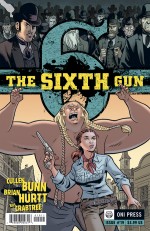
The Sixth Gun #19
Written by Cullen Bunn
Art by Brian Hurtt
Published by Oni Press

This series has become one of my favorite current comics, but unfortunately, it's so consistently good that I don't know if I have much to say about it. I do like that Cullen Bunn continues to build the world as the series goes on, adding new elements with each arc, details slowly accumulating to create a rich mythology that includes mystical weapons, warring religious factions, demons, sorcerers, monsters, and all sorts of cool details that make the Old West setting come to life. It makes me trust that there's a plan for the whole series, and I can't wait to find out where it's going each month. Brian Hurtt on art definitely helps; he's a monster, filling out and solidifying all those details while maintaining a great sense of character and place, and lending an appropriately creepy, moody air when it's called for, which is most of the time. I love it, and I always want more when it's over.
-----

Spaceman #4 (of 9)
Written by Brian Azzarello
Art by Eduardo Risso
Published by DC Comics/Vertigo

Brian Azzarello and Eduardo Risso are near-bulletproof for me after 100 Bullets, and they sure don't disappoint with this new Vertigo series, which is a completely different sort of thing, yet recognizably their work, full of that unique combined personality, all cryptic wordplay and encompassing atmosphere. The plot here, for those who don't know, follows a human-ape hybrid who was designed to work in space but has ended up scavenging the slums of a flooded earth as he ends up in possession of the kidnapped child of a celebrity couple. There are a bunch of twists and turns, and probably some secrets to be uncovered at inopportune times, but the most enjoyable part of the comic is getting to experience the future that Azzarello and Risso have created, trying to decipher the slang that everyone speaks in, marveling at the busted-up locales where the people survive and the believable technology that they use, enjoying the expressive characters and sudden, shocking violence. I expect nine issues is going to be too short of a time to spend in this fucked-up, all too possible future.
-----

Wasteland #34
Written by Antony Johnston
Art by Justin Greenwood
Published by Oni Press

Interest in this title may have been flagging around these parts due to the erratic schedule over the last year or so and the loss of artist Christopher Mitten, but things kind of snap back into place in this issue, with a revelation that brings many of the series' themes into focus, namely the emphasis on belief systems, the supernatural, creation stories, and religions. Suddenly, this isn't (necessarily) the sci-fi post-apocalyptic story that it appeared to be, but a sweeping history of mythological proportions. Huh, how about that? Color me reinvigorated.

Tuesday, August 9, 2011

Sweet Tooth: It has turned sour

Sweet Tooth, Volume 3: Animal Armies
By Jeff Lemire


I hate to complain about creators that I like, but this volume of Jeff Lemire's ongoing Vertigo series left such a bad taste in my mouth that I had to say (that is, write) something, at least to clear my head of the negative vibes. I had some reservations about the series in the first volume, and the second, while readable, didn't really get me excited, but this third volume was when I tipped into outright, eye-rolling negativity. While Lemire did an excellent job with his withdrawn characters in the Essex County Trilogy, he continues to display a lack of imagination here with his post-apocalyptic world, filling it with the standard ruined buildings, empty landscapes, and protective authority figures. The wispy art that worked so well on the empty vistas of rural Canada often seems hastily sketched here, and Lemire still has a problem depicting coherent action.

None of that has really changed since the beginning of the series, but what ends up being especially distasteful here are the attempts to shock, which seem ham-fisted and manipulative; The Road this ain't. The worst and most laughable involves a cult leader who keeps his five vicious dog-children on leashes. How he managed to build a city-conquering following of mask-wearing animal-worshipers is unexplained, but he's the type of cackling, violently crazy villain that shows up in B-grade action movies. We get to see how terrible he is when he explains that his wife died giving birth to her litter, so he let the babies eat her corpse. This is supposed to be repulsive, but all I could do was express disbelief at the thought that human, canine, or human/canine newborns would be eating meat. That's how well thought-through this world seems as a whole, really.

This volume's attempt at tragic poignancy in the climax is another bit that just seems manipulative (I'm going to spoil a big reveal from the ending of the volume here, so skip to the next paragraph if you really don't want to be surprised). The brutish Jepperd, who leads a rescue attack on the compound where deer-boy Gus is being held, finds out during a fight that his son, who he was told died in childbirth along with his mother, actually survived. Then, as he is rescuing Gus and some others, one of the kids, a horse-boy, gets caught by the evil dog-boys, and Jepperd forces everyone to leave him behind, but not before the boy (who hadn't spoken before this point) lets out a plaintive "Da?" Why, could this be Jepperd's long-lost son, which he just left for dead? Yes, it is, and we're all supposed to be so devastated. But we're not, we just sigh at the tiresome attempt at tear-jerking, which started with a sneering villain announcing the long-kept secret in the middle of a knife fight (which contains a page with an awkward panel arrangement that is read clockwise, stranding the reader's eye on the left side of the page) and ended with an escape that makes little sense in terms of where characters are situated in relation to each other. It's clumsy and poorly executed all around, and Lemire should be much better than this.

That's not the full extent of his ineptitude, however; much of the art and storytelling in general is poorly done. Action is often amateurishly done, with characters not moving or interacting believably. Take, for instance, this two-panel sequence from the middle of a fight scene, in which Jepperd is being held to the ground by a boot on his head:


That's a hell of an arm motion that can send a man flying like that. While not everything is so poorly done, Lemire does seem to struggle in the attempts to depict the violence that should be so essential to the series. Bad superhero artists often get made fun of for this sort of thing, and just because Lemire draws in a rougher style, he shouldn't get away with it.

The character work isn't much better, but it's fairly consistent, fitting in Lemire's standard style. However, the  cult leader once again provides an example of ugliness, being depicted with a more rendered, shaded face than the others:


It's a weird effect, like a Benjamin Marra version of an evil villain.

The odd pacing is another area of concern; Lemire can't seem to decide if he's going for propulsive action or slow contemplation. He wastes pages with pointless bits like a helicopter blade spinning:


Or a fly buzzing around a room:


Or, in an especially banal attempt at an Eisner-style title page, a scene that just makes one wonder why somebody would set up big letters in a field like that, and why the characters wander by them without noticing:


Other bits make one question the "reality" of the book as well; in one scene, a TV monitor displays an attacking horde of characters, but the image shown is obviously an image from the comic, and sure enough, it shows up a few pages later on what should be a big spread whose impact is dulled since we've already seen it (and also has the odd effect of making it seem like the attackers have been frozen in mid-charge for several pages).

The series seemed like it had some promise at the beginning, but this installment reveals that Lemire is well out of his depth here, and while it is admirable that he wants to stretch himself, the results definitely aren't worthwhile reading. It's surprising; Vertigo usually has better quality control than this. Maybe Lemire's attention has been drawn elsewhere by his work writing DC superhero comics; hopefully he'll finish this up soon and move on to something that is more his speed, but after this debacle, he's going to have to do something pretty good to get me back on his side.

Wednesday, July 13, 2011

Art What I Like: Burn, NYC, Burn

The latest collection of DMZ, Collective Punishment, is a good one, but that's not really anything surprising, at least from the standard the series has set for itself. The thing that I really dug about this particular volume was the art, all provided by guests rather than regular artist Riccardo Burchielli, and since this point in the long-running plot is seeing the merciless bombing of New York City by the US military, they all get to show off their own particular takes on the fiery destruction of the most famous city in the world. It's harrowing, arresting, gorgeous stuff (almost) all around, an awful, beautiful spectacle.

The one exception, unfortunately, is Cliff Chiang, who limits his large-scale destruction to a cityscape engulfed by orange clouds:


But everyone else takes the opportunity to dazzle with their destruction. Andrea Mutti eclipses Chiang's idea by rendering the skyline in silhouette and degrading the image to the point that the buildings look like burnt husks of themselves, making for a simple and horrifying image:


David Lapham does something similar in one image, making the whole city seem to be ablaze while death rains down out of the sky:


But he also includes a more visceral, apocalyptic image, including both the cause and effect of all the horrifying destruction in one breathtaking splash page:


Danijel Zezelj provides a long view of the city, and his rough-yet-detailed style takes the aforementioned "burnt out husk" idea and turns it into a city-wide bonfire, with the skyscrapers seeming like the protruding bones of Manhattan turned to smoldering embers:


But for my money, nobody beats Nathan Fox, who turns a birds' eye view of the city into a horrifying inferno, death raining down from above like nonchalantly destructive hailstones:


But he makes the rooftop view even more horrifying, an urban hellscape of flames and explosions:


DMZ has often been a harrowing read, bringing the foreign idea of war home to Americans, but rarely has it been so dismally horrifying, so full of widespread death and destruction. These artists have really risen to their task; I doubt I'll ever forget the awful sights they've shown me.

Tuesday, December 21, 2010

How to Understand Israel in 60 Days or Less: I only have about 30 more days to go...

Posting is very light these days due to craziness in my personal life from pending familial incrementation.  We'll see how well I can continue with the content, since I don't want people to forget I exist!

Links: This tribute to Harvey Pekar that Dean Haspiel did for Entertainment Weekly is really nice.

Via Sean T. Collins: I may have found my new favorite webcomics artist: Emily Carroll.  This recent strip of hers, "His Face All Red", is pretty amazing.

Via Alan David Doane: John Roberson has made a 2002 anthology done to benefit William Messner-Loebs called Working for the Man available for free download.  Looks good; I missed it the first time around, so lucky for me.

How to Understand Israel in 60 Days or Less
By Sarah Glidden


So what is the deal with Israel anyway?  That's the opening (and closing) question of this book, and its answer certainly shifts over the course of the read, at least for its author and central character if not the reader.  In 2007, Sarah Glidden took a Birthright trip to Israel, expecting to confirm her beliefs about the region and its longstanding conflicts, but hoping to learn more by experiencing it firsthand.  And luckily for readers, she takes us along for the ride, allowing free access to what she saw and heard, as well as her interpretations and emotions, and her attempts to make sense of them.  It's fascinating, enlightening, educational, and moving, an "only in comics" journey through a historically complicated land, and also the head of the person doing the traveling.

While Glidden is Jewish, she makes it known right away that she tends to lean to the anti-Israeli side of the region's conflicts, so the entire journey is a struggle for her, an ongoing attempt to reconcile her views and her knowledge of history with what people tell her, with the propaganda (from both sides) that she hears, and even with what she sees with her own eyes.  It's an emotional experience, for her and the reader, and an informative one, both in the historical anecdotes that she relates (did you know that Hebrew has only been a spoken language in modern times for a little over 100 years?) and in what she witnesses during her trip (apparently, Bedouins are an even more oppressed minority than Palestinians in Israel, but they have no fiery religious/nationalistic conflict to draw attention to themselves).  And impressively, she never makes it a dryly narrated series of geographical scenes, but brings life into the entire journey through conversation with other travelers, bits of history, occasional flashbacks to earlier times in her life, and imaginative flights of fancy in which she interacts with historical figures, holds a mental court over whether the guide is biased toward Israel, and comes up with other clever ways to illustrate what could be boring bits of exposition.  The book never flags, always remaining interesting through its multi-level approach of a vast, nearly incomprehensible subject.


And that's the true triumph here: readers will come away from this book feeling like they know a bit more about Israel, but also understanding that whatever they think of the situation, it's several thousand more times complicated than they could have possibly imagined.  Glidden's attempts at preparation for the trip are kind of laughable; she states that for several weeks beforehand, she "spent every spare moment reading about Israel...start[ing] with the beginnings of recorded history and working [her] way forward."  That's the amount of information required to even form a basic foundation of knowledge on the subject, without taking into account the millions of personal accounts, feelings, interactions, events, and so on, even within the last century.  Glidden probably realized the folly of her pursuit afterward, and while she doesn't make a big deal about it, she does present herself in a somewhat self-deprecating light, often making incorrect assumptions about people or acting in a know-it-all manner.  Afraid of being "brainwashed", she seems wary of a pro-Israel bias everywhere she goes, and a few traveling companions (her friend Melissa and the tour's guard, a young man named Nadan) often set her straight, or at least question her statements and make her rethink her positions.  While she doesn't finish her journey with reversed opinions, she does seem to have a fuller understanding of the region, and a realization that most people involved have good reasons for thinking the way they do.  Hopefully readers will feel the same way.


But even if they don't, if they feel that Glidden is hopelessly biased herself, they should still enjoy her storytelling acumen here, especially in her evocative art, with its ligne claire lines simplifying characters down to a minimal, yet expressive cartooniness and gorgeous watercolors adding life through warm skin tones, dusty desert browns, lush greenery, and deep blue water.  While many scenes consist of characters talking or listening to a speaker, the panels never just feature repetitive figures and word balloons; instead, Glidden fills them with background detail, jumps around to see the expressions of various people, or comes up with interesting ways of conveying information, like having ghostly historical figures appear in the scene, making a landscape model being viewed come to life with miniature armed forces, or having herself converse with people in photographs (which are amazingly depicted, by the way, the black and white images converted to gray watercolor brushstrokes).  It's never boring, and often is the opposite, being arrestingly fascinating and emotional, especially in a centerpiece scene that sees Glidden break down crying during a speech about peace, a cascade of mental imagery flooding the panels and making the onslaught of emotion she feels completely understandable and relatable.  It's just one tour de force in a book full of them.


Maybe that's the crux of this book: the combination of personal and political.  For so many, that emotion is inseparable from their stance on the conflict, along with an additional confusing layer of religious beliefs to muddy the waters even further.  Glidden has performed the admirable service here of directly approaching what she believed to be true, and attempting to share the small bit of understanding that she gained from the situation.  That she manages to convey it so efficiently and, yes, entertainingly, is a testament to her skill, a demonstration of her firm grasp of the language of comics.  Everyone who reads this book will come away enriched, and whether they agree with Glidden's opinions or not, they can see the real people and history that sit beneath the political and religious posturing, and understand the need for peace.  That's the impossible dream, but people like Glidden are the ones doing what they can to bring it to life.

Sunday, September 19, 2010

Collection catchup/manga emasculation/graphic novel grotesquerie

Links:  Dean Haspiel is serializing his first novel, Post-Disaster Adventure Chronicles, online; here's the first chapter.  It's about "the day money stopped"; sure, I'll read it.

Also serializing online: Mark Andrew Smith and Matthew Weldon's graphic novel The New Brighton Archeological Society.  Check it out, it's pretty.

Online, but not serialized: Lucy Knisley's new minicomic, Salvaged Parts, which is all about her recent breakup with her boyfriend.  It'll cost you $2, but it's worth it.

Twin Spica, volume 1
By Kou Yaginuma


This manga series has been getting a lot of praise as a good sci-fi series, and also some complaints about the cutesy cover art, but from what I can tell regarding this first volume, that image of a big-eyed, red-cheeked girl holding sparkly stars in her hands is a pretty darn good example of what is to be had inside.  Maybe things tend more toward hard SF in future volumes, but this one (which, as with most manga series, is concerned with introducing its concept and characters, so isn't necessarily indicative of future quality) is all shojo emotion, seeing a teen girl named Asumi strive toward her goal of being a spaceship pilot by entering the Tokyo Space School.  All the conflict here comes from interpersonal relationships, beginning with Asumi's father, who she thinks will disapprove of her choice for tragic reasons that are explained later on at the most dramatically appropriate moment.  Later, when she gets to her entrance test, we see her try to get to know and cooperate with her fellow applicants, who run the gamut from friendly and supportive, to curt and withdrawn, to obnoxious and self-centered.  It's obvious where the main thrust of the series will be, and that's in the emotions, friendships, and rivalries between these kids, along with what seems like some well thought out sciencey stuff.  Should be fun.

The volume also includes two "flashback" chapters to Asumi's childhood, although I suspect they were actually published first, as a sort of "try out" for the series, and they're also quite good, cranking up the emotion and sadness to incredible levels.  After the reveal of what happened to Asumi's mother and why her father might not want her to go to space school, one would expect tear-jerking stuff, and Yaginuma doesn't disappoint here; it's very well done, especially at conveying little Asumi's honesty and difficulty understanding what happened, as well as her father's continuing sadness and tired exasperation at the ordeals of single fatherhood.  Yaginuma does an excellent job here of writing believable characters, and the art conveys their lives really well, with the only oddity being characters' puffy hands that make it look like everyone is wearing dishwashing gloves.  It's a pretty nice-looking book, and it reads really well too.  We'll have to see where things go in future volumes; I bet it's up.
-----

Revolver
By Matt Kindt


Sometimes, writing about a book that you find to be just okay, rather than somewhere closer to the ends of the quality spectrum, can be pretty difficult.  I'm finding that to be the case here, with Matt Kindt's Vertigo graphic novel about a guy named Sam who experiences two lives in what seem like alternate timelines, which is a good concept but has an execution that left me somewhat cold, for reasons I'm having trouble articulating.  It does start out well, with Sam living through a terrible day that sees the apparent collapse of society due to terrorist attacks and natural disasters, then waking up in a world where none of that happened.  As the story progresses, he switches between worlds each day at the same time, with his two lives contrasting each other, eventually finding some connections between the two and facing some sort of decision about which world he wants to choose to continue in.  The early going is pretty interesting stuff, as he ends up doing some awful things in order to survive in the apocalyptic world, then comes back to what seems like a pointless existence in the other reality, barely able to function in a job he hates and a relationship with a woman that seems more interested in accumulating furniture and decorations for her apartment than anything else.  It's a fascinating contrast, looking at the complacency of modern life and how it would shock us to have to suddenly fight for our lives and cope with everything we know changing, and then how, after dealing with that upheaval, what it would be like to be thrust back into the previous lifestyle.  Kindt does a great job of illustrating the scariness and violence of the apocalyptic reality, as well as the dull boredom of middle class life in the life that's more like the "real world", and he uses some interesting techniques to differentiate the two, like a color scheme (if you can call it that; there appear to be only two colors used in the book, a dark blue and a light tan) that switches the dominant shade depending on which reality is being depicted, allowing for some nice ways to depict memories of one world experience while in the other, or attitudes and emotions that Sam is experiencing showing how his lives are bleeding together.  There is also a sort of "news ticker" that runs along the bottom of each page, incorporating the page number in each headline, demonstrating what is important to people in each reality; one mostly features celebrity gossip, while the other is a constant stream of death and violence.

This all works really well, but where Kindt stumbles, as far as I can tell, is in trying to wrap everything up and give meaning to the experience.  Sam ends up discovering a person who seems significant in both realities, and he sets out to determine what is going on, eventually leading him to a course of action that could determine which life he wants to live.  It seems like an attempt to give the whole story a complete dramatic arc, but it ends up seeming less like a natural progression, and more like an ending that was tacked on.  It might have been better if the story had stayed more down-to-earth, with Sam taking action that affects his own life and working to incorporate what he had learned and how he could change his life into both realities, without ever resolving which one would survive.  The dramatic, exciting ending does fit a world in which life as we know it has already ended, but I still found it unsatisfying.

But who knows, my reaction might not necessarily reflect anyone else's, and the book certainly drew a reaction.  It's got some great stuff, with some expressive art and a nice format, but it's just not what I wanted it to be, I guess.  How's that for an objective judgment?
-----

The Unwritten, volume 2: Inside Man
By Mike Carey and Peter Gross


Well, this series continues to hit my metafiction-loving buttons, although with this second volume, it gets more like a typical Vertigo series, one with on ongoing mystery as to what the hell is going on, and lots of barely-explained supernatural forces jerking people around.  It's still pretty cool though, with it's main character, the Harry Potter knockoff Tommy Taylor discovering his powers as a fictional character made flesh and freaking out as crazy shit keeps happening, like Frankenstein's monster just wandering into the story to compare notes, or him and his pals ending up in the middle of some sort of ghostly Nazi memory.  There's some fascinating ideas about the power of fiction and how people experience it, with a chapter involving two kids who get so caught up in the Tommy Taylor books that they think magic is real, and their father becoming near-hysterical as he insists on the magic of imagination and childhood innocence in the face of evidence that what it is going on is not good.  The bit with the Nazis is pretty strange too, with Tom and his companions confronting Joseph Goebbels (or some facsimile of him) in a living nightmare that came about because of his distortion of the novel Jud Suss into an anti-Semitic propaganda film.  And perhaps best of all, the final chapter takes a break from the main narrative to visit a world of cute animals like something out of A.A. Milne or Beatrix Potter, where a foul-mouthed rabbit turns out to be a man who was trapped in a fictional narrative, which turns out to be a really creepy fate.

Two books in, and it's not all that clear what this series is going to be about, as Tom is only just discovering his true nature and whatever undefined powers he has.  Maybe he's eventually going to settle into a series of quests into pieces of literature, meeting other fictional characters and fighting whoever the villains are that are shaping the world through fiction, or maybe Carey and Gross are going to go in a completely different direction.  Whatever the case, as long as they keep exploring the ways fiction affects the world and coming up with crazy metafictional ideas, I expect I'll be powerless to resist their thrall.

Tuesday, September 14, 2010

Two movies, one comic-related, and one kind of comical

Webcomics links: Check out this cool comic from Dan Hipp: Piggy Brown, Piglet Detective.  Also, Jim Rugg has placed his Rambo 3.5 minicomic online for download, so read that one too.  And hey, I also liked this one from Box Brown; it's an adaptation of a poem from a forwarded email, a message for Jehovah's Witnesses to not marry outside their faith.  It's sad, in that people actually think this way, but also funny in how it piles worse and worse anguishes on its protagonist, who committed the sin of marrying an unbeliever.


The Good, The Bad, The Weird
Korea, 2010, Directed by Ji-woon Kim


The Asian Western seems to be a growing genre, or at least one that comprises more than one example (the other being Takashi Miike's Sukiyaki Western Django, which is totally awesome), and that's a good sign, at least if the subgenre remains so damn entertaining.  This one is a stylish mix of East and West, taking a definite influence from its Sergio Leone namesake, although the central character here would be the Eli Wallach one, a goofball thief (played by the vampire priest from Chan-Wook Park's Thirst) who gets his hands on a treasure map and ends up being hunted by three or four different factions, including gangs of various levels of evil, a bounty hunter (the Clint Eastwood role, made somewhat less iconic by a funny-looking moustache), and even the Japanese army.  There's some crazy action (starting right away with a pretty cool train robbery), tons of shootouts, a lot of great cinematography, and a nice Ennio-Morricone-with-Asian-flair score.  It's really interesting too, being kind of hard to place historically, with Western fashion and guns alongside more modern stuff like motorcycles, trucks, and phones.  It's probably not meant to be accurate at all, but there's a bit of discussion of the Korean struggle for independence from Japan, so it's got something of a nationalistic feel that Westerners (or maybe anybody who isn't Korean) won't really get.  Whatever the case, it's tons of fun, with standout bits being the bounty hunter character spending a large portion of a shootout swinging on ropes above a town and shooting bad guys one-handed with a rifle, the thief wearing an old-fashioned diver's helmet to ward off bullets, a final three-way showdown that ends more "realistically" than the Eastwood/Wallach/Van Cleef version of the same, and a seemingly endless chase scene in which tons of guys haul ass on horses after our hero across an empty desert as he drives a sidecar-equipped motorcycle, the bounty hunter (in another display of badassery) takes out most of the army assholes who are bringing up the rear and shooting random guys with machine guns, and ending in a series of huge explosions when another division of the army starts firing big-ass cannon shells at them.  It's pretty nuts, a great time all around.
-----

The Losers
2010, Directed by Sylvain White

As with most any adaptation, it's hard to be objective when you're a fan of the original version of the story, and as somebody who read every issue of the comic book series this movie was based on, I can't help but make the inevitable assessment that "the book was better".  This certainly isn't bad for what it is though: a stylish, enjoyable, exciting action flick, with slightly less of the political commentary that the comic had, amounting basically to "powerful, secretive dudes manipulate world events for their own gain".  The story has been revised to remove any hint of Middle East conflict, instead centering in Columbia and various United States locales, and the bad guy (played with oozily nasty smarm by Jason Patric) is just some CIA guy named Max, rather than the shadowy force behind all evil done in the name of intelligence organizations.  The cast is pretty good, although Jeffrey Dean Morgan plays the leader of the eponymous team of presumed dead/framed for treason special forces badasses as a smirking joker rather than a tough, dedicated man in charge, and while Zoe Saldana might be one of the hottest women on the planet, she can't quite manage believability as the secretive, tough-as-nails Aisha (again, removing the Middle Eastern origin tones her down a bit, making her seem like one in a long line of tough black women), although she looks cool when firing a bazooka from the hip.  Everyone else is pretty good though, especially Chris Evans (who seems dedicated to only starring in comic book adaptations, from all across the spectrum of the medium; what's he going to play next, Ichigo from Bleach? Archie? Tintin?) as the team wiseacre; he gets all the best lines, and really throws himself into scenes like the one where he sings "Don't Stop Believin'" along with his headphones in order to clear out an elevator. And the action is pretty nice, full of explosions and shootings and whatnot, with lots of camera zooms and shiny "isn't this cool?" style, but still clear and easy to follow, unlike most of what passes for action these days.  The Jock illustrations (most of which seem to be original, done for the movie) in the opening credits are a nice touch too.  I don't know if it made enough money to continue as the franchise that it wants to be (it ends with a pretty obvious plan to continue into at least one more installment), but it's nice enough as it is.  The comic itself was little more than a solid bit of action, so a slightly dumbed-down Hollywood version is probably the best thing anybody could expect.  I would probably watch a sequel, sure.  Make it happen, somebody.

Monday, August 30, 2010

Collection catchup: Gods and suicides and lesbians, oh my

Elsewhere: I reviewed the second volume of Demo at IndiePulp; it's really good (and hopefully the review isn't bad either).

Links:  This Sophia Wiedeman (The Deformitory) comic at Top Shelf 2.0 is quite good.

This partly animated comic by Vincent Giard is also pretty great, a cool example of the way animation can be used effectively in comics rather than as a distraction.  I've got to check out more of this guy's work.

I'm also curious about this new Japanese comics anthology which is available in English for the Kindle (or really any platform, since Kindle books can be read on Iphone, PC, etc.).  It got attention because Shintaro Kago has some comics in it, which makes it his first officially available English work, but from what I understand, it's only a few gag strips, but he'll have a longer-format story in the second issue.  I dunno, maybe I'll get a subscription or something.

So, here's my latest collection of (probably) shorter looks at stuff I've read recently:

Godland, volume 5: Far Beyond the Bang!
Written by Joe Casey
Art by Tom Scioli


Some comics hit my buttons just right that I love them intensely while having trouble expressing the reasons for doing so beyond "Wow, that's awesome!"  The Jack Kirby riff that Joe Casey and Tom Scioli do here is a perpetual winner, and they manage to nail the feel of the King's cosmic bombast perfectly, with the shouted proclamations and the world/galaxy/universe-shaking implications of the fights made perfectly clear.  They keep things going at a breakneck pace, with hero Adam Archer dragged into interstellar cosmic battle with forces he barely understands, while back on Earth the villainous Friedrich Nickelhead launches a political takeover for the super-criminal set.  There's some weird social/political commentary going on, but Casey never sits still long enough to make it seem didactic, and the gigantic action and bizarre character designs by Scioli constantly dazzle the eye and grab hold of the mind.  It's the almost-too-big-to-comprehend Kirby-style godly morality that I dig most though, as in a scene in which an evil being prepares to influence the evolution of two warring species on some distant planet, declaring "Eventualism now!", before being attacked by two other baroquely attired space-farers who declare, "We bring forth the anti-pillage! Prepare to defend your religion!" before being sent 12,000 years into the future (taking them to our present) to face the results of the evolutionary shepherding that was inflicted on the winners of the species war.  It's totally nuts, and also totally awesome.  I can't get enough of this madness; it's the closest anyone has come to recreating Kirby, and it comes from understanding that you can't just keep trotting out the New Gods or the Fantastic Four and running them through the same old adventures; you've got to push the limits, explore new frontiers, come up with your own exciting ideas.  That's exactly what Casey and Scioli are doing here, and it's glorious to behold.  I wish it would never end.
-----

Sayonara, Zetsubou-Sensei, volume 2
By Koji Kumeta


The second volume of a manga series is often the place where the series really gels, and that seems to be the case here.  The first book was mostly focused on introducing the cast, including the ostensible main character, a suicidal teacher who exudes despair and hopelessness, trying to convince everyone he meets of the pointlessness of life.  The focus often turns to his wacky students though, who include his opposite number, a girl who is so optimistic that she can find a bright side to everything, as well as an ultra-precise neat freak, a shut-in, a boyfriend-obsessed stalker, a panty-flashing immigrant who threatens to sue everyone for sexual harassment, a refugee who barely speaks Japanese, and a girl who tries to stand out, but ends up being completely ordinary.  Having spent the first volume introducing all these goofballs, mangaka Koji Kumeta, who is apparently well-known as a satirist, can now just have goofy stuff happen and see how everyone reacts.  Sometimes a theme is established early on, like when Zetsubou-Sensei refuses to list grades on students' report cards, since life is better when you're ignorant of bad news, or when the Tanabata Festival, in which people write down wishes and hang them from trees, sees everyone sharing their wishes (and culminating in the teacher hanging himself from a tree).  This lets Kumeta riff on a theme, throwing out jokes left and right, having each character do something goofy that fits their personality, and always filling at least one panel with a list of examples of whatever the topic of the day is, usually making obscure references to Japanese culture that have to be explained in the footnotes.  Other times, something bizarre happens, making for a bunch of strange jokes, like a chapter in which a character claiming to be Admiral Matthew Perry (who forcibly opened Japan up to trade with the United States in 1854) shows up and goes around opening everything he sees, including a boy's zipper, the school's pool, and (in a failed attempt) Zetsubou-Sensei's heart.  Another story sees everyone travel back to the teacher's hometown, where his family apparently has an arranged-marriage custom in which anyone who looks into someone else's eyes has to marry them, which leads to all sorts of hijinx.  It's a totally ridiculous comic, but it's frequently really funny, even in the comedy that actually translates.  And that's a qualifier that must be made, since so many of the jokes are based on obscurities of Japanese language and culture, or pop culture and events that nobody on this side of the Pacific knows much about.  The extensive translator's notes do their best to explain things, but even with that resource, one gets the feeling that a lot of material is going right over their head.  But that's okay, since it just seems surreal and strange, and what does work, like the running jokes about things like a line of stalkers or a balding student that everyone ignores, is often laugh-out-loud funny.  It's that brand of odd, deadpan Japanese humor that you see in four-panel strips and the like, mixed with the loud proclamations and elaborate setups of other manga, ending up being a delightfully quirky collection of goofiness that makes just enough sense to be enjoyable. 
-----

Batwoman: Elegy
Written by Greg Rucka
Art by J.H. Williams III


I'm just about the last person on the internet to say this, but this is a pretty damn good comic.  If more superhero books were like this one, the genre wouldn't be a tiresome slog of soap opera plot developments and gratuitous violence.  This is a pretty simple deal about a crime fighter who stops a city-threatening scheme while balancing a private life and discovering a connection to a villain, while making some nods to a larger continuity that seems interesting enough to seek out more information or ignore as suits your purposes.  There's also an origin flashback and hints toward future plots that may or may not get around to happening, but that doesn't matter, because as an introduction to the character, this collected version works really well, telling a rousing story and quickly and memorably defining the characters.  It's really solid storytelling, although I must say that my favorite moment is when a fight between Batwoman and her arch-nemesis, a crazy lady who only speaks in quotes from Alice in Wonderland, is interrupted by a bunch of beast-men that just come rampaging through and start tearing into everybody.  It ends up being explained, but when it happens, it's a crazy "what the fuck?" moment, the kind of thing that can only happen in superhero comics.

But of course, the thing to talk about here is the art, by best-of-his-generation artist J.H. Williams III.  Without him, this would be an above-average exercise in Batman emulation, but he raises it to the level of the sublime, giving people realistic human motions and expressions and filling pages with dazzling layouts that propel the action excitingly across the page while highlighting the heightened-reality nature of superheroics with an art deco flair.  The great thing about it is that he does all this, encapsulating small actions in lightning-bolt-shaped panels, tilting frames and enclosing them in bat-themed shapes, turning panel borders into curlicued swirls of psychedelia when Batwoman is dosed with a hallucinogen, while still making all the action and movement perfectly clear.  During the flashback/origin story, he manages to transform his art into an imitation of David Mazzuchielli's work on Batman: Year One, but as the story progresses toward the present, it subtly metamorphoses into Williams' style, with a bit of Tim Sale or Sean Phillips.  It's pretty gorgeous work, worth all the acclaim it's received.  If the story ever gets finished, I'll try to read it as well, which is more than I can say for most Batman-related nonsense.
-----

Cinderella: From Fabletown with Love
Written by Chris Roberson
Art by Shawn McManus


The Fables franchise must be a tough one to get right, since what seems like a fairly easy story to handle (Cinderella as a spy, working with Aladdin to uncover a magical threat to the "mundane" world) comes off as fairly rote here, with little in the way of suspense or surprise, no real action to write home about, and some especially tiresome attempts to smoosh together fairy tale stuff with the real world.  Maybe it's the first-person narration, which constantly hangs over the proceedings, working in as many fairy tale references as possible, without much wit or humor.  It could be the fast-moving plot, which never sits still long enough to gather any sense of import, or the occasional shoehorning of a dumb moral into things.  The tiresome subplot about Cinderella's shoe-store employee screwing things up by selling magical shoes (like the ones from that fairy tale, you know, the one with the shoes that never stopped dancing) certainly doesn't help.  Whatever the case, writer Chris Roberson just doesn't have the feel for the Fables world that Bill Willingham and Matt Sturges do, as if he's managing to take things both too seriously and not seriously enough.  Artist Shawn McManus does his best to make it work though, turning his style into a reasonable facsimile of Mark Buckingham's distinctive work on the main Fables title, with some nice, thick lines, big expressions, and nicely anthropomorphic animals and monsters.  If it wasn't for him, this would probably be eminently skippable, but as it is, it's worth a look for Fables completists, but far, far from essential.