Thursday, November 15, 2012

The Neverending Fray: I'd prefer Tony Jaa or Jackie Chan

Groo the Wanderer #49
By Sergio Aragones, Mark Evanier, Stan Sakai (lettering), and Tom Luth (coloring)
Published by Epic Comics, 1989


While the cover of this issue promises the return of a supporting character, that doesn't actually happen until an epilogue, after the main story has finished. She'll have to wait for next month; in the meantime, Groo begins to explore the new land he reached in the last issue, where nobody knows who he is, and finds work as a protector for a village that is regularly attacked by bandits. He initially gets praised for not being afraid of the "wolfmen":


But soon, they figure out various ways to get past him. First, they clean up their scruffy appearances so they look like regular villagers, a process which causes them great agony:


Then, when Groo has all the villagers wear red headbands to signify that they are not bandits, the bandits just adopt the same signifier and keep on pillaging the village while Groo is confused. Groo tries several different shibboleths, but none of them seem to work very well:


It's funny stuff, although it's less than ideal, in that the bandits win in the end, having completely looted the village of anything of value. If the issue hadn't contained the few pages of epilogue, there might have been room to include some sort of comeuppance for them; instead, Groo just wanders off, assuming success since the villagers aren't being attacked anymore.

There's plenty to enjoy here though, including tons of great details from Sergio, both of the sort that I always love in which people are going about their mundane lives, and of the funny mayhem that tends to ensue when Groo is around. Here's a good example of the latter; I especially like the way the bandits demonstrate that they're total jerks by one guy kicking a dog and another one (in the lower right corner) just stabbing some woman's goods:


There are some great battle scenes here too, especially when Groo can't tell who is a bandit and who is a villager and just decides to battle everybody:


"FRAY!" is a great sound effect. And I love a good Sergio silhouette, like this one of the bandits laughing their way home with a haul of stolen goods:


While it might not be a perfect issue (which I'm learning is actually fairly rare, at least at this point in the series' run), there's plenty to enjoy here: great art, good laughs, Groo doing what he does best. You can't ask for much more (so please ignore that I just did anyway).

Next: "Chakaal Again!"
-----

This issue's stats:
Recurring characters: Chakaal, who last appeared in the final issue of the Pacific series (which I don't have), appears, but only on the last page.
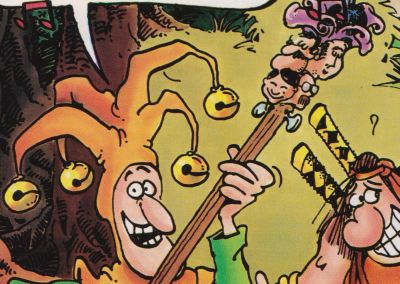
Hidden message(s): The decorations on this guy's clothes contain upside-down letters that can be arranged to spell "This is the hidden message":


Also, the name of the bandits' leader, Nivram, is "Marvin" spelled backwards, which is probably a reference to a friend of Mark Evanier's or something. UPDATED: Commenter kipper informs us that Nivram the Wolf-Man is based on comics writer/editor Marv Wolfman. Neat!
Moral: "Protect yourself from those who would protect you from yourself." That's a good moral, but I don't know if it really applies here...
Spanish words: The town of Maringa might be named after a city in Brazil (which would be Portuguese rather than Spanish, but oh well).
Running jokes: Groo has terrible table manners and says "You take me for the fool I am!" Rufferto bites a couple of different guys on the ass. The regular insults directed toward the comic's readers extends from the letter page into this month's title page poem, which contains the following lines:
"But there's one crime of which
  Our Groo must fairly be acquitted--
One foolish deed he hasn't done,
  Which you have all committed.
It's something very foolish
  Which does not speak well of you--
He's never spent his money
  On a comic book of Groo."
Mark Evanier's job(s): Circumlocutionist
Letter column jokes: Mark leaves most of the humor up to the readers this month, printing several letters he doesn't understand or thinks are very strange. There's a tale by Yurko Slobodovich, who admires Groo and wishes to model his life after the Wanderer, in which he tried to withdraw all his kopins from the bank and, upon meeting resistance, shouted "When Yurko wants what he wants, Yurko gets what he gets!" and chased everyone from the bank. George Coventry thinks Groo is great, and even if he's stupid, "look at some of the people who pass as national leaders these days!" Politics were apparently no smarter back in the 80s than they are here in 2012, but Coventry also calls out television evangelists, which were a big concern at the time, due to their regular scandals. A fellow calling himself The Shadow sends in a letter to Santa which mostly consists of laughter interrupting a request for every issue of Groo. And Patrick J. Rummans confesses that he used the pseudonym Sergio Valentez for a letter which was printed in issue #39, and now that his Groo-obsessive friend Tim Ficke has found out, he's in trouble.
Miscellaneous: I like this drawing of Hulk Hogan in an ad for a WWF Wrestlemania Nintendo game:

Tuesday, November 13, 2012

The Neverending Fray: Will Groo ever find acceptance? (No.)

Groo the Wanderer #48
By Sergio Aragones, Mark Evanier, Stan Sakai (lettering), and Tom Luth (coloring)
Published by Epic Comics, 1989


While it's pretty common knowledge that Groo is hated and feared by most everyone who has encountered (or just heard of) him, that fact is usually ignored by the man himself, as he is happy to go wandering on his merry way, in search of the next fray or meal (preferably cheese dip). But he has apparently reached a breaking point in this issue, which sees him tire of the constant insults and rejection, deciding to travel somewhere that nobody knows him, where he can finally have some peace. This doesn't go so well, as even after days of travel to an unfamiliar place, he still gets reactions like this:


The real plot kicks in when he quizzes a passer-by to his identity, leading to an amusing exchange:


This fellow, having survived the encounter, quickly informs his village that if they pretend not to know Groo, he will leave them alone. Unfortunately, this doesn't quite have the desired effect:


This leads to a variety of schemes to get Groo to leave, including covering the town with insulting graffiti, which leads to a joke that I've always found funny (because illiteracy is hilarious):


They also try avoiding Groo by having everyone run away whenever he approaches, which provides some excellent physical comedy (I love that everyone still carries their livestock and baskets of fruit and whatnot even when running all over the place):


The secret eventually comes out (after another comedic exchange, in which Groo refuses to admit he is Groo, which leads to everyone insulting him, which causes him to remember that he is Groo, so he beats them all up and destroys the town), so Groo decides to leave again, although the issue still has a few pages left, so it gets padded out with a bit about a merchant trying to take advantage of Groo's propensity for sinking ships by selling his cargo, then taking out insurance on his boat with the expectation that it will be lost at some point along the voyage. He doesn't know that one should never plan for Groo to do anything though, so he arrives at the end of his journey unscathed, and in deep trouble for not delivering the goods.

The final gag involves Groo expecting to be hated in this new land, but onlookers don't recognize him, which is something that the Groo Crew tried a few times throughout the series. It's probably a good idea, since stories in which Groo is constantly greeted with fear and derision can get monotonous, but it never lasts for long, partly because the temptation to bring back one or more members of the supporting cast is too great, but probably because Groo's exploits are too entertaining to stay secret for long. Even if he's a menace who will surely destroy every village and ruin every life he encounters, he's not somebody one easily forgets, and word of him would quickly spread no matter where he goes. I know I'll certainly try to do my part to keep his name recognized for as long as I can.

Also, on a "check out this awesome art" note, the title page for this issue is a doozy, forming a map of the last several issues' worth of stories, including the magic tower from issue #47, the mill with the giant wheel from issue #45, and the waterfall Groo ferried people past in issue #39:


Next: "The Protector"
-----

This issue's stats:
Recurring characters: Granny Groo is barely visible along with her Gypsy camp on the title page. Sergio and Mark also appear on the tile page, as portraits above the credits box and poem, respectively. And they and the rest of the Groo Crew appear running around in the town:


Hidden message(s): It's written upside down on these bundles of goods:


Moral: "Your reputation is what you make of it...and what you choose to take with you."
Spanish words: Signs for the towns Ajo ("garlic") and Cebolla ("onion"), which were seen in issue #41, appear on the title page.
Running jokes: Groo knows that "people take me for the fool I am." Rufferto bites a guy on the ass, and he thinks, "Groo is no lackey!" Groo gets called a mendicant. I don't think I've mentioned this before (probably because I don't find it all that funny), but one regular joke involves Groo not knowing how to count, and there's an example of it here that amused me, due to Rufferto's response:


Mark Evanier's job(s): Still Employed
Letter column jokes: Reader Patrick J. Towey, after claiming to be disgusted by the depths some people will sink to in order to get their letter printed, claims that God appeared to him and told him that he would die within six months unless one of his letters was published in Groo-Grams. Mark then says that they waited seven months to print the letter. When reader Jason Van Brunt asks how many issues of Groo they plan to publish, Mark first says they'll keep going until they run out of ideas and start repeating themselves, then interrupts himself with a comment that they've been doing that since issue #6, so he corrects himself and says they'll keep publishing it as long as people keep buying it. Chris Hutts says that while most people think Groo is the dumbest person on earth, he has several coworkers he would happily trade for Groo. Mark says not to be harsh on them, since they have to sell this comic to somebody. Hutts also adds that because he felt bad about people sending mulch and/or cheese dip to the Groo Crew, he enclosed a Ferrari. but Mark says that the hubcaps were missing and a taillight was shattered, so it was ruined.

Thursday, November 8, 2012

The Neverending Fray: The gang's all here, for some reason

Groo the Wanderer #47
By Sergio Aragones, Mark Evanier, Stan Sakai (lettering), and Tom Luth (coloring)
Published by Epic Comics, 1989


Here's another ensemble issue, one that gathers almost the entire supporting cast together (out of the "major" recurring characters, only Pal and Drumm are absent), but it kind of proves that the returns are diminished when so many players are crammed into the same story. Groo does get to play a major part of the plot though, following Arcadio along on a quest to obtain a valuable magic gem that is locked away in a tower filled with traps and guards. The Minstrel is there to sing Arcadio's praises, and everyone else shows up as the story goes along; Arcadio recruits Grooella so her army can lay siege to the tower, Groo runs into Taranto, who wants to come along and steal the gem, and, in one of the funnier moments of the story, Groo tries to figure out who can help him defeat some immaterial lizard soldiers:


Arba and Dakarba end up being summoned to offer magical help, and they get Grativo to come along, in hopes that he'll restore their powers, but in the end, Groo is the one that does most all of the work, slaying all the guards and retrieving the gem, which just sets off a bunch of bickering between everyone, since Groo had promised each of them a 50% share. This all provides the main joke of the issue, and gives us the classic final page scene of everyone chasing Groo away in anger.

The main problem here, as tends to happen with the series' character-stuffed stories, is that with so much going on and so many players involved, there's not a lot of room for jokes. There are a few decent lines here and there (like Groo saying "I am off!" and the Sage replying, "Very much so"), and I like this example of Groo trying to figure something out:


But the story itself ends up being an unsatisfying agglomeration of characters, most of whom don't really do anything or interact with Groo or each other in an interesting way.

We do at least get some nice fantasy images from Sergio. I'm especially fond of the splash page, with its nighttime scene of the tower and it's cool design:


I think the Groo Crew eventually figured out how to incorporate all of the characters they had created, either by limiting them to appearing one or two at a time or by stretching the stories out to lengths of three or four issues to allow the plot to breathe a little. They appeared to still be getting the hang of it here. It's definitely interesting to see the world of the comic expand as it has over 50 issues or so, but now that it's pretty much fully formed, I'm looking forward to seeing it get refined to perfection. That will be fun to watch, even if there are more missteps like this one along the way.

Next: "The Wanderer!"
-----

This issue's stats:
Recurring characters: Almost everyone: Minstrel, Sage, Grooella, Grativo, Arba and Dakarba, Arcadio, and Taranto. Also, the members of the Groo Crew can be seen working away in their houses on the title page:


Hidden message(s): Grativo uses a magic spell, which, when unscrambled, reads "Hidden Message! Please Sergio, no more poems!"


Later, another spell unscrambles to read "No more Minstrel! Mark's brain's turning to mulch!"


Moral: "What everyone wants, nobody gets. What nobody gets, everybody wants."
Spanish words: None.
Running jokes: I don't know if it counts as a joke, but every time Arcadio calls Groo his lackey, Rufferto retorts (if you can call it that when nobody hears him), "Groo is no lackey!" Groo recalls that he is the Prince of Chichester. I don't know if I've seen it before, but if not, this would be the first appearance of one of Groo's catchphrases: "You take Groo for the fool I am!" In mid-fray, Rufferto bites a guy on the ass.
Mark Evanier's job(s): Fed up with writing poems
Letter column jokes: Reader Mitch Warner asks about a possible hidden message in issue #32, saying that the phrase "Praise Megatheos" can be rearranged to spell "A ripe hot message". Mark says this was not intentional, but this reminds him to list the locations of the hidden messages in issues #27-42. Notably, he says the one written in binary code in issue #41 was Sergio's idea, which is why it was misspelled.

Wednesday, November 7, 2012

Many, many, minis: Depression, joy, love, sorrow; these run the whole gamut of emotion

Weather
By Gabby Schulz
Published by Secret Acres


Gabby Schulz (a.k.a. Ken Dahl) is a cartoonist like no other, somehow able to depict the saddest, most cripplingly depressing events and make them not only hilarious, but also lyrically beautiful. This wordless comic depicts a schlubby fellow on a packed airplane in mid-flight as he stumbles to the lavatory in misery, flashing back to a consultation with a doctor in which he was unable to afford medical care, possibly for a life-threatening disease like cancer. His cares are briefly forgotten when he glances out a window and imagines himself flying gracefully through the clouds, naked and alone from all the miseries and humiliations of life. But, this being a Gabby Schulz comic, the horrors of human existence quickly intrude on his reverie in the most disgusting manner possible, bringing him right back down to muck-encrusted earth.

It's a short piece, fully in line with Schulz's style, featuring gorgeous cartooning, images both beautiful and disgusting, and a reminder of the awfulness of life, while still acknowledging the moments of beauty and wonder that make everything else worthwhile. There's nothing else like Schulz's comics, and that's probably a good thing; I don't know if I could take more than one of him.
-----

Deathzone
By Michel Fiffe
Self-published


I know next to nothing about DC's Suicide Squad comics from the 80s, aside from the basic concept of villains pressed into government service and forced to undertake dangerous missions, but it seems to be pretty well-regarded among those who enjoy capes-and-tights stories, and this tribute by Michel Fiffe makes a good case for it. But it also provides Fiffe with a chance to riff on the visual styles of artists like Steve Ditko and just have fun with characters and concepts that he enjoys. He ostensibly retells a certain storyline in which the team fights a squad of terrorist supervillains, but it seems that at least the ending must have been changed from the original story. Whatever the case, it's obvious that Fiffe is having fun coming up with crazy depictions of superpowers, interesting confrontations between characters, occasionally shocking bits of violence, and neat visuals, especially once everyone gets sucked into another dimension and attacked by weird monsters. It's all pretty awesome, and probably more so if you're invested in the characters and their histories both together and apart, but just experiencing the palpable enjoyment that is radiating from the page makes the read worthwhile. Fans of Fiffe, Suicide Squad, and any overlap between the two shouldn't miss out on something this fun.
-----

So...Buttons #5
Written by Jonathan Baylis
Art by Paul Westover, Thomas Boatwright, Noah Van Sciver, and Lisa Rosalie Eisenberg
Self-published


This issue of Jonathan Baylis' autobiographical series is a bit shorter (and cheaper) than usual, containing only four stories, but it's still a satisfying bite of decent little tales from Baylis' life, illustrated by a cadre of talented artists and embellished with an eye-catching cover by Tom Scioli. The stories include an amusing look at Baylis' fear of taking his dog to the vet, a depiction of his determination to recreate the coffee blend that his deli stopped selling, a sort of gag about the pressure-valve release of a shared joke following the emotional trauma of watching Schindler's List, and a cute story about trying to find the secret behind cooking the perfect brisket (a story which was also included in the Digestate anthology). As always, Baylis works with excellent artists who are perfectly suited for the mood of each individual tale, with highlights including Paul Westover's over-the-top exaggeration of Baylis' tears, Thomas Boatwright giving him cartoonish displays of anguish and stiff-jawed resolve, Noah Van Sciver's sort of thousand-yard-stare and the relief that humor can bring to it, and a perfect plop take by Lisa Rosalie Eisenberg. It's all as good one would expect from previous issues of the series, another chance to have a visit with a pal and hear some of his stories.
-----

Losers Weepers #1-3
By J.T. Yost
Published by Birdcage Bottom Books


There's something fascinating about found notes, photos, and other such objects, as any reader of Found magazine knows, a glimpse into complete strangers' lives that offers tantalizing hints about the complexities of their personalities and situations, and a reminder that there are countless others surrounding us, each person as rich and deep as the rest of us. J.t. Yost apparently shares this fascination, crafting the stories in this series of minicomics into stories that could fit around various notes or letters that he had chanced upon.

Of the three extant issues (there is apparently one more to come at some point), the first is the most effective, taking a heartbreaking journal entry by a young woman who is contemplating breaking up with her unstable (due to a life of abuse and drugs and a traumatic brain injury) boyfriend, but worries what will happen to him if she does; and also incorporating some filthy rap lyrics scrawled on an envelope and a note from a junkie about borrowing some cocaine. Around these artifacts, Yost comes up with a sad tale in which the girl from the journal runs into her ex-boyfriend years later, her current happy relationship sending him into a spiral of drug use and despair. The other issues stretch a bit to incorporate humorous notes from schoolkids, poorly-worded bulletin board ads, and letters from prison into interrelated tales of woe, to the point that they seem unnecessarily miserablist, trying to wring pathos out of some basic building blocks that don't fully support it. But Yost is really just doing what most do when they encounter these bits of human ephemera, trying to imagine the stories behind them and see the humanity from this tiny glimpse into their lives. His approach, while fairly dark, is as valid as any, and it's neat to watch him spin characters and dramatic situations from these basic threads. Would that we all could be so eloquent when contemplating the drama unfolding around us.
-----

Thinger Dingers
It's Dream Time, Snoop Doggy Dogg
By J.T. Yost
Published by Birdcage Bottom Books


These two minis are more of a catch-all for J.T. Yost, with Thinger Dingers collecting various short comics that have appeared in anthologies or magazines, and It's Dream Time, Snoop Doggy Dogg featuring several dream comics similar to some Yost had done previously. One's mileage on the latter may vary, depending on tolerance for this sort of "Dude, I had the craziest dream last night!" narrative. Me, I like the surreal weirdness of Yost being at a party crashed by Snoop Dogg wearing a Richard Pryor mustache, carpooling with Dick Cheney and avoiding being poisoned by the former VP, Roseanne Barr being his mother for some reason, having his wife be stolen by Arnold Schwarzenneger, or running into Henry Rollins as a hot dog salesman. One could probably attempt to psychoanalyze these dreams, especially if they know Yost outside of the comics he makes (which I don't), but even outside of any consideration of their "meaning", they do a nice job of capturing of some of the bizarre stuff that our brains can get up to when we're sleeping. Yost's cartoony characters and celebrity caricatures work really well for the types of strangeness they're telling, somehow managing to make the emotions and interactions seem just on the far side of "normal". If you're open to this sort of thing, the comic is definitely worth a look.

As for Thinger Dingers, it's more of a "miscellaneous" collection, featuring stories both fictional and not, with the longest being "Ruemates", in which Yost relates tales of several bad roommates he's had to suffer over the years (and he doesn't let himself off the hook, noting that his weird taste in music and propensity for adopting stray cats doesn't make him the ideal living companion), including a drug-abusing porn star and a pretentious asshole who wouldn't let anyone else use his furniture for fear of "body oil contamination". There's also a funny two-page story about a friend's crazy hillbilly "alter-ego" that he would freak people with at parties, especially when drunk; a cute story about the lullabies Yost sings to his baby daughter; and a couple fictional stories about pigeon relationships and a badly-managed old-timey funeral parlor. It's a nice collection of Yost's work, the perfect use of the format to compile work that wouldn't really fit anywhere else. I really enjoy Yost's cute style and sense of humor, and the way he grounds his cartoony characters in realistic settings, making for down-to-earth looks at relatable human behavior. I'll be sure to keep my eye out for any future minis he releases into the wild.
-----

The Mire
By Becky Cloonan
Self-published


Becky Cloonan's minicomics are always a great chance to see her talent unleashed on something original. Not that there's anything wrong with her work on properties like Batman or Conan the Barbarian, but when she gets to devote her imagination to depicting beautiful, fantastical, mournful works like this, the results are so much more satisfying. This particular mini sees a medieval knight send his squire to deliver a message to a castle in the middle of a swamp that seems to be haunted. After some supernatural scares, the boy, who was lamenting the missed opportunity to join an impending battle, learns that his relationship with his master was much more complicated and, as a closing montage reveals, tragic, than he had ever realized. It's a sad tale that's visually arresting, featuring a distinctive silkscreened cover colored with an eerie green tint that enhances the creepy, moody art of the interior in the imagination; distinctively gruesome ghosts, and a beautifully sad ending. I wish Cloonan had the opportunity to create comics this this on a larger scale and more regular basis; as it is, I think these minicomics are an annual labor of love for her, and I'll be sure to go to whatever lengths necessary to read them as long as she keeps putting them out.
-----

The Stolen Lovelight
By Paul and Tara Abbamondi
Self-published


This minicomic by the husband-and-wife team Paul and Tara Abbamondi is a sort of sci-fi romance, and it's a bit slight, but the art is a nice example of a cartoony style reminiscent of someone like Faith Erin Hicks or Hope Larson, and there are some nicely creepy moments within. The story involves a woman who arranges her own kidnapping in order to escape the possessive jerk she was being forced to marry. But when she wakes up on the kidnappers' spaceship, she is all alone, aside from Doc, the robot left controlling the ship, an oddly attentive artificial intelligence that starts getting kind of creepy and calling her "lovelight" all the time. When M, the man she was trying to escape, shows up to "rescue" her, she learns Doc's disturbing secret and tries to escape. The ending is slightly unsatisfying, although it does attempt to demonstrate that love conquers all, which is a nice thought. As a whole, the story is a bit rushed, and I don't know if I fully understand what happened in the finale, but there are some really nice moments, like the initial kidnapping, the eerily empty ship, and the increasingly unsettling attitude Doc starts exhibiting. I do like Tara Abbamondi's art a lot, so she's a talent I'll be sure to keep an eye on. That's one of the great things about minicomics: discovering a new artist that you want to see more of.

Tuesday, November 6, 2012

The Neverending Fray: Clothes make the man

Groo the Wanderer #46
By Sergio Aragones, Mark Evanier, Stan Sakai (lettering), and Tom Luth (coloring)
Published by Epic Comics, 1988


Having already detailed the origin of Groo's swords and Groo's dog, it was inevitable that some of his other personal effects would be highlighted. This issue doesn't reveal the background of Groo's distinctive orange tunic, but it at least addresses it, mostly through people pointing out how awful he smells. He certainly doesn't help the issue by carrying fish around under his shirt, sleeping in a pigpen, and only bathing every few weeks. Having learned of his garments' odor as a source of people's distaste for him, Groo spends the issue trying to acquire a new wardrobe, leading to all sorts of mistaken identity shenanigans after he steals the garb of different passers-by, then being gifted with the fancy new clothes seen on the issue's cover seemingly at random. But he ends up much where he started (minus at least some of the stench) after a slapstick encounter with some jerks leads to a fight in a fabric-dyeing shop that results in his new clothes looking exactly like his old ones.

It's a pretty good way to restore the status quo, but while it's somewhat expected, the journey there is pretty hilarious, giving Groo a chance to have funny encounters with a bunch of people and cause all manner of mayhem and destruction. I especially like when he is mistaken for a master builder and orders the workers constructing an arch to remove the supports:


The way the guy so confidently follows instructions cracks me up, especially when juxtaposed with the massive chaos that is the immediate result. I also like the physicality of this gag:


Yep, it's another pretty good issue, full of the usual violence, stupidity, and silliness. This could go on for quite some time without me ever growing tired of it. And it will.

Next: "The 300% Solution"
-----

This issue's stats:
Recurring characters: None.
Hidden message(s): It's written on the side of the burdens a couple of guys are loading onto a ship:


And, in what I suspect is a case of the creative team forgetting whether they put a hidden message in the issue and rushing to fit one in at the last moment, there's another one tucked in the corner of the final page:


Moral: "No matter how you dress a cow, it still gives milk."
Spanish words: None.
Running jokes: Groo directly confronts his tendency to sink ships, with the expected results:


Mark Evanier's job(s): Haberdasher
Letter column jokes: Reader David Rickert begs Mark to reprint the pre-Marvel issues of Groo, so Mark pretends to be convinced, deciding to make the sacrifice of getting some extra money from forcing people to buy the issues again, on better paper and at a higher price, in the form of The Groo Chronicles. And in response to a straightforward, coherent letter from Jim Davie (which was really just somebody begging to have their letter printed), Mark prints one from Dan Wheeler that nonsensically accuses Mark of forgetting to call his own niece on his father's birthday, showing his face in Poughkeepsie, and going out with Juliet; then one from Tait Bergstrom which refuses to ask for free art, why Groo likes cheese dip, what Mark does, or the definition of mulch, and even to say anything about the comic at all, along with a maniacal laugh; then one from Jeff "LW" Lacasse that suggests replacing the mulch joke with one in which Mark repeatedly defines the word "carafe".

Thursday, November 1, 2012

The Neverending Fray: Don't worry, he's not really dead

The Death of Groo 
By Sergio Aragones, Mark Evanier, Stan Sakai (lettering), and Tom Luth (coloring)
Published by Epic Comics, 1987


This was the first Groo graphic novel, taking a larger, thicker format than the regular issues, and being something of a "prestige" event, prefiguring the trend of comic book characters being killed off a few years later. Of course, Groo doesn't actually die here, but he is presumed dead, allowing for a funeral scene featuring all the regular guest stars. That always seemed to be as much the point of killing off Superman or some similar character: seeing how the supporting characters and the rest of the world around them reacts to such a loss. However, this being Groo, the event is a bit different, more celebratory than mournful. Luckily, he doesn't stay dead long enough to let anybody get comfortable in their relieved happiness.

But we're getting ahead of ourselves. The story itself (which was apparently written before Rufferto had been introduced, even though it came out in late 1987, after the dog had already joined the cast) sees Groo wandering into the kingdom of a man who hates him with a passion far beyond that of any previous character, to the point that he has servants whose sole task is to hate Groo, a job which often isn't performed as well as expected:


The revelation of the reason for the king's distaste of our favorite mendicant is amusing, since it was due to a fairly standard military screw-up, of the type that Groo has committed countless times, which makes for a nice acknowledgement of the irrationality of hate, as well as the belief of those in power that they are somehow more entitled than others, with a single lost battle being a grievous insult that the king bases his life around from that point forward.

So, when Groo stumbles obliviously into this land of ubiquitous wanted posters featuring his face, he is almost immediately attacked by reward-seekers, and when he runs away and right into the lair of a dragon called the Floom-Floom, he is quickly presumed dead. Anyone who knows anything about Groo should realize that he has survived countless such encounters, and his actual death would be much stupider and more outrageous and catastrophic, but being eager to please their king, the people report to him the death of his mortal enemy, which sparks off a wave of celebration across the land.

The ensuing funeral scene ends up being kind of hard to endure, as the only person who is actually sad is a barmaid who Groo defended from sexist patrons earlier in the story. Everyone else treats it as an event to mock the deceased, turning the eulogies into something more akin to a celebrity roast:


As one would expect, Groo gets the chance to attend his own funeral, and he is rather disheartened to see how much everyone hated him. This gives us one of the sadder panels in the series' history:


But it's not long before he gets back to his regular Groo-ish activities, deciding to make people miss him by donning a disguise (consisting of a poncho for a costume and some pig intestines as a mask) and acting as a villain in order to make the people realize they need a hero. He screws it up, of course, accidentally foiling crimes and rescuing people, and he quickly becomes the hero in death that he never was in life. Soon enough, the celebration of Groo's heroism leads to him being feted in the king's castle, and various silly circumstances (Groo gets mistaken for the king's barber, and he misplaces his clothes when taking a bath), along with the quickly-spreading rumors that Groo is still alive, lead to a rather satisfying comeuppance for the spiteful king:


In the end, Groo gets to go on his way, secure in the knowledge that at least one person (the barmaid) appreciates him. Once Rufferto comes along, he'll have another, and that will be enough to keep him going even when many, many people want to kill him. That's all we need to get by, right? The Beatles said it best: "All you need is love."

As a Groo story, this is pretty enjoyable, and the fancy presentation makes for a nice chance to see Sergio's artwork in larger-than-normal size and on shiny paper that allows for bright, clear colors. Sergio also uses the increased page count as a chance to include more splash pages, so we get several images of battle scenes, giant dragons, and crowded celebrations; the detail-packed artwork really shines here. It's a lovely book, a good use of the format to tell a story in a way that couldn't necessarily be done in the regular monthly issues. That Groo Crew definitely knew what they were doing.

Next: "Groo's Clothes"
-----

This issue's stats:
Recurring characters: The gang's all here: Sage, Minstrel, Taranto, Grooella, Pal and Drumm, Arba and Dakarba, Grativo, and Arcadio, and even the Witch of Kaan and King Kassabist. And the Groo Crew appears in the illuminated border of the title page:


And also as one of the ever-transforming decorations on the Minstrel's lute:


Hidden message(s): It's written upside down on the invites some of the characters receive to Groo's funeral:


Moral: There's no "official" moral, but the Minstrel's final poem works in the same fashion:
"Where'er you go, you never know--
The reason someone hates you--
But folks as such--don't mean as much--
As who appreciates you!"
Spanish words: None.
Running jokes: The usual gags show up, like cheese dip, "Did I err?" and gross table manners, but the best variation on the regular jokes is when the ship supposedly bearing Groo's ashes (and, in secret, the actual Groo) seemingly demonstrates his ability to sink any ship, even from beyond the grave.
Mark Evanier's job(s): He actually gets a "written by" credit this time.
Letter column jokes: No letter column in this bad boy.