Tuesday, August 4, 2015

My new vampire powers should manifest themselves soon...

In a rather fortuitous bit of timing, my family recently visited a friend of ours who lives in Japan but was visiting the United States, and she brought some gifts for us. One interesting thing she gave to everyone were some facial cleansing masks that, when worn, supposedly give a person the appearance of things like a panda, a Kabuki performer, or a member of KISS. Since she knew I like manga, she got me this:


That's right, it's a JoJo's Bizarre Adventure face pack! Opening it up reveals that the mask is patterned after the evil stone mask from Phantom Blood (it says a Stardust Crusaders mask was also included, but I only got the one):


The instructions on the packet containing the mask have a somewhat terrifying visual demonstration:


Instructions are also included in English, reading 1) After cleansing, prepare your skin with the lotion. 2) Take out the mask sheet and unfold it. 3) Place it over your face. 4) Transform into a vampire. 5) Remove the mask after about 15 to 20 minutes,

What kind of horrible magical remedies do they sell in Japan? What will happen to me if I try it? I guess I'll find out soon...

Jojo's Bizarre Adventure: It certainly lives up to the title

JoJo's Bizarre Adventure, Part 1: Phantom Blood, Volume 1-2
By Hirohiko Araki
Published by Viz Media


Prior to reading these two volumes, I knew very little about JoJo's Bizarre Adventure, having only read the spinoff graphic novel Rohan at the Louvre. I've been interested in checking it out though, since it's purported to be pretty nuts, which, as I now know, is a pretty accurate description. This manga is something that has to be seen to be believed.

While a portion of the series had previously been published in the United States, this is the first time the original volume of the series, which began in 1986, has been available here, and if it starts off this crazy, I can't wait to see where it eventually goes. At face value, it seems like a fairly typical shonen manga, with young men battling each other with impressive displays of physical and mental fortitude, wise mentors, loyal companions, a series of battles leading up to climactic encounters, and lots of angst, but Hirohiko Araki makes his particular weirdness known early on. From what I've seen of his work, one of his signature stylistic tics is characters contorting their bodies into bizarre positions, and sure enough, one of the first things the main antagonist does to demonstrate his villainy is kick a dog in what's either an anatomical improbability or a case of very extreme foreshortening:


These two volumes are full of this kind of stuff, with characters moving their arms and legs into strange configurations, usually while emoting heavily. (Araki's other signature is incredibly weird fashion, but we'll get to that later.) One early fight scene is especially crazy, with our hero attacking his antagonist so ferociously that his body assumes Liefeldian proportions:


And when he strikes, the other guy's leg appears to telescope inside of his body:


This sort of thing is kind of hilarious, but it's also an essential part of the book's appeal; with every page turn, you wonder what strange anatomy will pop up next.

Ah, but what about that story? While it seems to fit into a standard shonen manga format, it's got its own quirks and weirdnesses, including presenting a version of history in which the awesomeness has been dialed up to 11 (and then maybe another 11 for good measure), plenty of gory horror visuals, and as a method of fighting that makes no sense, but seems like a cool idea, so why not go with it?

Our tale begins with a prequel about an ancient stone Aztec mask that priests wore when making human sacrifices. When blood splashes on it, it shoots out tendrils into its wearer's brain, granting them terrible powers. Fast forward to England in 1868, when a thief decides to loot a crashed carriage. The man inside isn't dead though, and he wakes up thinking the thief is helping him out, so he offers him a favor in return. Twelve years later, the thief is dying, and he cashes in his favor by sending his son, Dio Brando, to live with the rich man's family. But when he gets there, he immediately sets out to ruin the life of the family's son, Jonathan Joestar, and claim the inheritance as his own. Oh, also, the father owns the stone mask, which will be important later.

Fast forward another seven years, and Dio is about to realize his plans, having spent that time tormenting JoJo while still claiming to be his friend. He's about to poison the father, but he's caught in the act by Jonathan, who is now strong enough to beat him up. Jonathan heads off to find an antidote for the poison, and while he's gone, Dio steals the stone mask, planning to uncover its secrets.

To get the antidote, Jonathan has to go to the bad part of London: a slum called Ogre Street, where Victorian street punks roam, ready to murder anyone they see. He's quickly accosted by a group of these weirdos, and their leader is a guy named Speedwagon who has what appears to be a razor-edged bowler hat:


Jonathan defeats the punks, but he refuses to kill them, demonstrating that he is a true gentleman, so Speedwagon helps him find the antidote and decides to join him as a loyal companion, filling the role of the guy who gets freaked out by all the craziness happening around him and amazed by the hero's awesomeness.

While this is going on, Dio is wandering the streets, getting drunk on "Cronenberg Dead Zone" liquor:


He decides to test out the mask's power when he gets in a fight with more of the toughs that apparently roamed the streets of 19th century England at night. He does so by putting the mask on one guy's face and stabbing his friend, causing blood to splash on the mask. It turns out that this grants the guy vampire-like powers, including incredible strength, a reversion to youth, and the ability to suck blood through the fingers after jamming them into someone's neck (or, as we later see, other parts of the body). Dio only manages to survive when the sun rises and he finds that these vampires also burn up in the sunlight. Armed with this knowledge, Dio heads off to confront the Joestar family, and sure enough, he dons the mask and gains its awful powers.

This leads to a pretty epic battle, as Dio easily destroys the cops which were there to arrest him, but Jonathan is so pure of heart and such a badass strongman that he manages to fight the ultra-powerful vampire to a standstill, and, as the family's mansion is burning down, pursues him with suicidal abandon in an attempt to destroy the monster. It's intense, ridiculous stuff, and we understand the stakes because characters are freaking out at the horrors Dio is capable of or Jonathan's heroic attempts to stand up to him:


In the aftermath, it appears that Dio is dead, but we know it can't be over so soon, and sure enough, we learn that he survived and escaped to live another day, recruiting other villainous guys (including Jack the Ripper) to serve as his henchmen. Luckily, Jonathan gains a mentor to teach him how to fight such powerful enemies. That would be a weirdo named Zeppeli (named after Led Zeppelin, as Araki reveals in the second volume's backmatter), who first introduces himself to Jonathan by punching him in the solar plexus, which somehow heals his injuries:


Yes, it's time to reveal the series' strange superpowers, which are based on breathing techniques called "Hamon" that send ripples through one's body, controlling the blood and granting amazing abilities. It's ridiculous and nonsensical, but so are pretty much any explanation for superpowers, so I choose to go with it and enjoy the bizarre explanations of each technique.

Jonathan, Zeppeli, and Speedwagon set out to confront Dio and his gang, which leads to more crazy fights, including one in which Zeppeli insists that Jonathan defeat a henchman without spilling any wine in the glass he is holding, as well as the revelation that Dio can resurrect zombies, including some knights who defended Mary, Queen of Scots from that dastardly traitor, Queen Elizabeth I (did I mention the strange take on history?). That's about it for these two volumes, with the third seeing the end of this particular storyline, but definitely not the end of the series, which I believe is still continuing today.

I don't know how well I'm conveying the sheer craziness of all of this, since the plot doesn't sound all that different from something like Dragon Ball or Yu Yu Hakusho, but it's the kind of thing that has to be experienced to understand. However, I can still highlight some of the particular goofiness, like the breathless narration that describes, say, the importance of sports in 19th century England:


And aside from the aforementioned bodily contortions that the characters do, there's the build of the characters themselves. Araki mentions in the backmatter of the first volume that big muscles were in vogue at the time, with stars like Arnold Schwarzenegger and Sylvester Stallone ruling the silver screen, so he designed his characters in that mold, but he kind of went overboard, giving Jonathan and Dio huge barrel chests, tree trunk legs, and arms so massive that they seem unlikely to be able to move at all. There's a great scene midway through the first volume in which Jonathan and Dio compete in what I think is supposed to be a college rugby game, and it's one of those hilarious illustrations of strength in which a character simply cannot be stopped:


And then, of course, there's the insane fashions that Araki comes up with for his characters. This being the Victorian era, there are a lot of poofy collars, billowing sleeves, capes, and top hats, but Araki adds plenty of bizarre flourishes, like the feathers that adorn Dio's jacket here:


I also like this goofy cape/deerstalker hat/ascot/tiny bow tie/fingerless gloves/checked sleeves getup that Jonathan wears when he's going to confront the lowlifes in the slums of London:


And this one is pretty crazy too, with it's high-waisted pants, loose belt, huge collar, sideways hat, and shoulder harnesses:


The whole series is full of these strange outfits, and it's fun to see what sort of crazy fashions Araki will come up with next. He often uses chapter intro pages to showcase these, and one definite highlight is the emphasis on the Britishness of the characters by emblazoning outfits with the Union Jack:


There's also the prevalent gore, which is strikingly nasty. Characters shedding a lot of blood and shrugging off the damage they take is a pretty common shonen manga trope, but Araki goes above and beyond here, with most fights leading to blood spraying all over the place and all sorts of gross bodily damage being inflicted on people. It gets pretty gross at times, with body parts being skewered:


Limbs exploding:


And skulls being casually shattered:


I don't know if all of those examples are enough to convey the insanity of this series; like I said, it really has to be read to be believed. The funny thing is that by the time I finished these two volumes, I found myself getting used to it. There was still the occasional moment of disbelief at the sheer craziness, but after immersing yourself in this kind of nonsense, you start to accept it. That's part of what makes it so fun to read, I suppose.

I'm certainly excited to read the final volume in this volume of the series, and then go on to whatever comes next. From what I understand, this is just the launching point for an increasingly lengthy and complicated series that spans multiple generations of the Joestar family and eventually leads to globetrotting adventures and ever-more-crazy powers and battles. If the whole thing is as wild and weird as this initial story, I'm on board for the whole ride.

Monday, July 13, 2015

Love and Rockets: Can I request more "movies"?

Love and Rockets: New Stories #7
By Jaime and Gilbert Hernandez
Published by Fantagraphics


This latest volume of the Hernandez Brothers' always-ongoing series sees an interesting confluence of interests, in that it sees both brothers present comics versions of B-movies that exist within the world of their stories. This isn't anything new for Gilbert, who has been alternating between the ongoing adventures of his long-running characters and the weird movies they make for years, but it's interesting to see Jaime take the same tack. And while he's not new to sci-fi/superhero stories, this one is striking, since he seems to be competing with Gilbert in the weird, disturbing department. While Gilbert's readers are used to stuff like this (from elsewhere within this issue):


Seeing something like this from Jaime is kind of off-putting:


It's still pretty compelling though, with the "movie" (which Maggie and Hopey watch in a theater, although at first I thought it might have been one of the comics that Tonta's teenage friends were making, with the character based on Angel) following a disgraced space princess who is exiled to the "asteroid of sorrows" for the crimes she has committed, but once she gets there, she learns that consuming the blood of the creatures who dwell there gives her superpowers, and thus a means to revenge. It's dark, fascinating stuff, taking Jaime's penchant for depicting shapely women with a punk attitude and going in a fully nihilistic direction with it, making a scorned woman a terrible force of nature to be reckoned with.

That may have been the highlight of this year's installment for me, but the story around it, involving Maggie and Hopey meeting up to go to a reunion of their old gang in Hoppers is also very good, with the two of them reconnecting, pondering their relationships with each other and their individual significant others, and wondering if they made a mistake by not staying together. I expect we'll see more of this next year, and I can't wait.

As for Gilbert, well, I'm still enjoying the glimpses he gives of the movies that Fritz and Killer star in more than the characters' offscreen adventures, although one story called "Daughters and Mothers and Daughters" was quite good. It starts with Fritz as a baby, and it follows her, her mother, and her other relatives throughout the years, showing how choices and mistakes made echo through the generations. It's got a nice gravitas (even with glimpses of movies starring a ridiculous comedian named Ping Pong), and it offers some interesting insights into the characters' lives. The other "behind the scenes" stories throughout the volume aren't as good, but as we see how more and more of Fritz's imitators and doubles pop up, it's interesting to see how she becomes distanced from people, including what might possibly be her daughter. There's some compelling stuff to be had here, but I'm still not really feeling whatever Gilbert is going for here, whether it's meant to be Hollywood satire or just soap-opera-style drama.


The B-movies that he shows us though, that I'm into. The longest one here is "The Magic Voyage of Aladdin", and it sees a kid playing the title part, but the most meaty roles going to Fritz and a couple of other similarly-proportioned ladies who play Morgana Le Fey, Circe, and a captured damsel, all of whom have magical powers of some sort, with everyone getting into sometimes-violent battles and all sorts of other nonsense. It's pretty goofy, but it's lots of fun, and it's the kind of thing I look forward to in Gilbert's stories in each new installment.

So, who knows what to expect for next year, but I bet it will be good. For now, we can marvel at the quiet beauty of lovely scenes like this:

Tuesday, June 9, 2015

CAKE 2015: A Banner Year for Groo Sketches

This year's CAKE was another chance for me to get some new additions to my Groo sketchbook, and this batch is a doozy:


Zac Gorman brings his expressive, cartoony sensibility to the Wandering One. 


Evan Dahm makes Groo look pretty cool. 


Yes, this is a Groo sketch by JAIME FUCKING HERNANDEZ.


Derf gives Groo that signature Derf slouch. 


Drew Weing went kind of nuts here, fusing Sergio's style with Frank Frazetta in a "Death Dealer" homage. Awesome. 

Eleanor Davis went simple and cute, leading to another great representation of our favorite mendicant. 


Ed Luce drew his Wuvable Oaf character cosplaying as Groo (or is it the other way around?).


Kevin Czapiewski drew a great depiction of Groo wandering. 


John Porcellino did a nice Groo in his simplistic style. 


Zak Sally did a nicely grotesque image. 


Tom Kaczynski drew this nicely gory scene, with some spot color for added effect. 


And finally, Dash Shaw turned Groo and his swords into this cool, abstract image. 

Awesome stuff, as ever. Thanks to all these great artists for contributing to the increasing coolness of my sketchbook. 

Monday, June 8, 2015

CAKE 2015: I brought home many things

This past weekend was the fourth annual Chicago Alternative Comics Expo, or CAKE, and I'm happy to say that it seemed to be a successful event for everyone involved, from the organizers, to the attendees, to the many amazing artists who were exhibiting their work. I've volunteered for the event in previous years, but this year they asked me to get even more involved, so I was the Social Media Coordinator for the weekend, running the official CAKE Twitter, Facebook, and Tumblr accounts. I spent the weekend walking around, taking pictures on my phone, and doing lots of tweeting, retweeting, and sharing, so if you check out the past couple days of activity on those accounts, you'll have a pretty good picture of what I was up to.

But anyway, as I usually do when I attend these sorts of events, I want to share all the cool stuff I picked up. Check out this pile of comics goodness:


And here's an explanation of just what all that stuff is. Starting from the top "row":

Going across the middle:

Along the bottom:

That's a lot of comics to process! I'll be reading them over the next week or two, and since CAKE has gotten me inspired, I'll even try to write some blogs about them. But first, I'll do a post sharing the awesome Groo sketches that I got this year. Stay tuned!

Tuesday, January 13, 2015

Uncle Scrooge and Donald Duck: Sometimes life can be too adventurous...

Uncle Scrooge and Donald Duck: The Son of the Sun
The Don Rosa Library, Volume 1
By Don Rosa
Published by Fantagraphics


Donald Duck/Uncle Scrooge comics have long been some of my favorites, and next to the master of these characters, Carl Barks, Don Rosa has always been a close second as a creator whose work I loved, and one of the first cartoonists whose name I recognized. That means I'm very glad to read this collection of his earliest duck comics; however, reading these as an adult, while they're still very enjoyable, they don't quite meet the level of perfection that I thought they did when I was a kid. Having read a number of the classic Barks comics in recent years as Fantagraphics has been releasing them, I now notice just how fannish Rosa's work is, packing in as many references as possible to Barks' stories, dialogue style, flourishes of motion and emotion, incidental characters, and even background gags and bits of detail. It's a bit off-putting; Rosa's work is good enough to stand on its own, but he's so slavish to not just Barks' style, but even his actual stories. Characters regularly mention their previous adventures, flashbacks take place in and around various Barks stories, and some stories are even sequels or follow ups to some of the classics. Rosa would take this to an extreme a few years later with his The Life and Times of Scrooge McDuck, a biography of the character that is entirely based on things mentioned in Barks' comics, but even at the beginning, it's a crutch he leans on quite a bit.

To be fair, many of the reasons for this fannishness is explained in the volume's supplementary material, as Rosa describes how his entry into the world of professional cartooning basically arose from his work creating fanzines for the duck characters, and without any formal art training, he basically came to his particular style from copying Carl Barks. Given the chance to create official duck comics, it's only natural that he would try to build on the creations that his hero did so well, and he never claims to do anything but create stories that are reverent of what Barks did. He even explains his philosophy, stating that even though plenty of other creators have made duck comics, he only considers Barks' stories to be canonical, and he even insists that they all take place during the 50s, in order to keep the timeframes realistic (otherwise Scrooge would have to be upwards of 150 years old). It's an odd, interesting ruleset that he defined for himself, but hey, that's apparently what floats his boat, and even in these earlier, somewhat rougher comics, it's obvious that he has storytelling energy to spare, so why not spend some of it cramming in references and details that only die-hard Barks fans will get?

And while I'm pointing out the shortcomings of decades-old work that even its creator says he cringes to look at, I don't know if Rosa had an especially good grasp on Donald Duck's character in these early stories. He doesn't quite manage to capture the "everyman" essence of Donald that Barks imbued him with, and he often comes off as petty, violent, and prone to fits of anger (which actually makes him more in line with the portrayal of Donald in pretty the Disney cartoons where he was more likely to throw tantrums at Chip and Dale than hold down a job or have rivalries with his annoying cousin Gladstone). It's weird, and kind of strange, especially considering Rosa's devotion to Barks in every other aspect of his stories.


All complaints and nitpicks aside, Rosa's comics are still enormously fun to read, especially the action-filled adventures that he has Scrooge, Donald, and their nephews embark upon. He fills these tales with such vibrant detail and fun action that one can't help but be drawn along with a grin on their face. In fact, "The Son of the Sun", Rosa's very first duck adventure, may well be the highlight of the book, a classic story in the vein of Barks' globetrotting quests for treasure that even pairs the ducks up with their nemesis Flintheart Glomgold as they search for a treasure-filled Incan temple high in the Andes. There are plenty of fun gags and references along the way, but the real highlights come with the chosen venue, the snowy mountaintops being the perfect place for Rosa to include some of his signature motion-line gags in a scene with a runaway airplane:


The climax of the story presents another opportunity for Rosa to dazzle, as, after the ducks find the treasure they are seeking in a temple atop a near-inaccessible peak, a plugged-up gas vent literally explodes the mountaintop and sends the temple flying:


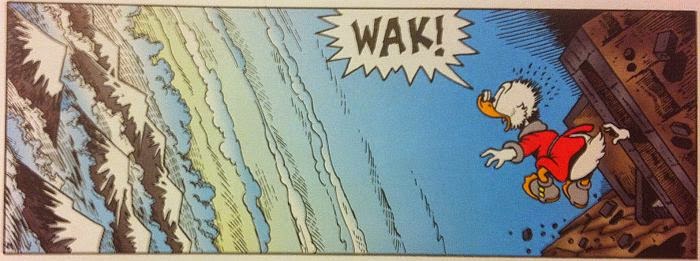
I love the sense of scale in that image, with the energy bursting out of the mountain, the snow being blown off of neighboring peaks, and the temple itself reduced to a tiny projectile sent soaring into the atmosphere with the ducks still "aboard". He follows this up with an image (and a tense scene) that conveys an excellent sense of vertigo, as the ducks realize that they have been sent sky-high, with nothing between them and the ground but thousands of feet of thin air:


This sort of crazy action is what Rosa does best, and this story is a great start to his career as the second-best duck artist (even if it was, as we learn in the book's backmatter, a repurposed story from a series that he drew for his college newspaper [although that series was meant as an homage to Barks, so it sort of makes sense for him to make the connection literal]). There are some other pretty good stories in this volume (including "Last Sled to Dawson", which expands on Barks' "Back to the Klondike") but the only other one that I think captures Rosa's particular specialty is "Cash Flow", in which Scrooge, Donald, and their nephews defend Scrooge's money bin against the Beagle Boys, who mount an effective assault through the use of a pair of rayguns that allow them to control inertia and friction. That's a fun concept, and it leads to a gloriously over-the-top climax that involves the complete destruction of the money bin, sending all of Scrooge's money (which acts like liquid, having been rendered frictionless) raging through Duckburg like an especially expensive flood:


Rosa also takes the chance to deliver another of his intricate tangles of motion-line action, as the ducks race through town in their inertia-free car to try to catch the money before it pours into the bay:


I love this sort of thing, and seeing it paired with Rosa's intense devotion to Barks only highlights it as a unique area in which he may have been better than his idol. I wish he had spent more time on this sort of zaniness and less on working in Barks' margins (which can also be fun, but I'll take originality over nostalgia any day). But I can't fault the guy for doing what made him happy, and I'm excited to read the coming collections of his comics and experience his continued growth as an artist and storyteller. Now I'll just have to wonder when William Van Horn will be getting his fancy hardcover library?

Wednesday, December 10, 2014

Kung-Fu Klassix: Legendary Weapons of China

Legendary Weapons of China
a.k.a Legendary Weapons of Kung Fu
Directed by Lau Kar-Leung
China, 1982


Man, I have no idea what was going on in this movie. It's got something to do with a society of "pugilists" who use semi-magical tricks (making the wind blow through the power of their punches, hypnosis, apparently shooting fireballs and/or smoke bombs while fighting) to fight their enemies. However, these powers are mostly trickery (although one character refers to them as "witchcraft"), but the government is still using them to recruit people to fight invading Westerners, making them believe they can gain the power of immunity to bullets. Lei Kung, one of the leaders of the society, left the organization and dissolved his branch of it because of this, so the others want to have him killed. And that's the main plot of the movie, with three or four different assassins from different factions of the society trying to track this guy down and murder him.

I think that's what was happening, anyway. There's one young guy who's kind of dumb and bumbling, and another guy who is obviously a girl in disguise, although everyone is amazed when her secret is revealed. Her uncle (the great Gordon Liu) is also on the case, but she appears to be leaning toward Lei Kung's side, bringing her into conflict with the other assassins. And there's also Lei Kung's brother, Lei Yung, who looks just like him and either wants to kill him and take over the society or help him. Plus, Lei Kung has gotten old and isn't as powerful as he used to be, so he's refusing to admit his true identity, which leads to a subplot in which he (or maybe his brother?) hires an impersonator to take the fall for him.

That's as close to a summary as I can come up with, since the plot of this movie was near-incomprehensible to me. Usually, I can get over that if the fighting is worth the time spent on dumb jokes and random nonsense, but other than some general weirdness (like the evil leader of the society using his powers to make some of his followers kill themselves in gruesome ways, with one guy tearing his own eyes out and another ripping his junk off, I think), this is just a confusing slog.

However, it's got a hell of an awesome final fight, with Lei Kung and Lei Yung facing off in a fight in which they use the 18 traditional weapons that give the movie its name. It's a great scene, full of everything the rest of the movie lacked, like understandable combatants, visible movements, dynamic acrobatics, exciting stakes, and lots of mindblowingly cool moves. I normally prefer to have some context for fights, since while they can be great on their own, relatable emotions and genuine dramatic stakes can turn them into great combinations of action and drama. In this case, however, there's little else about the movie that I found especially worthwhile, so feel free to just watch this fight on its own:


And just for fun, here are some GIFs of some of the other enjoyable stuff, like Gordon Liu fighting with his shoulder blades:


Guys under hypnosis maiming themselves:


Or Gordon Liu just looking awesome: