Wednesday, April 10, 2013

Art What I Like: One Piece Is Awesome, Example #24

As ever, I'm impressed by the subjects that Eiichiro Oda tackles in One Piece alongside all the awesome fights and wacky gags. In volume 31, he expands on his previous commentary on religion, revealing even more depth. While he had hinted at the use of religion as an oppressive means of control, here he looks at the way people use belief in the supernatural to try to understand the world around them and the forces that are beyond their control. While he ultimately favors science and knowledge over faith, he does show an understanding of the appeal of these sorts of beliefs, from the way they provide a grasp on the unknowable to their benefits in uniting a community of people.

Much of the 31st volume is taken up with a flashback to 400 years before the current story, explaining the background of the island of Jaya and its inhabitants, the Shandians, who were driven from their land after it was blasted up into the sky and assimilated into the cloud kingdom of Skypeia. But before that happened, we learn the true story behind the legend of an explorer named Mont Blanc Noland who landed on the island and changed their way of life. When he gets there, he's horrified to learn that the Shandians, who are currently being ravaged by a deadly plague, are practicing human sacrifice in an attempt to appease the gods and save themselves from being completely wiped out. He impulsively stops the sacrifice and kills the giant snake which they viewed as a deity, which makes them certain that all is lost. But he convinces them that he can cure the plague using medicine derived from herbs found on the island, and even though they're sure all is lost, they give him the chance to make good on his promise. However, after an earthquake hits the island, he gets trapped in a fissure and can't make it back to the village in time, and to make things worse, Kalgara, the Shandians' greatest warrior, happens across his predicament and decides to just watch him suffer. This leads to an incredibly dramatic debate about religion and science:


The thing that I find fascinating about this is that as horrifying and barbaric as Oda, Noland, and the audience see the practice of human sacrifice, he doesn't present it as the result of complete ignorance. The Shandians' religion makes sense to them; it's their way of understanding their world, and when they don't follow what they see as the gods' wishes, it seems that disaster inevitably results. They themselves are horrified by the awful things they do, but as loathsome as their acts are, they see them as necessary, an affirmation of the value of human life rather than the debasement that Noland sees it as. It's all they understand, and Oda manages to convey that really well in this exchange, demonstrating how they struggle with what they view as necessary in order to survive.

In fact, Oda seems to view the people's approach to their religion rather optimistically, presenting them as considering their beliefs deeply and willing to put them aside in favor of that which is more beneficial to them. If only that was true in the real world; in actuality, most religious people follow their dogmas blindly, never questioning the reasons they believe what they believe, and clinging to their antiquated ways in the face of knowledge and progress. Oda's take on the subject fits in to his exaggerated shonen world, in which heart and determination can win out over the most difficult obstacles; that he manages to fit the deeply complex ideas surrounding religion into this framework is kind of amazing. This series is really something special, and I can't wait to see what subject Oda manages to tackle next, while still providing all the thrills, laughs, and emotional bombast he does so well.

Monday, April 8, 2013

Art What I Like: One Piece Is Awesome, Example #23

Up through the seventh installment of the Skypeia storyline in volume 30 of Eiichiro Oda's One Piece, the main villain, Eneru, was pretty much untouchable. His lightning powers had rendered him invincible to almost any attacks, and his slightest touch was enough to nearly obliterate anybody who opposed him. The only one who had yet to face him was Luffy, since he had spent nearly two volumes in the belly of a giant snake. But when he finally gets a chance to confront Eneru, I expected that he would be able to team up with Nami (the only conscious member of the crew at this point) to find a way to fight him, possibly through some lightning rod-like weapon. I never even considered the obvious, which we learn in this moment:


The final page has an even better effect in the physical book, since it comes after a page turn. The expected result of Eneru's attack here would be for Luffy to be fried to a crisp, yet strong and determined enough to keep fighting. So to see his slightly puzzled face as he realizes along with the reader that his rubber body insulates him from bolts of electricity is an example of perfect timing on Oda's part. And he pulls it off again a couple pages later as Luffy responds to Eneru's repeated ineffective attacks with a physical assault that might be the first threat he has experienced since he gained his powers, providing us with a full-page look at his hilariously terrified face:


That's comedy gold right there. I love how Oda can still deliver on moments like this in the middle of a high-stakes battle that endangers the lives of thousands. He takes his stories seriously, but never so much so that he can't have a little fun in the middle of them.

Sunday, April 7, 2013

Art What I Like: One Piece Is Awesome, Example #22

I continue to be fascinated by the breadth and depth of Eiichiro Oda's One Piece; he's got a lot more going on than just fighting, friendship, and the pursuit of dreams. The Skypeia storyline has been especially rich, and along with the aforementioned hint at the oppression of native people, he's also throwing in some commentary on religion and the ways it can be used to control and oppress people. The big villain of the story is a guy who calls himself Kami Eneru (kami is the Japanese word for "god"), and he rules over the cloud island of Skypeia with an iron fist, demanding total obedience from the people under the threat of immediate death. But he's no god; he's just a human who has the devil fruit-granted powers to transform his body into lightning. This makes him incredibly powerful, but the interesting thing is that his rule is based on religious trappings rather than just tyrannical punishments for disobedience. He's got rituals set up to deal with non-believers (this being One Piece, they involve fighting his awesomely-powered servants before being killed as a sacrifice), and while everyone is constantly afraid of retribution, he's also managed to convince them, possibly through brainwashing and/or Stockholm Syndrome, of the rightness of his actions. This scene from volume 29 is a telling example of the way religion (and other forms of fanaticism) can ensnare people from a young age:


Later, in volume 30, the full extent of Eneru's plan has become clear: having looted Skypeia of its riches, he's going to move on elsewhere, and in a display of Old Testament-style sadism, he plans to annihilate the island and all its inhabitants on his way out the door. In an especially powerful moment, Conis, a young Skypeian woman who Eneru had condemned to death for daring to aid the Straw Hat Pirates, risks her life to warn everyone of their impending doom:


At first, the people refuse to believe her, but since Eneru is distracted elsewhere, his non-response to her blasphemy is enough to make the people question their faith, and the terror on their faces is palpable. It's one thing to live at the whims of a capricious deity, but when he's not even reliable enough to keep his promises not to kill everyone, it's enough to send everyone into a panicked flight for survival, and it's an awful thing to witness.

This is all mostly just background to the main conflict of the story, but it's enough to provide a sense of stakes and gives the battle life-or-death consequences for thousands of people. As ever, I'm blown away by how Oda handles so many characters and events and weaves themes from outside of his crazy world into everything. He contains multitudes.

Saturday, April 6, 2013

Art What I Like: One Piece Is Awesome, Example #21

I'm often fascinated by the worldbuilding that Eiichiro Oda does in One Piece. The series isn't just an excuse to depict one fight after another; he obviously has a plan in place for the overarching plot of the series, and each new land that the Straw Hat Pirates visit feels like a fully-realized culture, with people from all walks of life included. In the Skypeia arc, there's an especially interesting conflict in which an island from the land was somehow blasted up into the sky and conjoined with a different island in the clouds. As we learn more about the situation, we find that the people from the land island (known as the Shandians) were driven from their home, and are fighting to regain the territory that once was theirs. What's especially fascinating about this is that Oda has based the Shandians on Native Americans, as we can see from this glimpse of their hometown in volume 27:


It's a bit of a stereotypical depiction, with teepees, totem poles, dreamcatchers, and feathered headdresses, but this is shonen manga, which isn't exactly known for its subtlety. But by making this obvious connection to a race of real-world people who have been oppresses and driven from their land by people who desired their natural resources, it gives the situation resonance and makes the conflict more than just a silly reason for crazily-powered characters to beat each other up. I'm not sure if Oda is trying to make any sort of social commentary with this series, but he's definitely got more on his mind than just action and adventure, and that's part of what makes this series so special. I think I might just keep reading it.

Thursday, April 4, 2013

The Neverending Fray: Let's have some lawyer jokes, because why not

Groo the Wanderer #90
By Sergio Aragones, Mark Evanier, Stan Sakai (lettering), and Tom Luth (coloring)
Published by Epic Comics, 1992


Lawyers: they're the worst, amirite? That's the general sentiment that leads to them being a perennial target of comedy anyway, and the Groo Crew seems to enjoy taking these sorts of hoary old jokes and filtering them through their Grooish sensibilities (I'll keep an eye out to see if they can work in some gags about mothers-in-law, or come up with a way to joke about airplane food or Gilligan's Island). They're such comedy pros that they can take any old joke and make it seem fresh and funny by throwing Groo at it and seeing what happens. And that's exactly what they do here, with our favorite wanderer being accused of destroying a town and put on trial for his supposed crimes. When an unscrupulous lawyer gets wind of this, he rushes to take the case, hoping to make a name for himself by defending such a notorious figure, and also planning to make himself rich by selling the rights to every conceivable aspect of the trial, from the written coverage to the sales of food, vegetables for throwing, and even merchandising:


He's a pretty amusing character, the stereotypical ambulance-chaser who can't walk down the street without spotting an opportunity to sue somebody:


It's one of those over-the-top critiques of the all-too-familiar types who supposedly uphold the law, but actually bend and distort it for their own gain. Luckily, since he's trying to profit off of Groo, we know he's got a comeuppance in order, and the way it happens is an especially funny moment (never make the mistake of claiming Groo is incapable of destroying a town), and one that is highly satisfying. Yes, these guys know what they are doing, and no matter what topic you throw at them, they'll be able to make it hilarious. Even when I've read all these stories before, I'm excited to see what they come up with next.

Next: The next issue I have is #92, "The Fountain of Youth".
-----

This issue's stats:
Recurring characters: Weaver and Scribe get hired to chronicle the story of Groo's trial, and the puppeteers from issue #84 buy the rights to adapt the story into their medium of choice:


Sage also appears in a backup strip, and Chakaal is in the Groo-Grams header:


Hidden message: I knew they wouldn't be able to quit doing them. This lawyer has written "If we had a hidden message this will be it":


Moral: "Law is the best deterrence to justice."
Spanish words: Groo's lawyer is named Abogado, which means "lawyer", of course. The trial gets moved to the town of Caduca, which means "expires". The town of Flaca which Sage visits is named for the word for "skinny".
Running jokes: In addition to remembering to say that he is guilty, Groo recalls that he is the Prince of Chichester. It also takes him three pages (and a few days of story time) to respond to his lawyer calling him slow of mind. In the backup strip, Sage sneaks in a mulch reference while doing some farming:


Intro follies: Sergio decides to capitalize on the popularity of comics mini-series, declaring that this is the first issue of a lawyer mini-series (which ends on page 22), as well as a short Sage mini-series and a short Rufferto mini-series on the back cover. Also, Stan Sakai's daughter appears, and she's playing with a Usagi Yojimbo doll:


Value-added: This issue has another maze on the inside back cover, and it's a marvel of design, with the pathways of the maze surrounding the images on the page to look like pools of water, swirls of smoke, rolling hills, and trees:


Mark Evanier's job(s): For the Defense
Letter column jokes: Nine-year-old Nina Pliska says people compliment her on being mature for liking Groo and asks how mature one has to be to like the comic. Mark (whom she had referred to as Zigfried) responds that they've had complaints from embryos that it was beneath them, and says that the real measure of her maturity is her ability to provide such good straight lines. Jason Hillenbrand sends in a numbered list of questions, including what he should do to get an autograph from Sergio (Mark: "Teach him to write"), what an appropriate middle name for his son would be if he named him Groo ("Doomed"), and how to get a letter printed ("Send in six pointless questions). Carlos Garcia threatens to rent and watch Hudson Hawk until he is bored to death if Mark doesn't print his letter. Jennifer Guilbeault writes in to note that Sergio was mentioned on "Jeopardy", in a "Newspapers and Magazines" clue that mentioned him being a cartoonist who scribbles in the margins. The answer was "What is MAD?", but she shouted "GROOOO!" (luckily, no one else was home). Mark responds by giving her a "Final Groo Jeopardy" clue: "A PROCESS OF INBRED FERTILIZATION WHICH EMPLOYS CERTAIN DECOMPOSED ORGANIC MATERIALS--INCLUDING BUT NOT LIMITED TO ANIMAL SEDIMENT--TO BLANKET AN AREA IN WHICH VEGETATION IS DESIRED". He then notes that she has written "What is mulch?" which is correct. Mike Parnell says that Mark keeps saying Groo is a stupid comic, but he's been reading since issue #21 and hasn't seen anything stupid yet. Mark replies that he hasn't seen his answer to Jennifer Guilbeault's letter yet. Somebody claiming to be Mark's mom and dad writes to say that they are proud of him, but if he doesn't print the letter, they'll make him finish his tuna casserole. Mark is confused as to why Donald Schuldt of Mokena, Illinois is sending their letters to him. Brian Anderson thanks Mark for changing the format of Groo; his reading enjoyment is diminished due to the increased number of story pages, but "the quality of the mulch produced from the new issues surpasses by far that from the back issues." M. Wayne Williams says that since the price of the comic has doubled, he can only buy every other issue, and asks that Mark print his letter in an issue he'll buy rather than one that he'll skip. Mark promises to print the letter next month as well to make sure he sees it (in fact, he went on to print it in every issue for a while, in hopes that Wayne would buy them all). Pat Reynolds asks what exactly it is that mark does besides interpreter, interlocutor, cryptographer, [every other job that has been listed for Mark throughout the series so far], and wrangler. Mark says he does all those things, and he also has to find someone to retype the letters for publication, which means Pat just made that part of the job much harder.

Wednesday, April 3, 2013

Art What I Like: One Piece Is Awesome, Example #20

I love the crazy concepts that Eiichiro Oda comes up with in One Piece; he's s non-stop fount of imagination and creativity, throwing so much wild and wacky stuff onto the page that there's probably at least one cool new idea in each chapter, whether it's the regular introduction of characters with new and strange abilities and weapons, pseudo-scientific explanations for said powers and technologies, new ways for characters to use their abilities to fight, bizarre costumes and antics, well-realized cultures, or hilarious jokes. The Skypeia storyline is a bonanza for all of these aspects, with the characters exploring a land that floats on solid clouds and encountering people who use a technology based on shells that can absorb different kinds of energy and then release it on demand. Here's a bit that I like from volume 26, in which the Straw Hats end up in conflict with the local authorities:


It might not be obvious out of context, but what's happening there is that the "cops" shoot arrows that leave a trail of solid clouds behind them, then, using the rocket skates that they use to travel across the clouds, fly down the trails and attack. That's just cool. Of course, the fight doesn't last long, because this is just a brief skirmish that kicks off the conflict that lasts for the next several volumes, but it works great as a quick moment that demonstrates what people in this land are capable of. I love the way Oda just tosses out this sort of thing; he definitely never lets the fighting get boring, and there's always some new idea around the corner. It's downright addictive; I can never wait to see what's going to happen next. On to the next chapter!

Tuesday, April 2, 2013

The Neverending Fray: Groo isn't the only simple-minded one

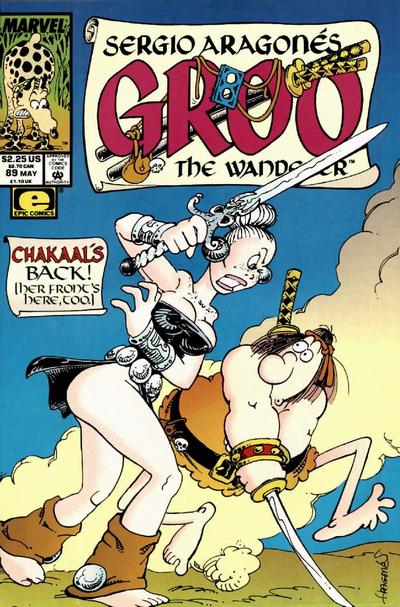
Groo the Wanderer #89
By Sergio Aragones, Mark Evanier, Stan Sakai (lettering), and Tom Luth (coloring)
Published by Epic Comics, 1992


I suspect there's something of a generation gap between myself and the Groo Crew in some of the humor in this issue, with its many jokes about annoying flower-child cultists. I'm vaguely aware of the idea that Hare Krishnas used to hang out in airports handing out flowers to people, but as far as I know, that's never been something that has existed in my lifetime; in fact, most of my knowledge of the idea comes from this scene from the movie Airplane. Interestingly, Sergio and company create an equivalent location for cultists to recruit travelers:


That's an odd bit of detail, with people traveling on carriages like plane passengers (the people inside the carriages must be in First Class), and I'm not sure it really works as a gag, but it's an impressively goofy idea for a joke about cultists. The rest of the story is similarly ineffective for me, since people being recruited and brainwashed by cults hasn't really been a big deal for as long as I can remember, but it works as an amusing situation to place Groo into, since he's so weak-minded that he would be a perfect recruit.

So: some people try to get Groo to rescue their sons and daughters from the cult that has brainwashed them, but he ends up becoming a member, so they send for some others to do the job. First is Arcadio, but he is just as easily swayed as Groo is. Then Chakaal comes to help, and she has no problems resisting their wiles. And after Rufferto figures out a way to break Groo's brainwashing, he joins his beloved warrior woman to take them down. And that's all. It's a decent enough story, with some amusing gags, like a cultist who is constantly pestering people for donations, but it's fairly lightweight as these stories go.

I did find this fight scene between Groo and Chakaal pretty interesting, since it's a rare case of Groo having an extended battle with someone who matches him in skill, rather than just rampaging through a group of goons:


It's put together a bit odd, with a bunch of images jumbled together into one panel, and some of them are oddly awkward and non-kinetic, but I do like to see Sergio try something a little different from usual. Even with all the fighting that occurs, this isn't really an action comic, so it's interesting to see occasional gestures in that direction.

This issue is also notable for its use of the expanded page count; the Groo Crew seems to be trying to make sure readers are getting as much value as possible for the increased price. The main story is the standard, 22-page length this time around, but there are also two backup strips in the back of the issue and a couple of "activity" pages, along with the now-standard inside-front-cover intro strip and back-cover Rufferto comic. It ends up being a pretty full package, with lots of stuff to enjoy besides the regular tale of Groo getting up to his usual antics. These guys know how to keep the reader entertained; I know they've been doing it for me for most of my lifetime.

Next: "The Lawyer"
-----

This issue's stats:
Recurring characters: Chakaal and Arcadio are in the main story, and Pal and Drumm and Minstrel are featured in backup strips. And there's a neat puzzle on the inside back cover that features just about every supporting character: Chakaal, Weaver and Scribe, Arba and Dakarba, Pal and Drumm, Minstrel, Taranto, and Sage:


Also, Usago Yojimbo can be seen on the intro page:


And I like this Groo-Grams header featuring Stan Sakai:


Moral: "The emptier the brain is of facts, the easier it is to fill with nonsense." Also: "The greatest monster of them all is ignorance."
Spanish words: None
Running jokes: Lots of people comment on the size of Arcadio's chin. Groo's brainwashing is defeated through his love of cheese dip, and he keeps asking Chakaal to marry him. He also says "Did I err?"
Intro follies: Now that each issue has an intro page, I think it's worth noting some of the jokes in those strips that star the Groo Crew. This issue, Mark asks Sergio why they haven't had Chakaal appear in the book, and suggests that it's because Rufferto is easier to draw, they might need to think of some new jokes, and that Sergio's wife doesn't like when he hires women to model for the character (which is probably an inside joke, since Chakaal's appearance is based on Sergio's wife). Also, Sergio insists that this is Groo #1 for some reason, which I think becomes something of a running joke.
Mark Evanier's job(s): Spiritual Leader
Letter column jokes: The letter column is expanded to two pages this issue, so there's a lot to cover, although I suspect I'm the only one who cares enough to go into so much detail. Alex S. Proctor asks where Groo's home is, and if Sergio's English is really as bad as his appearances in the intros make it out to be. Mark replies that Groo's home is the entire world that existed in his time period, but when that time period was is unknown, since Rolexes hadn't been invented then. He also reveals that Sergio doesn't really talk that funny, but his dialogue is Mark's way of getting back at him since Sergio draws Mark so unflatteringly. Rol Hirst offers the following suggested cast for a Groo movie:
Groo: Jim Belushi
Grooella: Roseanne Barr
Sage: Sean Connery
Minstrel: Chevy Chase
Arba: Cher
Dakarba: Danny DeVito
Pal: Al Pacino?
Arcadio: Arnold Schwarzenegger or Gerard Depardieu
Director: Francis Ford Coppola
Producer: Joel Silver
Jacob Huebert notes that Groo has been thinking and having ideas and showing common sense in recent issues, which makes him believe that Mark has kidnapped the real Groo and is keeping him in his closet. He says Mark will be hearing from the FBI, most of whom have subscriptions to the comic. Mark replies with surprise that the FBI reads Groo, and says that he can't wait to see the Oliver Stone movie about it. Apparently, the previous issue featured a pointless letter from Adam Hodgin, and Mark features another one this issue (which he had promised to do; he notes that they keep their promises, unless they're related to on-sale dates of graphic novels or the mailing of Grooism certificates), in which Adam says he was offended by Mark's behavior at a party and asks for his lawn mower back. Collin Nordman contributes a Grooism, in which his family was having a turkey dinner and his brother asked what animal turkey meat comes from. He threatens to throw cocktail wieners and tapioca pudding at Mark's house if he doesn't print his letter, but Mark says that he obviously doesn't know how much he likes cocktail wieners and tapioca, especially together. Greg Walpole offers a simple joke letter that replaces all the Rs with Ls because his "typewliter" is broken, but then he notes in a P.S. that the "lettel" is "handwlitten". Frisco Roque writes to offer a Grooism, but after a bunch of hemming and hawing, he can't remember it. Mark replies that it's okay, he forgot to send out any Grooism certificates. Nigel A. Warren sends a letter that just asks if Mark will be his friend, but Mark thinks that it's actually from notorious silly letter writer Kim Yeoman. He suggests Kim team up with Adam Hodgin in order to reduce the volume of silly letters that he's not going to print anymore. He immediately breaks that promise by printing a letter from Michelle Anatone that offers a ridiculous mathematical equation for determining Groo's level of stupidity (it involves the number of times Groo utters a catchphrase, the average amount of cheese dip he eats in a year, and the amount of phrases spelled incorrectly when Sergio is talking). Robert A. Thrash says he doesn't care what the thing on Groo's chest is or what mulch means, he just wants to see his name in a comic book. Mark compliments his honesty, then realizes that he included a P.S. in which he asked what the thing on Groo's belt is. Justin DeMonte submits a Grooism in which his sister's goldfish died and was buried in their yard, and when she later noticed that there were weeds growing on the grave, their dad offered to use some weed killer on them, but she didn't want it to seep down into the ground and kill her dead fish. Mark congratulates him for submitting the first Grooism about mulching. 

Monday, April 1, 2013

Art What I Like: One Piece Is Awesome, Example #19

By the 25th volume of Eiichiro Oda's One Piece, the characters have become strong enough that we don't need to see big proclamations of strength and the will to defeat their enemies. We've seen Luffy and company defeat some pretty major villains already, so they don't need to make a big deal every time they're challenged. In fact, they can demonstrate their strength and resolve by not fighting, as in a scene in this volume when an upstart pirate named Bellamy mocks Luffy and Zolo for having dreams and repeatedly attacks them, but they don't give him the satisfaction of fighting back. But later, after Bellamy steals something from a friend of Luffy's, Luffy goes to confront him and his gang alone and retrieve what was taken. In this scene, Bellamy (who has the power to turn his limbs into springs) continues to mock Luffy, who responds almost casually with a complete and utter beatdown:


There are plenty of high-stakes battles in this series, but I like that Oda includes more minor confrontations of the sort that would naturally occur as the Straw Hat Pirates become more notorious, and while he's sure to continue introducing greater threats and larger-scale conflicts, he's able to demonstrate their awesomeness in less grandiose ways as well. And when he does this while still including moments of action that explode off the page, that's all the better.