Wednesday, November 7, 2012

Many, many, minis: Depression, joy, love, sorrow; these run the whole gamut of emotion

Weather
By Gabby Schulz
Published by Secret Acres


Gabby Schulz (a.k.a. Ken Dahl) is a cartoonist like no other, somehow able to depict the saddest, most cripplingly depressing events and make them not only hilarious, but also lyrically beautiful. This wordless comic depicts a schlubby fellow on a packed airplane in mid-flight as he stumbles to the lavatory in misery, flashing back to a consultation with a doctor in which he was unable to afford medical care, possibly for a life-threatening disease like cancer. His cares are briefly forgotten when he glances out a window and imagines himself flying gracefully through the clouds, naked and alone from all the miseries and humiliations of life. But, this being a Gabby Schulz comic, the horrors of human existence quickly intrude on his reverie in the most disgusting manner possible, bringing him right back down to muck-encrusted earth.

It's a short piece, fully in line with Schulz's style, featuring gorgeous cartooning, images both beautiful and disgusting, and a reminder of the awfulness of life, while still acknowledging the moments of beauty and wonder that make everything else worthwhile. There's nothing else like Schulz's comics, and that's probably a good thing; I don't know if I could take more than one of him.
-----

Deathzone
By Michel Fiffe
Self-published


I know next to nothing about DC's Suicide Squad comics from the 80s, aside from the basic concept of villains pressed into government service and forced to undertake dangerous missions, but it seems to be pretty well-regarded among those who enjoy capes-and-tights stories, and this tribute by Michel Fiffe makes a good case for it. But it also provides Fiffe with a chance to riff on the visual styles of artists like Steve Ditko and just have fun with characters and concepts that he enjoys. He ostensibly retells a certain storyline in which the team fights a squad of terrorist supervillains, but it seems that at least the ending must have been changed from the original story. Whatever the case, it's obvious that Fiffe is having fun coming up with crazy depictions of superpowers, interesting confrontations between characters, occasionally shocking bits of violence, and neat visuals, especially once everyone gets sucked into another dimension and attacked by weird monsters. It's all pretty awesome, and probably more so if you're invested in the characters and their histories both together and apart, but just experiencing the palpable enjoyment that is radiating from the page makes the read worthwhile. Fans of Fiffe, Suicide Squad, and any overlap between the two shouldn't miss out on something this fun.
-----

So...Buttons #5
Written by Jonathan Baylis
Art by Paul Westover, Thomas Boatwright, Noah Van Sciver, and Lisa Rosalie Eisenberg
Self-published


This issue of Jonathan Baylis' autobiographical series is a bit shorter (and cheaper) than usual, containing only four stories, but it's still a satisfying bite of decent little tales from Baylis' life, illustrated by a cadre of talented artists and embellished with an eye-catching cover by Tom Scioli. The stories include an amusing look at Baylis' fear of taking his dog to the vet, a depiction of his determination to recreate the coffee blend that his deli stopped selling, a sort of gag about the pressure-valve release of a shared joke following the emotional trauma of watching Schindler's List, and a cute story about trying to find the secret behind cooking the perfect brisket (a story which was also included in the Digestate anthology). As always, Baylis works with excellent artists who are perfectly suited for the mood of each individual tale, with highlights including Paul Westover's over-the-top exaggeration of Baylis' tears, Thomas Boatwright giving him cartoonish displays of anguish and stiff-jawed resolve, Noah Van Sciver's sort of thousand-yard-stare and the relief that humor can bring to it, and a perfect plop take by Lisa Rosalie Eisenberg. It's all as good one would expect from previous issues of the series, another chance to have a visit with a pal and hear some of his stories.
-----

Losers Weepers #1-3
By J.T. Yost
Published by Birdcage Bottom Books


There's something fascinating about found notes, photos, and other such objects, as any reader of Found magazine knows, a glimpse into complete strangers' lives that offers tantalizing hints about the complexities of their personalities and situations, and a reminder that there are countless others surrounding us, each person as rich and deep as the rest of us. J.t. Yost apparently shares this fascination, crafting the stories in this series of minicomics into stories that could fit around various notes or letters that he had chanced upon.

Of the three extant issues (there is apparently one more to come at some point), the first is the most effective, taking a heartbreaking journal entry by a young woman who is contemplating breaking up with her unstable (due to a life of abuse and drugs and a traumatic brain injury) boyfriend, but worries what will happen to him if she does; and also incorporating some filthy rap lyrics scrawled on an envelope and a note from a junkie about borrowing some cocaine. Around these artifacts, Yost comes up with a sad tale in which the girl from the journal runs into her ex-boyfriend years later, her current happy relationship sending him into a spiral of drug use and despair. The other issues stretch a bit to incorporate humorous notes from schoolkids, poorly-worded bulletin board ads, and letters from prison into interrelated tales of woe, to the point that they seem unnecessarily miserablist, trying to wring pathos out of some basic building blocks that don't fully support it. But Yost is really just doing what most do when they encounter these bits of human ephemera, trying to imagine the stories behind them and see the humanity from this tiny glimpse into their lives. His approach, while fairly dark, is as valid as any, and it's neat to watch him spin characters and dramatic situations from these basic threads. Would that we all could be so eloquent when contemplating the drama unfolding around us.
-----

Thinger Dingers
It's Dream Time, Snoop Doggy Dogg
By J.T. Yost
Published by Birdcage Bottom Books


These two minis are more of a catch-all for J.T. Yost, with Thinger Dingers collecting various short comics that have appeared in anthologies or magazines, and It's Dream Time, Snoop Doggy Dogg featuring several dream comics similar to some Yost had done previously. One's mileage on the latter may vary, depending on tolerance for this sort of "Dude, I had the craziest dream last night!" narrative. Me, I like the surreal weirdness of Yost being at a party crashed by Snoop Dogg wearing a Richard Pryor mustache, carpooling with Dick Cheney and avoiding being poisoned by the former VP, Roseanne Barr being his mother for some reason, having his wife be stolen by Arnold Schwarzenneger, or running into Henry Rollins as a hot dog salesman. One could probably attempt to psychoanalyze these dreams, especially if they know Yost outside of the comics he makes (which I don't), but even outside of any consideration of their "meaning", they do a nice job of capturing of some of the bizarre stuff that our brains can get up to when we're sleeping. Yost's cartoony characters and celebrity caricatures work really well for the types of strangeness they're telling, somehow managing to make the emotions and interactions seem just on the far side of "normal". If you're open to this sort of thing, the comic is definitely worth a look.

As for Thinger Dingers, it's more of a "miscellaneous" collection, featuring stories both fictional and not, with the longest being "Ruemates", in which Yost relates tales of several bad roommates he's had to suffer over the years (and he doesn't let himself off the hook, noting that his weird taste in music and propensity for adopting stray cats doesn't make him the ideal living companion), including a drug-abusing porn star and a pretentious asshole who wouldn't let anyone else use his furniture for fear of "body oil contamination". There's also a funny two-page story about a friend's crazy hillbilly "alter-ego" that he would freak people with at parties, especially when drunk; a cute story about the lullabies Yost sings to his baby daughter; and a couple fictional stories about pigeon relationships and a badly-managed old-timey funeral parlor. It's a nice collection of Yost's work, the perfect use of the format to compile work that wouldn't really fit anywhere else. I really enjoy Yost's cute style and sense of humor, and the way he grounds his cartoony characters in realistic settings, making for down-to-earth looks at relatable human behavior. I'll be sure to keep my eye out for any future minis he releases into the wild.
-----

The Mire
By Becky Cloonan
Self-published


Becky Cloonan's minicomics are always a great chance to see her talent unleashed on something original. Not that there's anything wrong with her work on properties like Batman or Conan the Barbarian, but when she gets to devote her imagination to depicting beautiful, fantastical, mournful works like this, the results are so much more satisfying. This particular mini sees a medieval knight send his squire to deliver a message to a castle in the middle of a swamp that seems to be haunted. After some supernatural scares, the boy, who was lamenting the missed opportunity to join an impending battle, learns that his relationship with his master was much more complicated and, as a closing montage reveals, tragic, than he had ever realized. It's a sad tale that's visually arresting, featuring a distinctive silkscreened cover colored with an eerie green tint that enhances the creepy, moody art of the interior in the imagination; distinctively gruesome ghosts, and a beautifully sad ending. I wish Cloonan had the opportunity to create comics this this on a larger scale and more regular basis; as it is, I think these minicomics are an annual labor of love for her, and I'll be sure to go to whatever lengths necessary to read them as long as she keeps putting them out.
-----

The Stolen Lovelight
By Paul and Tara Abbamondi
Self-published


This minicomic by the husband-and-wife team Paul and Tara Abbamondi is a sort of sci-fi romance, and it's a bit slight, but the art is a nice example of a cartoony style reminiscent of someone like Faith Erin Hicks or Hope Larson, and there are some nicely creepy moments within. The story involves a woman who arranges her own kidnapping in order to escape the possessive jerk she was being forced to marry. But when she wakes up on the kidnappers' spaceship, she is all alone, aside from Doc, the robot left controlling the ship, an oddly attentive artificial intelligence that starts getting kind of creepy and calling her "lovelight" all the time. When M, the man she was trying to escape, shows up to "rescue" her, she learns Doc's disturbing secret and tries to escape. The ending is slightly unsatisfying, although it does attempt to demonstrate that love conquers all, which is a nice thought. As a whole, the story is a bit rushed, and I don't know if I fully understand what happened in the finale, but there are some really nice moments, like the initial kidnapping, the eerily empty ship, and the increasingly unsettling attitude Doc starts exhibiting. I do like Tara Abbamondi's art a lot, so she's a talent I'll be sure to keep an eye on. That's one of the great things about minicomics: discovering a new artist that you want to see more of.

Tuesday, November 6, 2012

The Neverending Fray: Clothes make the man

Groo the Wanderer #46
By Sergio Aragones, Mark Evanier, Stan Sakai (lettering), and Tom Luth (coloring)
Published by Epic Comics, 1988


Having already detailed the origin of Groo's swords and Groo's dog, it was inevitable that some of his other personal effects would be highlighted. This issue doesn't reveal the background of Groo's distinctive orange tunic, but it at least addresses it, mostly through people pointing out how awful he smells. He certainly doesn't help the issue by carrying fish around under his shirt, sleeping in a pigpen, and only bathing every few weeks. Having learned of his garments' odor as a source of people's distaste for him, Groo spends the issue trying to acquire a new wardrobe, leading to all sorts of mistaken identity shenanigans after he steals the garb of different passers-by, then being gifted with the fancy new clothes seen on the issue's cover seemingly at random. But he ends up much where he started (minus at least some of the stench) after a slapstick encounter with some jerks leads to a fight in a fabric-dyeing shop that results in his new clothes looking exactly like his old ones.

It's a pretty good way to restore the status quo, but while it's somewhat expected, the journey there is pretty hilarious, giving Groo a chance to have funny encounters with a bunch of people and cause all manner of mayhem and destruction. I especially like when he is mistaken for a master builder and orders the workers constructing an arch to remove the supports:


The way the guy so confidently follows instructions cracks me up, especially when juxtaposed with the massive chaos that is the immediate result. I also like the physicality of this gag:


Yep, it's another pretty good issue, full of the usual violence, stupidity, and silliness. This could go on for quite some time without me ever growing tired of it. And it will.

Next: "The 300% Solution"
-----

This issue's stats:
Recurring characters: None.
Hidden message(s): It's written on the side of the burdens a couple of guys are loading onto a ship:


And, in what I suspect is a case of the creative team forgetting whether they put a hidden message in the issue and rushing to fit one in at the last moment, there's another one tucked in the corner of the final page:


Moral: "No matter how you dress a cow, it still gives milk."
Spanish words: None.
Running jokes: Groo directly confronts his tendency to sink ships, with the expected results:


Mark Evanier's job(s): Haberdasher
Letter column jokes: Reader David Rickert begs Mark to reprint the pre-Marvel issues of Groo, so Mark pretends to be convinced, deciding to make the sacrifice of getting some extra money from forcing people to buy the issues again, on better paper and at a higher price, in the form of The Groo Chronicles. And in response to a straightforward, coherent letter from Jim Davie (which was really just somebody begging to have their letter printed), Mark prints one from Dan Wheeler that nonsensically accuses Mark of forgetting to call his own niece on his father's birthday, showing his face in Poughkeepsie, and going out with Juliet; then one from Tait Bergstrom which refuses to ask for free art, why Groo likes cheese dip, what Mark does, or the definition of mulch, and even to say anything about the comic at all, along with a maniacal laugh; then one from Jeff "LW" Lacasse that suggests replacing the mulch joke with one in which Mark repeatedly defines the word "carafe".

Thursday, November 1, 2012

The Neverending Fray: Don't worry, he's not really dead

The Death of Groo 
By Sergio Aragones, Mark Evanier, Stan Sakai (lettering), and Tom Luth (coloring)
Published by Epic Comics, 1987


This was the first Groo graphic novel, taking a larger, thicker format than the regular issues, and being something of a "prestige" event, prefiguring the trend of comic book characters being killed off a few years later. Of course, Groo doesn't actually die here, but he is presumed dead, allowing for a funeral scene featuring all the regular guest stars. That always seemed to be as much the point of killing off Superman or some similar character: seeing how the supporting characters and the rest of the world around them reacts to such a loss. However, this being Groo, the event is a bit different, more celebratory than mournful. Luckily, he doesn't stay dead long enough to let anybody get comfortable in their relieved happiness.

But we're getting ahead of ourselves. The story itself (which was apparently written before Rufferto had been introduced, even though it came out in late 1987, after the dog had already joined the cast) sees Groo wandering into the kingdom of a man who hates him with a passion far beyond that of any previous character, to the point that he has servants whose sole task is to hate Groo, a job which often isn't performed as well as expected:


The revelation of the reason for the king's distaste of our favorite mendicant is amusing, since it was due to a fairly standard military screw-up, of the type that Groo has committed countless times, which makes for a nice acknowledgement of the irrationality of hate, as well as the belief of those in power that they are somehow more entitled than others, with a single lost battle being a grievous insult that the king bases his life around from that point forward.

So, when Groo stumbles obliviously into this land of ubiquitous wanted posters featuring his face, he is almost immediately attacked by reward-seekers, and when he runs away and right into the lair of a dragon called the Floom-Floom, he is quickly presumed dead. Anyone who knows anything about Groo should realize that he has survived countless such encounters, and his actual death would be much stupider and more outrageous and catastrophic, but being eager to please their king, the people report to him the death of his mortal enemy, which sparks off a wave of celebration across the land.

The ensuing funeral scene ends up being kind of hard to endure, as the only person who is actually sad is a barmaid who Groo defended from sexist patrons earlier in the story. Everyone else treats it as an event to mock the deceased, turning the eulogies into something more akin to a celebrity roast:


As one would expect, Groo gets the chance to attend his own funeral, and he is rather disheartened to see how much everyone hated him. This gives us one of the sadder panels in the series' history:


But it's not long before he gets back to his regular Groo-ish activities, deciding to make people miss him by donning a disguise (consisting of a poncho for a costume and some pig intestines as a mask) and acting as a villain in order to make the people realize they need a hero. He screws it up, of course, accidentally foiling crimes and rescuing people, and he quickly becomes the hero in death that he never was in life. Soon enough, the celebration of Groo's heroism leads to him being feted in the king's castle, and various silly circumstances (Groo gets mistaken for the king's barber, and he misplaces his clothes when taking a bath), along with the quickly-spreading rumors that Groo is still alive, lead to a rather satisfying comeuppance for the spiteful king:


In the end, Groo gets to go on his way, secure in the knowledge that at least one person (the barmaid) appreciates him. Once Rufferto comes along, he'll have another, and that will be enough to keep him going even when many, many people want to kill him. That's all we need to get by, right? The Beatles said it best: "All you need is love."

As a Groo story, this is pretty enjoyable, and the fancy presentation makes for a nice chance to see Sergio's artwork in larger-than-normal size and on shiny paper that allows for bright, clear colors. Sergio also uses the increased page count as a chance to include more splash pages, so we get several images of battle scenes, giant dragons, and crowded celebrations; the detail-packed artwork really shines here. It's a lovely book, a good use of the format to tell a story in a way that couldn't necessarily be done in the regular monthly issues. That Groo Crew definitely knew what they were doing.

Next: "Groo's Clothes"
-----

This issue's stats:
Recurring characters: The gang's all here: Sage, Minstrel, Taranto, Grooella, Pal and Drumm, Arba and Dakarba, Grativo, and Arcadio, and even the Witch of Kaan and King Kassabist. And the Groo Crew appears in the illuminated border of the title page:


And also as one of the ever-transforming decorations on the Minstrel's lute:


Hidden message(s): It's written upside down on the invites some of the characters receive to Groo's funeral:


Moral: There's no "official" moral, but the Minstrel's final poem works in the same fashion:
"Where'er you go, you never know--
The reason someone hates you--
But folks as such--don't mean as much--
As who appreciates you!"
Spanish words: None.
Running jokes: The usual gags show up, like cheese dip, "Did I err?" and gross table manners, but the best variation on the regular jokes is when the ship supposedly bearing Groo's ashes (and, in secret, the actual Groo) seemingly demonstrates his ability to sink any ship, even from beyond the grave.
Mark Evanier's job(s): He actually gets a "written by" credit this time.
Letter column jokes: No letter column in this bad boy.

Tuesday, October 30, 2012

The Neverending Fray: Dogs can have adventures too

Groo the Wanderer #45

By Sergio Aragones, Mark Evanier, Stan Sakai (lettering), and Tom Luth (coloring)
Published by Epic Comics, 1988


Last issue's fantasy about Rufferto must have bothered the creative team too, because this issue almost seems like a corrective to that, sending our doggie pal off on his own adventure without Groo and having him menaced at every turn, only to run away unheroically. It's kind of a funny idea, that without Groo around, Rufferto will just be constantly running for his life from dognappers, pirates, predators, and monsters. There are a few gags mixed into his constant fleeing, such as this lady who seems to have an interesting story:


But it's mostly a bunch of well-drawn action/escape scenes, all leading to a nice variation on the usual "somebody chases Groo" ending. Meanwhile, Groo is stuck working at a mill that is operated by slaves (he signed up because he misunderstood what somebody meant when they said "the pay is nil"), having left his swords to be guarded by Rufferto. This leads to several funny bits, including a hilarious moment in which he tries to get fed:


But once he gets his swords back, he gets a nice fight scene that's like a samurai duel:


I also like the design of the mill, which appears to grind grain like a windmill, but instead of using wind to turn a wheel, it uses what looks like a big Ferris wheel that the workers turn by climbing like a ladder:


I don't know how effective that would be in real life, but it certainly looks cool.

Yep, this is another pretty good issue of the series, if a bit light on gags about frays, cheese dip, and mendicants. But there's always next issue for those.

Next: "The Death of Groo"
-----

This issue's stats:
Recurring characters: None.
Hidden message(s): It's barely visible in the thatching on this building's roof:


Moral: "Everyone's life seems easier from the outside."
Spanish words: None.
Running jokes: There's an occasional joke in which somebody calls Groo's name, and he responds "Who Grooed?" Well, this issue has a Rufferto variant:


Groo also remembers that he is the Prince of Chichester.
Mark Evanier's job(s): Sgraffitist (a maker of sgraffito, presumably)
Letter column jokes: When reader Lon Wolf confesses that Groo's reunion with Rufferto in issue #39 made him cry, Mark responds by listing things that make the Groo Crew do the same: Stan Sakai's paycheck, Tom Luth's coloring duties, and long specials in which the Minstrel rhymes in every panel for Mark. Mark says there are 81 separate things that make the Groo Crew cry, then when another reader asks for the definition of mulch, he updates the number to 82. When reader Doug Green asks why Groo's nose looks like a jelly bean and Arcadio's chin looks like a cucumber, Mark responds that it's due to "the strange Jelly-Bean-and-Cucumber Diet that Sergio has been on for the last seven years." He's also allowed to eat black-eyed peas once a year, which explains the existence of Rufferto. Finally, when Benny Boucher sends a letter simply asking "Why?", Mark answers with a long, jargon-filled paragraph about how that question has plagued philosophers for years, before concluding "Because."

Thursday, October 25, 2012

The Neverending Fray: Dogs are not good with swords

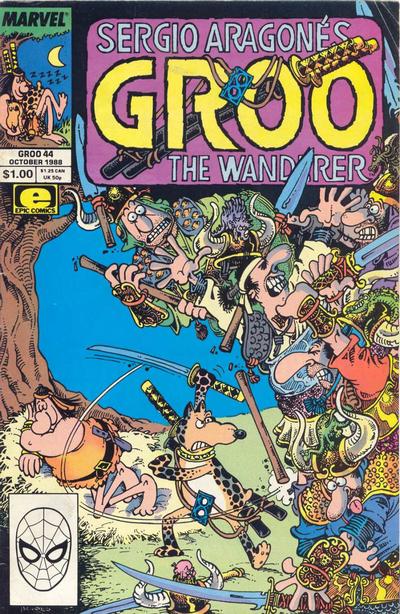
Groo the Wanderer #44
By Sergio Aragones, Mark Evanier, Stan Sakai (lettering), and Tom Luth (coloring)
Published by Epic Comics, 1988


The creative team apparently liked the fantasy sequence last issue in which Rufferto dreamed of wielding Groo's swords and being a hero, because they pretty much built this whole issue around it. There's a pretty standard scene in which Groo charges into a battle to stop some bandits, but accidentally kills all the guards and lets the bandits get away, but then almost the entire rest of the issue is given over to a long daydream of Rufferto's, where he imagines taking over for Groo in a rescue of a kidnapped dog. He fights his way through several bad guys and ends up fighting in a gladiatorial arena, carving up all the evil thieves and soldiers he meets with Groo's swords. But while it's a cute idea, it goes on for way too long, to the point that Rufferto himself seems to acknowledge its tiresomeness:


The problem is, it's just not funny, outside of the semi-humorous visual of a bipedal dog getting in swordfights. Rufferto's idea of himself as a hero is ultra-competent, which stands in pretty stark contrast to the bumbling Groo, and while that's not surprising, considering his idolization of his master, it's just one scene after another of him killing everyone who gets in his way (often after they've surrendered, to add a disturbing note to the proceedings). The funniest moment is at the very end, when he has a romantic kiss with the rescued dog:


A following scene of Rufferto trying to wield Groo's swords in real life is pretty funny too, managing some pretty great physical comedy even from a dog:


It's a nice contrast to the lengthy fantasy, but it's much too little to save the issue, which ends up being a tiresome exercise rather than a fun flight of fancy. That's probably to be expected here and there throughout the series, as the creative team would kind of go wherever their imaginations led them, and more often than not, they would wring great jokes out of it. Unfortunately, this is one of the times they didn't really do so, but luckily, it's definitely the exception rather than the rule.

Next: "Rufferto Reality!"
-----

This issue's stats:
Recurring characters: None, although the Groo Crew (Sergio, Mark, Stan, and Tom) appear in this crowd scene, along with some cameos from people like William B. Gaines and Al Jaffee:


Hidden message(s): Didn't find it. UPDATE: As revealed in issue #58, it's written upside down across the banners on these guys' trumpets:


Moral: "Fantasy is a nice vacation, but reality is where you spend your life."
Spanish words: The Sultans of Galleta and Canino are named after the words for "cookie" and "canine".
Running jokes: There's a "Did I err?", and I don't think I've mentioned this one before, but there's an example of the joke where somebody calls Groo a series of insulting names, and he responds, "Just what are you getting at?"
Mark Evanier's job(s): Musard ("dreamer; absent-minded person")
Letter column jokes: When reader Patrick Hayes comments that he's glad Groo confessed to liking Rufferto rather than running the idea of his dislike for the dog into the ground, Mark takes mock offense, saying that they have so few jokes, they have to milk them for every drop of humor. Well-known Groo fanatic Gary Grossman writes a letter composed almost entirely of words beginning with the letter G, and reader James Calloway finds a way around Mark's restriction against defining mulch by doing it in a letter.

Tuesday, October 23, 2012

The Neverending Fray: Granny Groo is a terrible, terrible person

Groo the Wanderer #43
By Sergio Aragones, Mark Evanier, Stan Sakai (lettering), and Tom Luth (coloring)
Published by Epic Comics, 1988


This issue cements my hate for Granny Groo when she, having decided she is unable to exploit her grandson, gets rid of him by selling him into slavery. What a swell lady. We learn in a flashback that this is a scheme she used to run when Groo was a kid, selling him to some family, then later sneaking him a potion that makes him sick so they will give him back. But this time, she has no intention of rescuing him; after receiving her payment, she waltzes off out of the book, hopefully to plague her kin no more (she does show up again in flashbacks, but I don't remember if she comes back in the "present").


Being a slave does allow Groo to do some funny stuff though, as he insists on staying in shackles and waiting for Granny to rescue him, even after he repeatedly breaks out or is set free:


There's also an odd interlude in which Rufferto, having been left in charge of Groo's swords while he is in the slavers' custody, makes up a story to impress some other dogs, coming up with a silly scene in which he runs around on two legs, fighting off bad guys with the swords:


It's a weird little sequence, seemingly included to pad out the page count while the creative team was figuring out how to get rid of the monstrous Granny Groo. These multi-issue arcs in which characters get introduced or "major" events happen seem to have settled into a standard length of three issues, so this one is the finale, making for something of an awkward transition back to the status quo. Good jokes still make their way into the story, and Sergio's art is as wonderful as ever, but it's becoming clear that at this point in the series' evolution, continuity is more of a hindrance than a boon. Hopefully the single-issue stories will continue to be the prevalent method of storytelling for a while yet.

Next: "Rufferto Reverie"
-----

This issue's stats:
Recurring characters: Granny Groo, and Lil' Grooella gets another flashback appearance.
Hidden message(s): I didn't find any, although there's an in-joke in which a monkey thinks "Vootie.", which is a reference to the famous monkey J. Fred Muggs:


UPDATE: As revealed in issue #58, it's written in the leaves of this tree:


Moral: "Friends are people who are there when you need them. (Also applies to dogs)"
Spanish words: None.
Running jokes: Groo sets a record for the longest gap (at least chronologically) between the initial statement and the "Say, what did she mean 'slow of mind'?" callback, with Granny Groo insulting him in a flashback, and Groo remembering it years later. Lil' Groo does some mulching. Groo gets called a mendicant.
Mark Evanier's job(s): Ripieno
Letter column jokes: Reader Blake Vojta asks how many copies of Groo Sergio has signed, and Mark replies that unsigned copies are rarer than signed ones, and Sergio should save time and go to Sparta, Illinois, where the comics are printed, and sign each copies as it comes off the press. Reader J.A. Todd rules out "video cassette" and "pop tart" as answers for the blue thing on Groo's chest, and decides it must be a carburetor gasket. He also asks what the stuff is in Sage's flask, which Mark declares is water, in hopes that it won't start another running joke (don't worry, it does anyway).

Monday, October 22, 2012

Digestate: Yep, that sounds gross

Digestate: A Food & Eating Themed Anthology
Edited by J.T. Yost
Published by Birdcage Bottom Books


Judging by the title of this anthology, it's not only meant to be about food, but should hopefully give readers some ideas to consider, perhaps implanting them with, if not full-on change in the way they eat, at least a consideration of what they put into their body. That seems to be editor J.T. Yost's intent, at least, judging by the semi-confrontational nature of his piece. Of course, not all the contributors followed this direction. Actually, stories fall into one of three categories: autobiographical tales involving the cartoonist's relationship to food, issue-based looks at where food comes from and the morality of eating it, and other stories that happen to feature food in some respect. There are also a few illustrative pieces from the likes of Kevin Cannon, Danny Hellman, and John Kerschbaum, with the latter contributing pieces which open and close the book with a perfect evocation of the title, the inside front cover depicting a multitude of anthropomorphic foodstuffs marching into a gaping mouth, as if the book itself is chowing down on a huge meal, and the inside back cover matching it with a hilariously disgusting end result, an image that won't soon leave the mind of anyone who sees it.


When it comes to the comics themselves, the autobiographical stories vary from standard descriptions of the kind of food the cartoonist ate as a child (Liz Prince, Jeremy Tinder, Ayun Halliday, Tod C. Parkhill, Alex Robinson), to relating food-related incidents (Noah Van Sciver, Pranas T. Naujokaitis, Nicole J. Georges, Jonathan Baylis and Lisa Rosalie Eisenberg, K. Thor Jensen, Ben Snakepit), to discussions of personal eating philosophies (Sam Henderson, James Kochalka, Al Ortiz, K. Thor Jensen, Hazel Newlevant, L. Nichols, Kieth Knight). By the end of the book, a lot of them seem to blend together, but some of them stand out, like Alex Robinson's discussion of his phobia about eating unfamiliar foods, Noah Van Sciver's funny story about the consequences of eating too much Raisin Bran, and Jeremy Tinder's story about getting in trouble as a kid for accidentally letting an entire freezer full of meat thaw out and leak blood everywhere. Marek Bennett's "Successful Slaughter!" is also quite good; an excerpt from his Coffee+Dumplings+Komiks book-in-progress about living in Slovakia, it relates an incident in which he went to a neighbor's house for a "slaughter", in which the family cut up and wrapped half of a bull, then cracked the bones open in order to use the marrow for soup, all while drinking vodka and chatting about subjects like the uselessness of the Hungarian language. Bennett depicts everyone as animals like rabbits or bears, but he gives the characters a nice expressiveness, and really communicates a lovely inter-personal atmosphere.


The third category, that of stories that contain food in some aspect, is kind of hit or miss, ranging from the weird, somewhat impenetrable stories of Josh Bayer, J.T. Dockery, Aron Nels Steinke, Renee French, Sophia Wiedeman, and William Cardini, to the goofy gag comics of Sam Henderson and Dan Piraro, stories featuring anthropomorphic foods by Josh Burggraf and Minty Lewis, and fairly entertaining tales of slacker superheroes by Darryl Ayo and a doggy with a gross diet by Gary Fields. Adam Hines, creator of Duncan the Wonder Dog, has an ambitious story called "Last Thoughts From the Watchtower" that layers time-jumping imagery, narration taken from a Looney Tunes cartoon, and sidebar text involving a message from an immortal speck of a star, all adding up to a confusing whole that I kind of admired, even if I didn't really understand it. Victor Kerlow's story about a guy with a taco for a head encountering resistance when he tries to buy food from Taco Bell is amusing, and it fits the impetus of the title by making one consider some of the oddness of what we eat. Anuj Shrestha's "Foodies" is a creepy little tale of what people might actually be getting from the closed-off kitchens of gourmet restaurants, featuring nicely-realistic art that makes the twist that much more disturbing. Sungyoon Choi's "Piggy Piggy" is a short series of dreamlike images involving the eating of pigs. Neil Brideau's "Tell Now, the Tale of the Argus Mushroom!" is a neat sci-fi story in which some alien(?) kids learn about how a scientist ancestor of their tribe used a certain mushroom to genetically engineer them into dominance, with a funny punchline that once again ties into the theme of the inherent weirdness of eating. Jonas Madden-Connor has a quirky story about a resident of the future imagining himself as a 21st century woman (or is it vice-versa?) who doesn't have to eat through a tube. Jeff Zwirek contributes a short gag strip about a caveman and his mate that features some nice, thick linework. And Box Brown's "When Cows Ran Free: 1000 Years After Meat" is a quick glimpse of society in a meatless future, which is only slightly different from our present aside from the games kids play with each other.

As entertaining as all of those stories can be, the last category, featuring journalistic stories and pieces in which the creators confront themselves or the reader about the morality of what they eat, is the real highlight of the anthology. French cartoonist Cha (who also drew the cover) contributes two stories featuring a character called Gwenaelle the Baby Sitter, who torments her charges with the hard truth about the suffering of animals on farms. She kicks off the book with a recasting of "The Three Little Pigs" as piglets who are born on a cold factory-farm floor before running off to escape the "Big Bad Farmer", who eventually captures them and has them mercilessly butchered; she ends the book with another tale of the horrible lives of dairy cows. It's incredibly expressive, cartoony work, creating cute, lovable animals whose deaths are especially disturbing.


Other "advocacy" or journalistic stories include C.M. Butzer's "20 Billion Chickens", which looks at the huge number of chickens on the planet, the vast majority of which are raised in inhumane factory farms; and Jess Ruliffson's "City Chickens", a nice, naturalisically-illustrated piece about a community garden in New York City that raises chickens. A couple of the autobiographical stories overlap with this category as well, such as K. Thor Jensen's story about how accidentally severing two of his young daughter's toes opened his eyes about the reality of meat, or James Kochalka's spiritual attempt to justify the morality of eating meat in his inimitably open-hearted fashion.

But the best piece by a long shot is J.T. Yost's "Slaughterhouse Stories", a testimony from a long-time employee of the John Morrell company who details, in excruciating fashion, the awful things that go on inside a slaughterhouse. Interestingly, Yost holds off on levying vegetarian outrage at the barbaric nature of the proceedings, letting "Craig's" words tell the tale of how corporate greed not only encourages animal suffering, but also endangers human life by insisting on keeping up a pace that all but ensures that hogs are brutally beaten, improperly stunned, bled out while alive, and eventually drowned in boiling water. The cost-saving measures that the higher-ups in the company took to increase production are horrifying in their callousness, making the employees struggle to do an already-dangerous job while keeping constantly on edge in case live animals get loose and cause injuries. Yost stretches the story out to an exhausting length, filling the pages with large images and stark text, but not sensationalizing the subject as much as he could have with blood and gore; instead, he mostly limits the ever-present blood to dark splotches of ink that suggest the horror rather than shove it in the readers face, and focusing as much on the workers' exhausted faces and some of the darker implications like the alcoholism and abusive relationships that many men fell into after killing thousands of beings each day. It's a hard-to-read story, but it's not a preachy one, leading readers to the conclusion that while eating meat might not be morally wrong, holding life both human and animal at such a low value certainly is.

Yost's story alone is worth reading this book for, but all in all, it's an impressively rich collection of comics that covers a wide variety of well-known and under-the-radar creators, with material that is funny, thought-provoking, beautifully drawn, and well-written. As a successful project that resulted from the ever-growing method of crowdfunding (via Kickstarter), it's a sign that the vast pool of comics-making talent is deep and wide, and given the chance to collaborate toward a theme, can deliver quality comics in spades. If this is the kind of book that results when such creators work together, the future is bright indeed.

Thursday, October 18, 2012

The Neverending Fray: Family is bad for you, Groo, don't try to start a new one

Groo the Wanderer #42
By Sergio Aragones, Mark Evanier, Stan Sakai (lettering), and Tom Luth (coloring)
Published by Epic Comics, 1988


This issue continues with the gypsy stereotypes, but luckily it downplays this aspect, mostly turning Granny Groo and her minions into a band of schemers who are constantly trying to come up with ways to cheat themselves into money. The story revolves around one of their plots, a complicated affair in which they hope to marry Groo off to a princess, but first have to marry him to an ugly farmer's daughter in order to gain the funds to transform themselves into a royal entourage. This all provides the chance for plenty of good jokes, including Groo and his would-be bride's mutual revulsion:


After the ceremony, the gypsies spirit Groo off to attempt to transform him into a prince, which makes for some excellent comedy as he struggles to understand the role he is supposed to play:


They eventually determine that the reason the princess has trouble finding a husband is that she insists on marrying for love, but once she realizes the true identity of her suitor, she decides to marry him after all in order to teach her father a lesson. Unfortunately, none of the various parties have learned how fruitless it is to base any plans around Groo, and he manages to ruin everyone's schemes all at once in a moment that the episode builds to perfectly, allowing for a great example of the "everyone angrily chases Groo" ending. It's a pretty great example of the mastery of structure that the creative team has acquired, and a good sign for the series' future, as it settles into a groove of excellence. More, please.

Next: "Slave!"
-----

This issue's stats:
Recurring characters: Granny Groo again, and Lil' Grooella appears in a flashback. The Groo Crew (Sergio, Mark, Stan, and Tom) show up on the title page, horrified at the destruction Groo was capable of even as a child:


Hidden message(s): Its letters are secreted upside down among the flowery decorations surrounding the issue's title:


And there's another one written in the priest's Bible during Groo's second wedding:


In fact, in another panel on that page, the text in the Bible says "How many hidden messages did you find in this comic? Ha ha ha," so maybe there are more I missed.
Moral: "He who marries for money never marries for real."
Spanish words: None.
Running jokes: At least one running joke begins here, with the phrase Groo is drilled to remember ("I am the Prince of Chichester!") popping up in future issues. There's also a gag in which Groo keeps wondering "Start what?" after the following exchange:


I don't remember if that one continues beyond this issue, but it might. There's also a mulch reference.
Mark Evanier's job(s): Nomancer
Letter column jokes: In response to a request for a second Groo title, Mark announces The Groo Chronicles, which repackaged the pre-Marvel Groo stories. He says there will also be "some new stuff," but I never bought any of those issues, so I don't know if that's true. A list of numbered questions from reader Tracy Abbott includes one asking why people say they have a complete collection except for a certain issue, which prompt Mark to joke that Groo is unique in that collections of the series go up in value according to how many issues are missing (he also claims this is a "cheap switch on an old joke about winning a week's vacation in Philadelphia). Tracy also asks why people write and why they think their letter will be printed, so Mark talks about the huge amount of mail they receive, "some of it even not from Steven W. Ebner." He describes how the letters are received, read by Mark and Sergio, and then retyped for publication by Mark's associate Tracy Abbott, realizing in the middle of a sentence who the writer of that particular letter is. Finally, in response to a reader named James Troesch who says he wants to be just like Sergio, Mark claims that he and Sergio bring great shame to their families by creating Groo, and James should learn from their mistakes, maybe even being lucky enough to someday be someone who doesn't read Groo.